
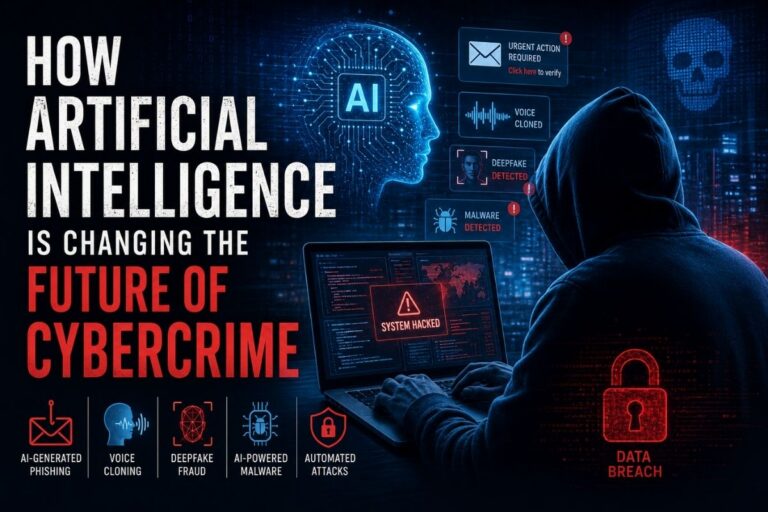
Artificial intelligence has become one of the most influential technologies of the modern era. It is helping businesses automate tasks, improving healthcare, making transportation smarter, and transforming the way people work. At the same time, the same technology is giving cybercriminals powerful new tools that make cyber attacks faster, cheaper, and more convincing than ever before.
Cybercrime has always evolved alongside technology. Years ago, attackers needed advanced programming knowledge to create malware or launch phishing campaigns. Today, many of those barriers have disappeared. AI-powered tools can generate malicious code, write realistic phishing emails, clone voices, create deepfake videos, and automate attacks within minutes. As a result, criminals are scaling their operations at a speed that traditional security systems struggle to match.
The future of cybercrime is no longer about individual hackers working alone. It is becoming an ecosystem where artificial intelligence helps attackers identify victims, exploit weaknesses, and adapt to security measures in real time. Understanding how this shift is happening is essential for businesses, governments, and individuals who want to stay protected in an increasingly connected world.
What Is Artificial Intelligence in Cybersecurity?
Artificial intelligence refers to computer systems that can perform tasks normally requiring human intelligence. These tasks include learning from data, recognizing patterns, making decisions, and improving performance over time.
In cybersecurity, AI is used for both defense and offense. Security companies rely on AI to detect threats, analyze unusual behavior, and respond to attacks more quickly. Unfortunately, cybercriminals have also embraced the same technology to make their attacks more efficient and difficult to detect.
Unlike traditional hacking methods that often require manual effort, AI allows attackers to automate large parts of their operations. Instead of targeting a handful of victims, criminals can now launch thousands of personalized attacks simultaneously with very little additional effort.
This growing use of artificial intelligence in cybercrime has changed the threat landscape dramatically. The speed, scale, and sophistication of attacks have all increased, making cybersecurity more challenging than ever before.
Why Cybercrime Is Evolving Faster Than Ever
Cybercrime is no longer limited to stealing passwords or infecting computers with simple viruses. Modern attacks involve advanced planning, automation, and data analysis that would have been impossible only a few years ago.
One of the biggest reasons for this rapid evolution is the availability of AI-powered tools. Many of these tools are publicly accessible and designed for legitimate purposes, such as writing content, generating code, or analyzing data. However, cybercriminals often misuse them to develop more effective attack techniques.
Artificial intelligence also reduces the technical knowledge required to conduct cyber attacks. Someone with limited programming experience can use AI to create convincing phishing emails, write malicious scripts, or identify security weaknesses much faster than before.
The cost of launching attacks has also decreased. Criminal groups can automate repetitive tasks instead of hiring large teams, allowing them to target far more victims while spending fewer resources.
Also Read: Technology Ethics and Accountability: The AI Responsibility Crisis
This combination of accessibility, automation, and scalability explains why cybercrime is expanding at a pace that many organizations struggle to keep up with.
Why Criminals Are Scaling Faster Than Security Systems
Security professionals continuously improve their defenses, but attackers only need to find one successful entry point. Artificial intelligence gives cybercriminals the ability to search for those opportunities much faster than humans ever could.
AI systems can scan websites, networks, and software for vulnerabilities around the clock. Instead of spending weeks searching manually, attackers can identify weaknesses within hours or even minutes.
Automation also allows cybercriminals to launch attacks continuously. Rather than sending a few phishing emails each day, AI can generate and distribute thousands of personalized messages targeting different individuals across multiple countries.
Machine learning makes attacks even more effective. By analyzing which attacks succeed and which fail, AI systems can adjust future campaigns automatically. This constant learning process enables criminals to improve their techniques without significant human involvement.
Also Read: Hidden in Plain Sound: Audio Steganography in Streaming Communities
Meanwhile, many security teams still rely on manual investigations, traditional detection methods, and limited staffing. Even organizations with advanced security infrastructure often struggle to review the enormous number of alerts generated every day.
This imbalance gives cybercriminals a significant advantage in speed and scale.
Types of AI-Powered Cyber Attacks
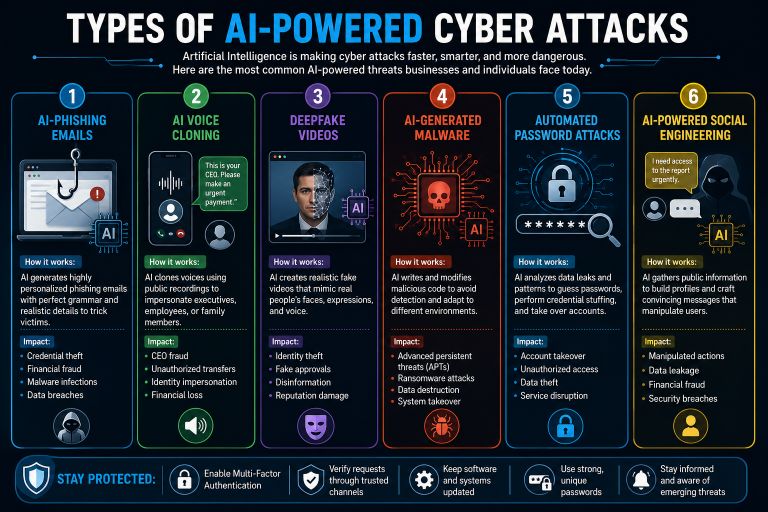
Artificial intelligence has introduced several new attack methods while making existing ones much more dangerous.
AI-Generated Phishing Emails
Phishing has existed for decades, but artificial intelligence has transformed it into a far more convincing threat.
Earlier phishing emails were usually easy to identify because they contained poor grammar, spelling mistakes, or unrealistic messages. AI can now generate professional-looking emails that closely resemble legitimate business communications.
Attackers can personalize messages by collecting publicly available information from social media, company websites, and professional networking platforms. Instead of sending identical emails to thousands of people, they create customized messages that appear genuine.
For example, an employee may receive an email that references a recent company project, mentions colleagues by name, and requests an urgent payment or document review. Because the message appears authentic, the likelihood of success increases significantly.
As AI continues to improve language generation, phishing campaigns will become even more difficult to distinguish from legitimate communications.
AI Voice Cloning Scams
Voice cloning has emerged as one of the most alarming developments in cybercrime.
Modern AI models can reproduce a person’s voice using only a short audio recording. Criminals can collect these recordings from interviews, podcasts, social media videos, or publicly available speeches.
Once a voice has been cloned, attackers may impersonate company executives, family members, or business partners.
Also Read: Digital Surveillance and the Decline of Personal Freedom
Imagine receiving a phone call that sounds exactly like your manager requesting an urgent bank transfer. The voice sounds familiar, the conversation feels natural, and there is little reason to suspect fraud.
Several organizations have already reported financial losses caused by AI-generated voice impersonation. As voice synthesis technology continues to improve, verifying identity will become increasingly important.
Deepfake Videos
Deepfake technology uses artificial intelligence to generate highly realistic videos that appear authentic.
Cybercriminals use deepfakes to impersonate executives during video meetings, spread false information, manipulate public opinion, or deceive employees into approving sensitive transactions.
Unlike traditional edited videos, deepfakes can recreate facial expressions, eye movements, and speech patterns with remarkable accuracy.
Businesses are particularly vulnerable because many organizations now rely on virtual meetings for communication. Employees may trust what they see on screen without realizing the video has been artificially generated.
Although deepfake detection technology is improving, the quality of AI-generated videos continues to advance, creating an ongoing challenge for cybersecurity professionals.
AI-Generated Malware
Artificial intelligence is changing how malicious software is created.
Traditional malware often follows predictable patterns that antivirus software can recognize. AI-generated malware has the potential to modify its own behavior, making detection more difficult.
Some malicious programs can analyze the environment in which they are running and adjust their techniques to avoid security systems. Others may delay execution until they determine that security software is inactive.
AI also assists criminals in writing malicious code much faster. Instead of manually developing every function, attackers can use AI to generate scripts, improve existing malware, and automate repetitive coding tasks.
Although experienced cybercriminals still play a central role in sophisticated attacks, AI significantly reduces development time and lowers the barrier for less experienced attackers.
Automated Password and Credential Attacks
Passwords remain one of the most common targets in cybercrime.
Artificial intelligence improves password attacks by analyzing leaked credential databases and identifying common password patterns. Instead of making random guesses, AI predicts which passwords are more likely to succeed based on user behavior.
Credential stuffing has also become more efficient. Criminals automatically test stolen usernames and passwords across multiple websites because many people reuse the same login credentials.
AI helps prioritize targets, optimize attack timing, and identify accounts with a higher probability of success.
This is one reason why cybersecurity experts strongly recommend using unique passwords for every account along with multi-factor authentication.
Why Traditional Security Systems Are Falling Behind
Cybersecurity has improved significantly over the years, but the pace of AI-driven cybercrime is creating new challenges. Many security systems were designed to detect threats based on known patterns. They compare files, network traffic, or software behavior against databases of previously identified threats. This approach works well for familiar attacks, but it becomes less effective when attackers use artificial intelligence to create new variations continuously.
AI-powered attacks can change their tactics quickly. A phishing email that fails in the morning may be rewritten by AI and resent with different wording by the afternoon. Malware can be modified automatically to avoid detection, making it difficult for traditional antivirus software to recognize it.
Another challenge is the sheer volume of security data. Large organizations generate millions of security events every day. Security analysts cannot manually investigate every alert, and attackers often hide their activities within this enormous stream of data.
Many companies also face a shortage of cybersecurity professionals. While attackers use automation to scale their operations, defenders still depend heavily on human expertise for investigation and decision-making. This imbalance allows cybercriminals to move faster than many security teams can respond.
The rapid adoption of cloud computing, remote work, and Internet-connected devices has further expanded the attack surface. Every connected device, application, or online service represents another potential entry point for attackers.
As artificial intelligence continues to evolve, security systems must also become more intelligent. Relying only on traditional defenses is no longer enough.
Real-World Examples of AI in Cybercrime
Artificial intelligence is already being used in real cyber attacks. While the technology itself is not malicious, criminals are finding new ways to exploit it.
AI-Generated Phishing Campaigns
One of the most common examples is AI-generated phishing emails. Criminals can create thousands of unique messages that look professional and are tailored to specific individuals or organizations.
Instead of sending generic emails with obvious mistakes, attackers now generate messages that match a company’s writing style, include relevant details, and create a sense of urgency. These improvements significantly increase the chances that someone will click a malicious link or download an infected attachment.
Business Email Compromise
Business Email Compromise (BEC) attacks have become more convincing with the help of AI.
Attackers gather publicly available information about executives, employees, and business relationships. AI then helps generate realistic conversations that closely resemble legitimate business communication.
Employees may receive requests to transfer money, update banking information, or share confidential documents without realizing the email is fraudulent.
Since these attacks rely on trust rather than technical vulnerabilities, they can bypass many traditional security controls.
Deepfake Fraud
Deepfake technology has introduced a new form of identity fraud.
There have been cases where cybercriminals used AI-generated audio or video to impersonate senior executives during online meetings or phone calls. Employees believed they were speaking with legitimate company leaders and approved financial transactions that resulted in significant losses.
Also Read: Deepfake Cyber Threats: 7 Dangerous Ways Synthetic Media Is Used in Cybercrime
As remote work becomes more common, verifying identities during virtual communication is becoming increasingly important.
AI-Assisted Malware Development
Artificial intelligence is also helping criminals accelerate malware development.
Instead of writing every line of malicious code manually, attackers can use AI to generate code, improve existing malware, and identify programming errors much faster.
This reduces development time and allows criminals to release new malware variants more frequently, making detection more challenging for security vendors.
Industries Most at Risk
Almost every industry depends on digital systems, but some sectors face greater risks because of the value of the information they store.
Banking and Financial Services
Banks process millions of financial transactions every day, making them attractive targets for cybercriminals.
AI-powered fraud, phishing attacks, account takeovers, and identity theft can result in significant financial losses for both institutions and customers.
Financial organizations invest heavily in cybersecurity, yet they remain constant targets because successful attacks can produce immediate financial rewards.
Healthcare
Hospitals and healthcare providers store highly sensitive patient information, including medical records, insurance details, and personal identification.
Cybercriminals often target healthcare organizations because these records can be sold on underground markets or used for identity theft.
Ransomware attacks against hospitals have also increased, disrupting medical services and putting patient care at risk.
Government Agencies
Government organizations manage critical infrastructure, national security information, and personal records for millions of citizens.
AI-powered cyber attacks against government systems can involve espionage, data theft, misinformation campaigns, or attempts to disrupt essential public services.
Protecting these systems has become a national security priority in many countries.
E-Commerce Companies
Online retailers collect customer information, payment details, and purchasing behavior.
Criminals target e-commerce platforms to steal payment information, hijack customer accounts, or distribute malicious software through compromised websites.
As online shopping continues to grow, so does the need for stronger cybersecurity.
Educational Institutions
Schools, colleges, and universities maintain large databases containing student records, research data, and financial information.
Many educational institutions operate with limited cybersecurity resources, making them attractive targets for ransomware groups and data thieves.
Critical Infrastructure
Power grids, transportation systems, water treatment facilities, and communication networks are increasingly connected to digital technologies.
A successful cyber attack against critical infrastructure can disrupt essential services and affect entire communities.
Because these systems are so important, they require continuous monitoring and advanced security measures.
How Artificial Intelligence Is Also Helping Cybersecurity
Although AI has strengthened cybercriminals, it is also becoming one of the most valuable tools for cybersecurity professionals.
Modern security platforms use artificial intelligence to analyze enormous amounts of data far more quickly than humans can.
Instead of waiting for known attack signatures, AI can identify unusual behavior that may indicate an attack is already in progress.
Faster Threat Detection
AI continuously monitors networks, devices, and user activity.
When something unusual occurs, such as an employee logging in from an unexpected country or downloading unusually large amounts of data, the system can generate an alert immediately.
This allows security teams to investigate suspicious activity before significant damage occurs.
Behavioral Analysis
Traditional security systems focus on known malware signatures.
AI takes a different approach by learning what normal behavior looks like for users and systems.
If an account suddenly begins accessing confidential files at unusual hours or from unfamiliar devices, AI can recognize the abnormal behavior even if no known malware is involved.
Also Read: The Internet Knows You Better Than Your Family
Automated Incident Response
Responding quickly is essential during a cyber attack.
AI-powered security platforms can automatically isolate infected devices, block malicious IP addresses, disable compromised accounts, or prevent suspicious file downloads before attackers spread further through the network.
Automation reduces response times from hours to seconds.
Fraud Detection
Banks and payment providers increasingly rely on AI to detect fraudulent transactions.
Instead of using fixed rules alone, AI evaluates multiple factors such as spending habits, location, device information, and transaction history.
If a payment appears unusual, additional verification can be requested before the transaction is approved.
Malware Analysis
Security researchers analyze thousands of new malware samples every day.
Artificial intelligence helps classify these threats, identify similarities, and prioritize the most dangerous samples for further investigation.
This enables security vendors to develop protective measures much more quickly than manual analysis alone.
How Businesses Can Defend Against AI-Powered Cybercrime
Artificial intelligence has changed the nature of cyber threats, but businesses are not powerless. A strong cybersecurity strategy combines technology, employee awareness, and continuous monitoring.
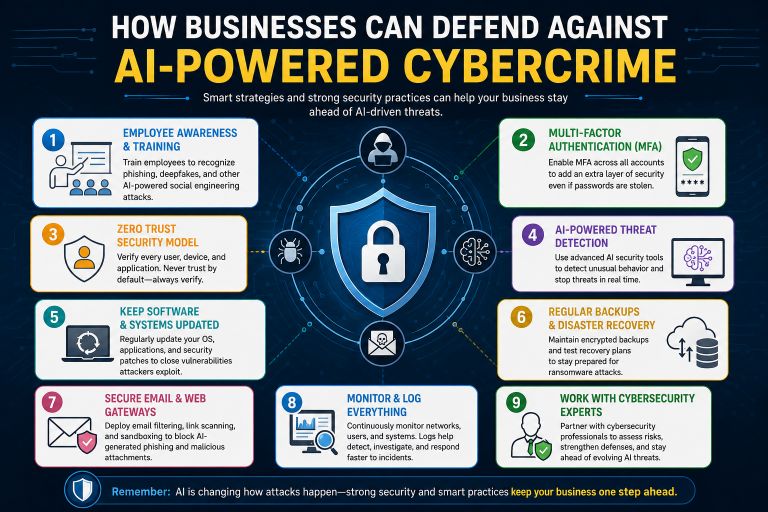
Invest in Employee Cybersecurity Training
Employees remain one of the most common targets for phishing and social engineering attacks.
Regular training helps staff recognize suspicious emails, fake websites, unexpected phone calls, and deepfake scams before they become security incidents.
Awareness is often the first line of defense.
Enable Multi-Factor Authentication
Passwords alone are no longer enough.
Multi-factor authentication adds another verification step, making it much harder for attackers to access accounts even if passwords have been stolen.
Organizations should enable MFA for email, cloud services, financial systems, and remote access platforms.
Adopt a Zero Trust Security Model
The traditional assumption that users inside a company network are trustworthy is becoming outdated.
A Zero Trust approach requires continuous verification of every user, device, and application before access is granted.
This reduces the risk of attackers moving freely after compromising a single account.
Use AI-Based Security Solutions
Businesses should take advantage of the same technology that attackers are using.
Modern security platforms powered by artificial intelligence can detect unusual behavior, identify emerging threats, and automate responses much faster than traditional tools.
Using AI defensively helps close the gap between attackers and defenders.
Keep Software Updated
Many successful cyber attacks exploit known software vulnerabilities that already have available security patches.
Regular updates for operating systems, applications, servers, and network devices significantly reduce these risks.
Patch management should be an ongoing process rather than an occasional task.
Maintain Secure Backups
No security system can guarantee complete protection.
Organizations should maintain regular offline or immutable backups of critical data. If ransomware encrypts production systems, clean backups allow operations to recover without paying criminals.
Backups should also be tested regularly to ensure they can be restored successfully.
Continuously Monitor Security Activity
Cybersecurity is not a one-time project.
Organizations should continuously monitor their networks, review security logs, assess vulnerabilities, and update their defenses as new threats emerge.
AI-powered attacks evolve quickly, and security strategies must evolve just as fast.
What Individuals Should Do to Stay Safe
Artificial intelligence has made cyber attacks more advanced, but individuals can still reduce their risk by following good cybersecurity practices. Most successful attacks do not happen because of highly sophisticated hacking techniques. They succeed because someone clicks a malicious link, shares sensitive information, or reuses a weak password.
Think Before You Click
Unexpected emails, text messages, and social media messages should always be treated with caution. Even if a message appears to come from a trusted company or a familiar person, take a moment to verify it before opening attachments or clicking links.
AI-generated phishing emails are designed to look convincing. Checking the sender’s email address, looking for unusual requests, and confirming important messages through another communication channel can prevent many attacks.
Verify Voice and Video Requests
With AI-powered voice cloning and deepfake technology becoming more common, it is no longer safe to assume that every phone call or video meeting is genuine.
If someone requests an urgent payment, asks for confidential information, or instructs you to change account details, verify the request through another trusted method. A quick phone call or face-to-face confirmation can prevent significant financial losses.
Use Strong and Unique Passwords
Using the same password across multiple websites increases the risk of account compromise. If one website suffers a data breach, attackers often try those credentials on other platforms.
A password manager makes it easier to create and store strong, unique passwords for every account without needing to remember them all.
Enable Multi-Factor Authentication
Multi-factor authentication (MFA) is one of the simplest and most effective ways to improve account security.
Even if a password is stolen, attackers still need the second verification factor, such as a mobile authentication app or security key, to access the account.
Whenever possible, enable MFA for email accounts, banking services, social media, cloud storage, and business applications.
Keep Software Updated
Software updates often include important security fixes. Delaying updates gives cybercriminals more time to exploit known vulnerabilities.
Enable automatic updates for operating systems, browsers, antivirus software, and mobile applications whenever possible.
Be Careful About What You Share Online
Many AI-powered attacks begin by collecting publicly available information.
Personal details shared on social media can help attackers create convincing phishing emails, security question answers, or identity impersonation attempts.
Review your privacy settings regularly and avoid sharing unnecessary personal information publicly.
The Future of AI and Cybercrime
Artificial intelligence is still evolving, and its role in cybercrime will likely continue to grow over the coming years. The tools available today are only the beginning of what may become possible in the future.
One expected development is the rise of autonomous cyber attacks. Instead of requiring constant human control, AI systems may eventually identify vulnerable targets, select attack methods, adapt to security defenses, and continue operating with minimal human involvement.
Deepfake technology is also expected to become more realistic. Video calls, voice messages, and online interviews may become increasingly difficult to verify without advanced authentication methods. Businesses and governments will need stronger identity verification processes to reduce the risk of impersonation.
Artificial intelligence will also improve social engineering attacks. Future AI systems may analyze public information, communication habits, and online behavior to create highly personalized scams that are much harder to recognize.
Fortunately, cybersecurity is evolving alongside these threats. Security companies are investing heavily in AI-powered defense systems capable of detecting unusual behavior, responding to attacks automatically, and identifying threats before they spread.
The future of cybersecurity is likely to become an AI-versus-AI environment, where intelligent defense systems continuously compete against intelligent attack systems. Success will depend on how quickly defenders can adapt to new techniques while maintaining strong security practices.
Governments around the world are also introducing new regulations aimed at improving cybersecurity, protecting personal data, and encouraging the responsible development of artificial intelligence. While regulations alone cannot eliminate cybercrime, they can help establish standards that make digital environments safer.
Conclusion
Artificial intelligence is changing the future of cybercrime in ways that were difficult to imagine just a few years ago. It has lowered the technical barriers for attackers, automated complex tasks, and enabled cybercriminals to launch highly personalized attacks on a massive scale.
From AI-generated phishing emails and deepfake fraud to voice cloning and intelligent malware, modern cyber threats are becoming faster, smarter, and more difficult to detect. At the same time, traditional security systems often struggle to keep pace because many were designed to defend against older attack methods.
The good news is that artificial intelligence is also becoming one of the strongest tools available for cybersecurity professionals. AI-powered threat detection, behavioral analysis, automated response systems, and fraud prevention technologies are helping organizations strengthen their defenses against increasingly sophisticated attacks.
For businesses, protecting digital assets now requires more than installing antivirus software. It involves continuous monitoring, employee awareness, strong authentication, regular software updates, and the adoption of modern security technologies.
Individuals also have an important role to play. Using strong passwords, enabling multi-factor authentication, verifying unexpected requests, and being cautious with personal information can significantly reduce the risk of becoming a victim.
Artificial intelligence itself is neither good nor bad. Its impact depends on how it is used. As cybercriminals continue to adopt AI, governments, businesses, security researchers, and technology companies must work together to ensure that innovation strengthens cybersecurity rather than undermines it.
The future of cybercrime will undoubtedly be shaped by artificial intelligence, but the future of cybersecurity will be shaped by how prepared we are to respond.
Frequently Asked Questions
What is AI-powered cybercrime?
AI-powered cybercrime refers to cyber attacks that use artificial intelligence to automate tasks, generate phishing emails, create deepfakes, develop malware, analyze stolen data, or improve social engineering attacks.
Why are cybercriminals using artificial intelligence?
Cybercriminals use AI because it allows them to launch attacks faster, automate repetitive work, personalize scams, identify vulnerabilities, and target more victims with fewer resources.
Can artificial intelligence create malware?
Artificial intelligence can assist in writing or modifying malicious code, making malware development faster and helping attackers create new variants that are more difficult to detect.
How does AI improve phishing attacks?
AI can generate professional-looking emails with correct grammar, personalize messages using publicly available information, and imitate legitimate communication styles, making phishing attacks more convincing.
Can AI also improve cybersecurity?
Yes. AI is widely used in cybersecurity for threat detection, fraud prevention, behavioral analysis, malware identification, automated incident response, and continuous network monitoring.
How can I protect myself from AI-powered cyber attacks?
Use strong and unique passwords, enable multi-factor authentication, keep software updated, verify unexpected requests, avoid clicking suspicious links, and limit the personal information you share online.