

Think about the last thing you searched online. Perhaps you looked for a new smartphone, watched a travel video, checked the weather, or searched for a solution to a health problem. It may have felt like a private moment—just you and your device. But every click, search, swipe, and purchase quietly added another piece to your digital profile.
Now consider this question: Who knows you better—your family or the Internet?
At first, the idea sounds absurd. Your family has watched you grow up, celebrated birthdays with you, and knows your favorite meals, hobbies, and childhood stories. Yet the Internet sees something different. It watches your daily habits in real time. It notices when you stay awake late at night, when you begin searching for a new job, when you start planning a vacation, or when you suddenly become interested in fitness or home loans.
Unlike people, digital platforms never forget. They continuously collect, organize, and analyze information about millions of users every second. Individually, each piece of data seems harmless. Together, they create an incredibly detailed picture of who you are, what you like, how you think, and sometimes even what you are likely to do next.
This isn’t science fiction. It’s the modern Internet powered by artificial intelligence, big data, and sophisticated tracking technologies.
Understanding how this works is no longer optional. Whether you use social media, shop online, stream movies, or simply browse websites, you are constantly creating a digital footprint. The more you know about it, the better you can protect your privacy and make informed decisions online.
Your Digital Shadow Begins Earlier Than You Think
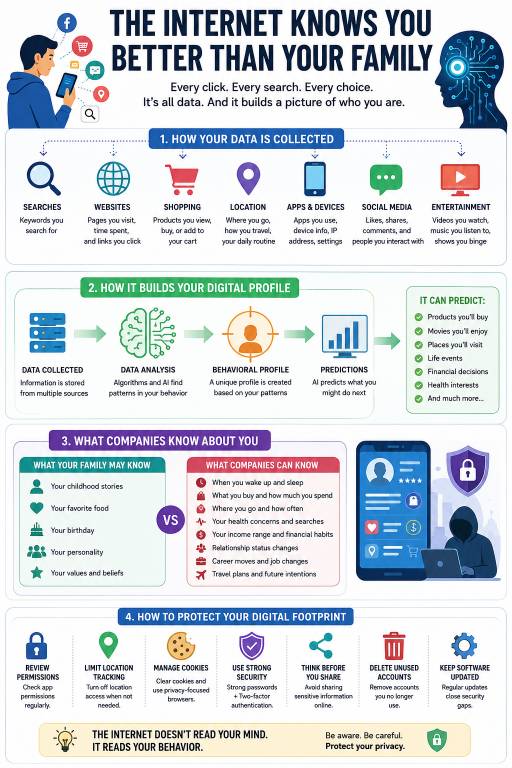
Most people assume that personal data is collected only when they create a social media account or fill out an online form. In reality, your digital shadow begins growing the moment you start using connected services. Think about an ordinary weekday. Before leaving home, you check the weather, use a navigation app to avoid traffic, order coffee through a delivery platform, reply to emails, scroll through social media during lunch, and stream a television series before going to bed. None of these activities feels unusual because they have become part of modern life.
However, each of those actions leaves behind a trail of information. Your location, search terms, viewing habits, shopping preferences, and the times when you are most active online are quietly recorded. Search engines, banking apps, food delivery services, streaming platforms, fitness trackers, smart TVs, and voice assistants all contribute pieces to the same puzzle. Even websites you visit for a few seconds may store cookies or other tracking technologies that remember your preferences for future visits.
The surprising part is that you do not need to actively share personal details for companies to learn about you. Simply browsing the Internet is often enough. Over months and years, countless small interactions accumulate into a living profile that evolves alongside your changing interests and routines.
Also Read: Corrupted File vs Damaged Storage: What’s the Difference?
Every Click Builds Your Digital Profile
Imagine walking into a bookstore every weekend. One week you browse travel guides, the next week you spend time in the fitness section, and a month later you begin reading books about investing. The store owner would eventually notice that your interests are changing. Now imagine millions of bookstores sharing that information instantly. That is much closer to how the modern web operates.
Every interaction online contributes to a larger picture of who you are. When you visit an e-commerce website, the platform does not simply record whether you bought something. It also pays attention to what you searched for, which products you compared, how long you viewed each item, whether you read customer reviews, and whether you added something to your cart before changing your mind. Similar information is collected when you read news articles, watch videos, or use social media.
Modern algorithms do not rely on a single action. They look for patterns across thousands of behavioral signals. Suppose you spend several evenings researching baby strollers, parenting blogs, health insurance plans, and nursery furniture. You may never tell anyone about your plans, yet online systems can already infer that a major life change may be approaching. Your digital profile is not built from one search or one purchase; it is built from thousands of small actions that gradually reveal your interests, priorities, spending habits, and future intentions.
AI Can Predict What You’ll Do Next
Artificial intelligence has transformed data collection from simple record-keeping into powerful prediction. Years ago, companies mostly analyzed what customers had already done. Today, machine learning focuses on a more valuable question: What is this person likely to do next?
AI systems examine billions of online interactions every day and compare your behavior with patterns observed across millions of users. If you suddenly begin searching for running shoes, healthy recipes, workout equipment, and fitness watches, there is a good chance you will soon see advertisements for gym memberships, sportswear, and nutritional products. Not because a person manually selected those ads, but because the algorithm recognized a familiar behavioral pattern.
Also Read: Your Digital Twin Already Exists
The same technology can identify people who appear to be planning a vacation, buying a house, changing careers, starting a business, or researching financial investments. Streaming platforms use similar methods when recommending movies or music. They learn which content you finish, which songs you skip, and which genres keep your attention the longest. Over time, these recommendations become surprisingly accurate.
Artificial intelligence is not reading your thoughts. It is using probability. When enough behavioral data exists, future actions become easier to estimate than many people realize.
The Data Your Family Doesn’t See—but Companies Do
Your family knows many important things about you. They remember your childhood nickname, your favorite holiday destination, and the stories that shaped your personality. But there are aspects of your daily life that even close relatives rarely observe.
Internet companies often know what time you usually wake up, when you stay awake unusually late, which routes you drive every day, how frequently you shop online, what products you are comparing, whether you have been researching home loans, and what hobbies you have developed over the past year. They may notice that you have recently searched for medical symptoms, career opportunities, or travel destinations long before you mention those topics in conversation.
This is one reason personalized advertisements can feel unsettling. Your family might not realize that you have spent three nights researching electric cars or reading articles about stress management. Algorithms notice because they are designed to detect behavioral changes. They do not understand emotions the way humans do, but they excel at recognizing patterns in your online activity. In many cases, behavior reveals more than words.
How Advertisers Build an Invisible Version of You
Behind almost every website is an advertising ecosystem that works quietly in the background. Cookies, analytics tools, advertising identifiers, and tracking pixels help companies understand how visitors behave online. Information from different websites may be combined to create a broader picture of your interests.
Advertisers use this data to answer practical questions. What products are you interested in? How often do you shop? Are you likely to belong to a particular age group? Have you recently shown interest in travel, finance, or technology? If you searched for laptops yesterday, it is not a coincidence when laptop advertisements follow you across multiple websites today.
An invisible digital version of you is constantly being updated. It does not know your personality the way your family does, but it knows your online behavior with remarkable precision. For businesses, that information has enormous commercial value. For users, it raises important questions about privacy, transparency, and control over personal data.
Is This Good or Bad?
The answer is not as simple as calling online tracking good or bad. Like many technologies, it offers both benefits and risks.
On the positive side, personalization makes the Internet more useful. Search engines provide more relevant results, streaming platforms recommend content you are likely to enjoy, navigation apps find faster routes, and banks can detect suspicious transactions more quickly. Online shopping becomes more convenient because websites remember your preferences and previous purchases.
At the same time, extensive data collection creates significant privacy concerns. Large databases of personal information become attractive targets for cybercriminals. Data breaches can expose sensitive details that may be used for identity theft or financial fraud. Detailed user profiles can also enable aggressive advertising, manipulation, misinformation campaigns, and highly targeted scams.
The real issue is not whether data should ever be collected. The challenge is ensuring that personal information is gathered responsibly, stored securely, and used transparently.
How to Reduce Your Digital Footprint
Completely disappearing from the Internet is unrealistic for most people, but reducing your digital footprint is entirely possible. Start by reviewing the permissions granted to your mobile apps. Many applications request access to your location, contacts, microphone, or camera even when those permissions are not essential.
Clear browser cookies regularly, remove unused browser extensions, and delete online accounts you no longer use. Limit the amount of personal information you share on social media, especially details such as your home address, travel plans, financial information, or identification documents.
Use strong, unique passwords for every account and enable multi-factor authentication whenever available. Keep your operating system, browser, and apps updated to reduce security vulnerabilities. If privacy is a priority, consider using privacy-focused browsers and search engines that minimize tracking.
Most importantly, pause before clicking. Every search, download, purchase, comment, and post becomes another piece of your digital footprint. The less unnecessary information you share, the more control you retain over your online identity.
Conclusion
The Internet does not truly know who you are. It does not know your memories, your dreams, or the conversations you have shared with your family around the dinner table. What it knows is your behavior, and behavior can reveal an astonishing amount about a person.
Over time, millions of small digital actions combine to create a profile detailed enough to predict your interests, habits, and future decisions with surprising accuracy. Your family knows the person you have been throughout your life. The Internet knows the person you become every day through your clicks, searches, purchases, and online activity.
That is why protecting your digital footprint has become one of the most important aspects of modern cybersecurity and personal privacy. The next time you search for something online, remember this: the Internet is not reading your mind—it is reading the story you write with every click.