If your security strategy still trusts what it sees and hears, you’re already behind.
We’ve entered a phase of cybercrime where reality itself is being manipulated. Deepfakes are no longer internet gimmicks or social media curiosities—they are precision tools used by attackers to exploit trust, bypass verification, and move fast without raising suspicion.
This is the new battlefield. And deepfake cyber threats are at the center of it.
Attackers don’t need to break into your network the hard way anymore. Sometimes, all they need is your voice, your face, or a few seconds of video—and they can manufacture the rest.
Let’s break down exactly how this works, why it’s dangerous, and how you shut it down.
What Makes Deepfake Cyber Threats So Dangerous
At a basic level, deepfakes use artificial intelligence to generate realistic audio, video, or images that mimic real people. But the real danger isn’t just the technology—it’s what it breaks.
It destroys the idea that:
- Seeing is believing
- Hearing is trusting
- Identity is verifiable
Those assumptions used to protect businesses. Now, they’re liabilities.
Modern deepfake cyber threats don’t target systems first—they target perception. If an attacker can convince you something is real, they don’t need to hack your firewall. You’ll open the door for them.
📌 Recommended Reading
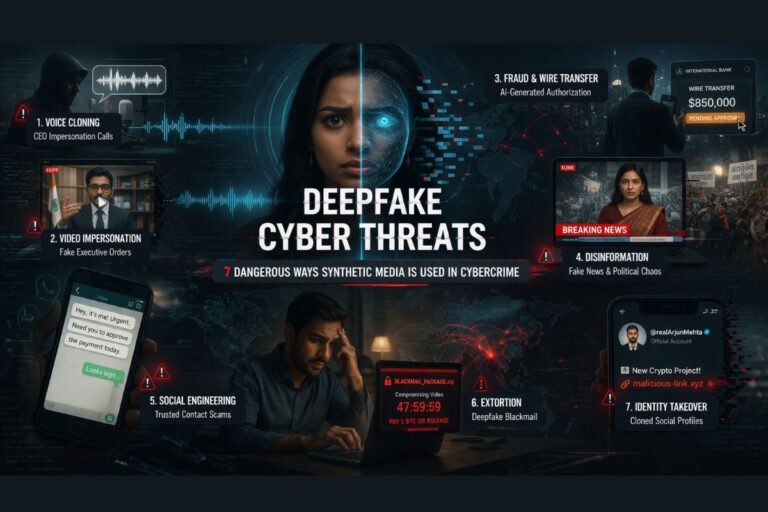
Defending Against Phishing Kits as a Service1. Voice Cloning Attacks Are Replacing Phishing
Phishing emails are getting old. Voice cloning is taking over.
Attackers can now replicate a CEO’s voice using just a short audio sample pulled from interviews, webinars, or social media. From there, they place a call that sounds legitimate—urgent tone, familiar voice, no red flags.
“Wire this now.”
“Send the file.”
“Approve the transfer.”
And it works.
These deepfake cyber threats hit hard because they bypass skepticism. Employees are trained to question emails—but not their boss’s voice.
This is where voice cloning cybercrime becomes lethal.
2. Deepfake Video Is Breaking Identity Verification
Video used to be a strong trust signal. Not anymore.
Attackers can now create fake video calls or pre-recorded clips that show executives giving instructions or approving actions. In some cases, they even inject deepfakes into live meetings.
This turns standard identity verification into a joke.
A finance team sees the CFO on screen confirming a transaction. Everything looks right. Everything sounds right.
But it’s fake.
That’s the reality of modern deepfake cyber threats—they don’t just trick people, they override internal controls.
3. Synthetic Media Fraud Targets Financial Systems
This is where things get expensive.
Synthetic media fraud combines deepfake audio, fake identities, and social engineering to manipulate financial workflows. Attackers impersonate vendors, executives, or partners and redirect payments.
It’s clean. It’s fast. And it often goes unnoticed until the money is gone.
Unlike traditional fraud, these attacks don’t rely on brute force. They rely on precision—crafted communication that looks and feels legitimate.
That’s why synthetic media fraud is one of the fastest-growing forms of cybercrime right now.
4. AI Impersonation Attacks Scale Like Never Before
Here’s what makes this worse: scale.
Traditional social engineering required time and effort. Deepfakes automate it.
Attackers can:
- Clone multiple identities
- Generate personalized messages
- Launch simultaneous attacks across targets
This isn’t one attacker targeting one victim. This is automation at scale.
AI impersonation attacks allow cybercriminals to operate like a business—efficient, repeatable, and profitable.
That’s the evolution of deepfake cyber threats. They’re not just smarter—they’re scalable.
5. Deepfake Scams Exploit Human Psychology
Let’s be real—this isn’t just a tech problem. It’s a human one.
Deepfake attacks succeed because they exploit:
- Authority (the “boss” effect)
- Urgency (act now, no time to verify)
- Familiarity (recognized voice or face)
Attackers don’t need perfect deepfakes. They need convincing ones delivered under pressure.
That’s why deepfake scams in 2026 are more effective than older phishing attacks. They hit both logic and emotion at the same time.
6. Deepfake Cyber Threats Bypass Traditional Security Controls
Most security systems are built to detect malware, suspicious logins, or network anomalies.
Deepfakes don’t trigger those.
They operate outside traditional detection systems because the “attack” happens through human interaction.
No exploit.
No payload.
No alert.
Just a conversation that leads to compromise.
That’s what makes deepfake cyber threats so dangerous—they exist in the gap between technology and human trust.
7. Reputation Attacks and Disinformation Campaigns
Deepfakes aren’t just used for financial gain—they’re also used to destroy credibility.
Attackers can create fake videos or audio clips that appear to show individuals saying or doing damaging things. These can spread quickly and cause reputational damage before they’re even verified.
For businesses, this means:
- Loss of trust
- Public relations crises
- Legal complications
This is the darker side of deepfake cyber threats—not just stealing money, but manipulating perception at scale.
How to Defend Against Deepfake Cyber Threats
You don’t stop this with one tool. You stop it with layered awareness and control.
Start here:
Kill Blind Trust
Voice and video are no longer verification methods. Period.
Always require secondary confirmation for sensitive actions.
Implement Multi-Factor Verification
Not just MFA for logins—MFA for decisions.
Financial transactions and sensitive requests should always require multiple validation steps.
Train for AI-Based Attacks
Your people need to understand how deepfake cyber threats work. Awareness is your first line of defense.
Use Advanced Detection Tools
AI is being used to create deepfakes—so use AI to detect them.
Behavioral analysis and anomaly detection tools help identify unusual activity patterns.
Lock Down Financial Workflows
No single person should be able to approve or execute high-risk actions alone.
Segregation of duties kills a lot of these attacks instantly.
External Resources
Learn more about emerging cyber threats from the Cybersecurity and Infrastructure Security Agency (CISA): https://www.cisa.gov
For research on AI security risks and vulnerabilities, visit: https://owasp.org
Explore more cybersecurity insights and threat analysis at: https://www.filecorrupter.org
Conclusion
Deepfakes didn’t just change cybercrime—they changed the rules of trust.
If your organization still relies on voice, video, or identity at face value, you’re operating on outdated assumptions. And attackers know it.
Deepfake cyber threats are fast, scalable, and built to exploit human behavior. They don’t break systems—they manipulate people into breaking them.
The defense isn’t just technical. It’s strategic. It’s psychological. And it requires a shift in how trust is verified across your organization.
Because in this new landscape, the biggest vulnerability isn’t your network.
It’s what you believe is real.
😄 Cyber Joke
Why did the hacker use a deepfake video?
Because even their real face couldn’t convince anyone! 😄