
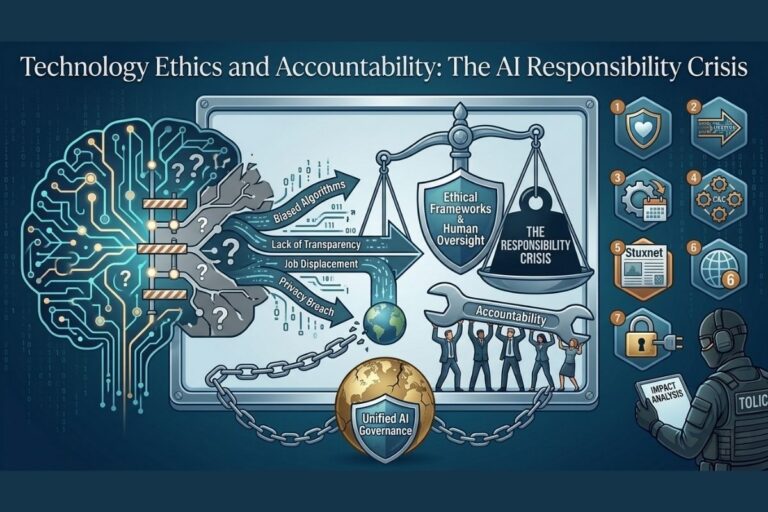
Technology Ethics and Accountability is no longer an abstract academic concept. Technology Ethics and Accountability now sits at the center of artificial intelligence, cybersecurity, and the systems shaping modern society. Technology Ethics and Accountability is no longer optional in a world driven by AI decision making.
Every algorithm, every platform, and every automated decision system reflects human intention. Technology Ethics and Accountability reveals that technology is never neutral. Technology Ethics and Accountability exposes how design choices shape human behavior at scale.
This is the core of the AI Responsibility Crisis. As artificial intelligence systems become more powerful and more autonomous, Technology Ethics and Accountability becomes harder to ignore and more difficult to assign.
Who is responsible when AI systems cause harm? Technology Ethics and Accountability demands this question be answered clearly. Is it the developer, the engineer, the executive, or the corporation? Technology Ethics and Accountability shows that responsibility is shared across all layers.
The Illusion of Neutral Technology
Technology Ethics and Accountability challenges the myth that technology is neutral.
Technology Ethics and Accountability shows that every system is shaped by design decisions. These include data collection, ranking logic, and behavioral targeting systems.
Recommendation engines are not neutral. Technology Ethics and Accountability reveals they are engagement machines optimized for attention and emotional response.
This is why Technology Ethics and Accountability is critical in cybersecurity and AI governance.
The Cybersecurity and Infrastructure Security Agency emphasizes responsible system design and risk management in modern digital ecosystems.
Reference: https://www.cisa.gov
NIST also provides guidance on trustworthy AI systems and governance frameworks: https://www.nist.gov/artificial-intelligence
Individual Responsibility in the AI Era
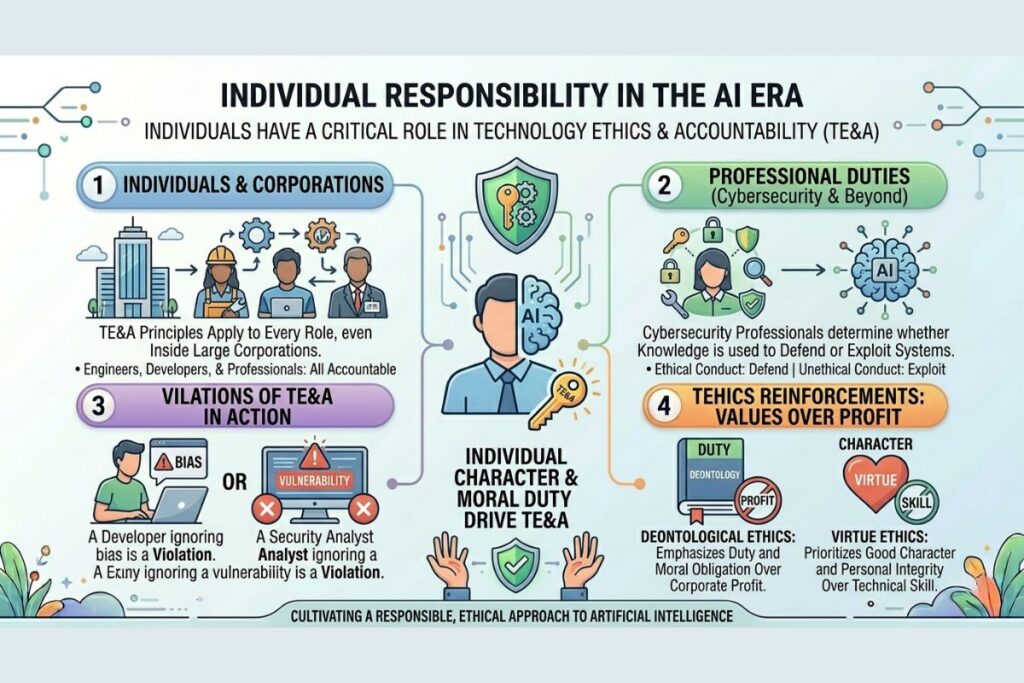
Technology Ethics and Accountability requires individual responsibility even inside large corporations.
Engineers, developers, and cybersecurity professionals all operate under Technology Ethics and Accountability principles whether they acknowledge it or not.
A developer ignoring bias violates Technology Ethics and Accountability. A security analyst ignoring vulnerabilities violates Technology Ethics and Accountability.
Deontological ethics reinforces Technology Ethics and Accountability by emphasizing duty over profit.
Virtue ethics reinforces Technology Ethics and Accountability by emphasizing character over technical skill.
In cybersecurity, Technology Ethics and Accountability determines whether knowledge is used to defend or exploit systems.
Corporate Responsibility and Systemic Risk
Technology Ethics and Accountability becomes even more important at the corporate level.
Technology companies operate globally, and Technology Ethics and Accountability must scale with that influence.
Corporate systems optimized for engagement often violate Technology Ethics and Accountability principles by prioritizing attention over wellbeing.
Outrage driven algorithms conflict with Technology Ethics and Accountability because they maximize engagement at the expense of truth.
Technology Ethics and Accountability requires structural reform including:
- Independent ethics boards
- Algorithmic audits
- Transparent data policies
- Whistleblower protections
- Cybersecurity governance frameworks
OECD AI Principles reinforce Technology Ethics and Accountability globally: https://oecd.ai/en/ai-principles
IBM research also supports Technology Ethics and Accountability through governance models: https://www.ibm.com/topics/ai-ethics
Cybersecurity and Ethical Risk Are Unified
Technology Ethics and Accountability connects cybersecurity and ethics into one system.
Data breaches often occur when Technology Ethics and Accountability is ignored.
Excessive data collection violates Technology Ethics and Accountability by increasing risk exposure.
Weak encryption reflects failure in Technology Ethics and Accountability.
CISA continues reinforcing Technology Ethics and Accountability through resilience guidance: https://www.cisa.gov
OWASP AI security guidelines also reinforce Technology Ethics and Accountability in machine learning systems: https://owasp.org/www-project-ai-security-and-privacy-guide/
AI systems increase the importance of Technology Ethics and Accountability because scale amplifies harm.
A Christian Ethical Perspective on Technology
Technology Ethics and Accountability also extends into moral and spiritual frameworks.
From a Christian perspective, Technology Ethics and Accountability is grounded in human dignity and imago Dei.
Technology Ethics and Accountability rejects systems that exploit, manipulate, or degrade human beings.
Stewardship reinforces Technology Ethics and Accountability by reframing technology as responsibility rather than ownership.
Technology Ethics and Accountability requires asking:
- Does this system respect human dignity
- Does this system align with stewardship principles
- Does this system protect users or exploit them
Technology Ethics and Accountability ensures technology serves humanity rather than consuming it.
Also Read: 7 Shocking Satellite Cybersecurity Threats That Could Cripple Society
The Future of AI Depends on Technology Ethics and Accountability
The AI Responsibility Crisis cannot be solved without Technology Ethics and Accountability at every level.
AI is transforming decision making, cybersecurity, and digital infrastructure.
Without Technology Ethics and Accountability, innovation becomes exploitation at scale.
Trust depends entirely on Technology Ethics and Accountability.
Without trust, digital systems collapse.
Conclusion
Technology Ethics and Accountability is the defining issue of the AI Responsibility Crisis.
Technology Ethics and Accountability requires both individuals and corporations to act with responsibility, transparency, and integrity.
The future of AI depends on Technology Ethics and Accountability being enforced, not just discussed.
At Filecorrupter.org, Technology Ethics and Accountability is central to exposing cybersecurity risks, ethical failures, and digital manipulation.
Explore more at filecorrupter.org
Because Technology Ethics and Accountability are not optional, it is the foundation of digital trust.
FAQ: Technology Ethics and Accountability
1. What is Technology Ethics and Accountability?
Technology Ethics and Accountability refers to the responsibility of individuals and organizations to ensure that technology systems such as AI, algorithms, and digital platforms are designed and used in ways that are ethical, transparent, and aligned with human dignity and safety.
2. Why is Technology Ethics and Accountability important in AI?
It is important because AI systems now influence decisions in healthcare, finance, cybersecurity, and communication. Without ethical accountability, these systems can amplify bias, invade privacy, and cause large scale harm.
3. Who is responsible for ethical failures in technology?
Responsibility is shared between developers, engineers, executives, and corporations. Individual creators are responsible for their actions, and organizations are responsible for governance, oversight, and deployment decisions.
4. How does Technology Ethics and Accountability relate to cybersecurity?
Cybersecurity and ethics are closely connected. Weak ethical standards often lead to poor data protection, excessive data collection, and system vulnerabilities that increase the risk of cyberattacks and data breaches.
5. How can companies improve Technology Ethics and Accountability?
Companies can improve accountability by implementing independent audits, transparent AI governance, strong data protection practices, whistleblower protections, and ethical review boards that oversee system design and deployment.
6. What is the biggest challenge in enforcing Technology Ethics and Accountability?
The biggest challenge is the misalignment between profit incentives and ethical responsibility. Many organizations prioritize speed, growth, and market dominance over long-term accountability, making ethical enforcement inconsistent without strong governance, regulation, and independent oversight.
Explore More Free Tools
Hash Generator Tool
Generate secure MD5, SHA1, SHA256, and other cryptographic hashes instantly online.
Open Tool →Dummy File Generator
Create sample dummy files of custom sizes for testing uploads, storage, and applications.
Open Tool →Password Strength Checker
Analyze password security and identify weak passwords before using them online.
Open Tool →File Hash Checker
Verify file integrity by checking MD5, SHA256, and other file hash signatures.
Open Tool →UUID Generator
Generate random UUIDs and unique identifiers instantly for apps, APIs, and databases.
Open Tool →Text Diff Checker
Compare two text blocks side by side and quickly detect additions, deletions, and edits.
Open Tool →