
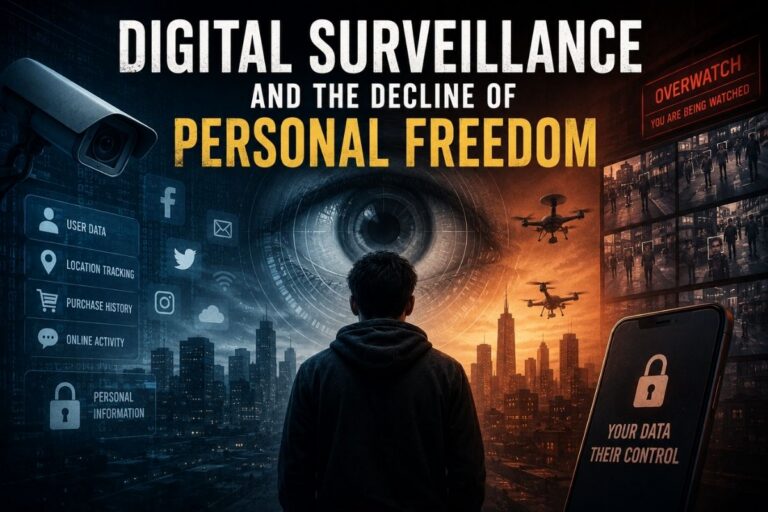
Over the last two decades, life has moved rapidly into the digital space. From morning alarms on smartphones to late-night scrolling on social media, almost every activity now leaves behind a trace of data. Most people do not notice it, but this constant generation of information has built a massive system of observation around modern society.
Digital surveillance is no longer limited to government agencies or security operations. It is now deeply embedded in everyday tools—search engines, mobile apps, social platforms, payment systems, and even home devices. The result is a world where being online often means being observed.
This shift raises an important concern: as digital surveillance expands, personal freedom quietly begins to shrink. Not through force, but through convenience, habit, and dependence on technology. The decline of personal freedom in the digital era is not sudden. It is gradual, almost invisible, and that is what makes it powerful.
What Is Digital Surveillance?
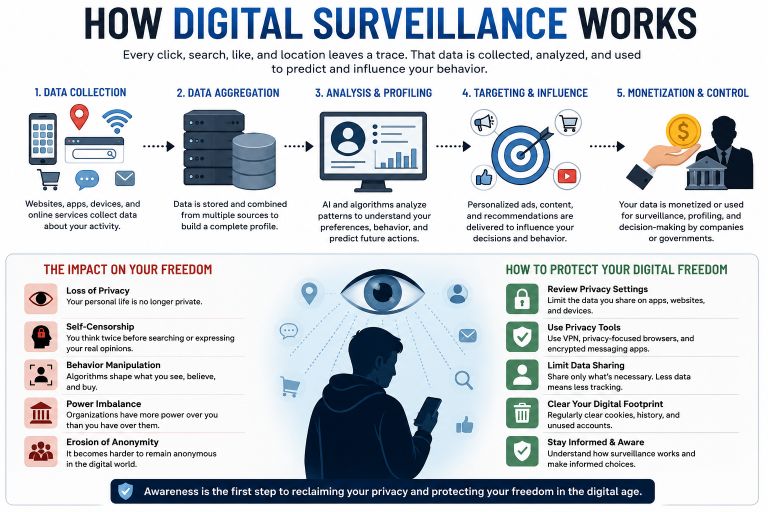
Digital surveillance refers to the systematic monitoring, collection, and analysis of data generated by individuals in digital environments. This includes browsing history, location data, communication patterns, purchase behavior, and even movement across devices.
Unlike traditional surveillance, which required physical observation or targeted monitoring, digital surveillance operates continuously and at scale. It does not need to focus on one person at a time. Instead, it gathers data from millions of users simultaneously and builds behavioral profiles.
There are generally three major forms of digital surveillance. Government surveillance is conducted for security, law enforcement, and intelligence purposes. Corporate surveillance is driven by businesses collecting user data for profit, advertising, and product optimization. Then there is behavioral tracking, which happens silently through apps, websites, and platforms that record user interactions to predict future actions.
Together, these systems form a vast ecosystem where almost every digital movement is recorded in some form.
How Surveillance Systems Actually Work
To understand the decline of personal freedom, it is important to see how surveillance actually operates behind the scenes.
Every time a person uses a smartphone or visits a website, small pieces of data are collected. These include cookies, device identifiers, location signals, and interaction patterns. Over time, these fragments build a detailed profile of behavior.
Artificial intelligence plays a major role in this process. Modern systems do not just store data; they analyze it. Machine learning models identify patterns such as interests, habits, financial behavior, emotional responses, and even political preferences. This allows companies and institutions to predict what a person might do next.
Location tracking has become especially powerful. With GPS-enabled devices, individuals can be traced in real time. Even when location services are turned off, indirect signals from Wi-Fi networks and cell towers can still provide approximate positioning.
The combination of constant data collection and intelligent analysis means that digital surveillance is no longer passive. It is active, adaptive, and predictive.
The Hidden Infrastructure of Monitoring
Most users interact with a few visible platforms, but the actual surveillance system runs much deeper. Big technology companies form the backbone of this infrastructure. Search engines, social networks, mobile operating systems, and cloud services all contribute to data collection.
However, the ecosystem does not end there. Telecom providers also hold extensive metadata about calls, messages, and internet usage. Data brokers purchase information from multiple sources and combine it into detailed user profiles that can be sold to advertisers, insurers, or other organizations.
Also Read: The Internet Knows You Better Than Your Family
In some cases, government agencies can access this data through legal requests or partnerships with private companies. Even when surveillance is not direct, indirect access to aggregated data can still reveal significant personal details.
This hidden infrastructure means that individuals are rarely interacting with a single observer. Instead, they are inside a network of interconnected monitoring systems that continuously exchange information.
The Trade-Off: Convenience vs Freedom
One of the main reasons digital surveillance has expanded so quickly is convenience. Free apps, personalized services, and smart devices make life easier. In exchange, users often allow access to their data without fully understanding the consequences.
Personalized recommendations, targeted advertisements, and automated suggestions are all built on surveillance data. While they improve user experience, they also shape decisions. Over time, this creates a subtle form of influence where choices are guided rather than fully independent.
Smart devices add another layer to this trade-off. Voice assistants, wearable devices, and connected home systems constantly listen, track, or record data to function properly. The more integrated these systems become, the harder it is to avoid data collection altogether.
What makes this trade-off complex is that it does not feel like loss. Instead, it feels like improvement. That is why the decline of personal freedom often goes unnoticed.
How Digital Surveillance Impacts Personal Freedom
Personal freedom is not only about legal rights. It also includes the ability to think, act, and express oneself without constant observation or influence.
Digital surveillance affects this freedom in multiple ways. One of the most significant is the loss of privacy. When every action is recorded, privacy becomes fragmented. People begin to feel that their behavior is always visible, even in private digital spaces.
This leads to a psychological effect known as self-censorship. Individuals may avoid searching for certain topics, expressing opinions, or engaging in discussions simply because they know they are being tracked. This is often referred to as the “chilling effect.”
Another impact is reduced anonymity. In the physical world, people can move without leaving detailed records. In the digital world, anonymity is increasingly rare. Even anonymous accounts can often be linked back to real identities through behavioral patterns.
Over time, this constant observation changes how people behave. Freedom becomes conditional, shaped by what is acceptable within monitored systems rather than what is personally desired.
Case Examples of Surveillance in Action
Digital surveillance is not theoretical. It is already present in everyday life.
Social media platforms continuously track user activity, from posts and likes to how long a person views specific content. This data is used to shape feeds, advertisements, and recommendations.
Mobile apps often request permissions that go beyond their basic function. A simple flashlight app may request location or contact access, contributing to hidden data collection.
Search engines store queries that reveal interests, concerns, and intentions. Over time, this creates a detailed behavioral history that can be analyzed or monetized.
Data leaks and breaches also highlight the risks of large-scale surveillance systems. When centralized databases are compromised, personal information can be exposed, misused, or sold without consent.
These examples show that surveillance is not limited to rare or extreme cases. It is part of normal digital interaction.
Psychological Effects of Being Constantly Watched
One of the less visible consequences of digital surveillance is its psychological impact. When people believe they are being observed, even indirectly, their behavior changes.
This idea is often compared to the “panopticon effect,” where the possibility of observation is enough to influence actions. In digital environments, this effect becomes widespread because users are rarely sure when or how they are being monitored.
Over time, this can lead to increased anxiety about online behavior. People may become more cautious, less expressive, and more aware of their digital footprint. While this may improve “responsible usage,” it also reduces spontaneity and natural expression.
Also Check: Text Diff: The Most Overlooked Code Review Tool
Trust is also affected. As awareness of surveillance grows, users begin to question platforms, services, and even communication channels. This erosion of trust contributes further to the sense of reduced freedom.
Can Surveillance and Freedom Coexist?
There is an ongoing debate about whether surveillance and personal freedom can coexist. Some argue that regulated surveillance is necessary for security, crime prevention, and system optimization.
Privacy laws such as GDPR in Europe attempt to create boundaries around data collection. Encryption technologies also give users more control over their information. These developments show that some level of balance is possible.
However, the challenge lies in scale and dependency. Modern digital systems are built on data. Restricting surveillance too heavily can affect functionality, business models, and even user experience.
This creates a structural tension: systems designed for efficiency often rely on surveillance, while systems designed for privacy may require trade-offs in convenience.
How Individuals Can Protect Their Digital Freedom
Although complete avoidance of digital surveillance is difficult, individuals can reduce exposure. One important step is managing app permissions carefully and limiting unnecessary data access.
Using privacy-focused browsers and search engines can also reduce tracking. Regularly clearing cookies and reviewing privacy settings helps minimize long-term profiling.
Being selective about what is shared online is equally important. Every piece of information contributes to a larger digital footprint. Awareness of this footprint is the first step toward controlling it.
Finally, reducing dependence on a single ecosystem of services can help distribute risk and limit centralized tracking.
The Future of Digital Surveillance
The future of digital surveillance is likely to become more advanced. Artificial intelligence will make predictive monitoring more accurate. Instead of just recording behavior, systems will anticipate it.
Smart cities may introduce continuous monitoring of public spaces using sensors, cameras, and connected infrastructure. Biometric systems such as facial recognition and fingerprint tracking may become more common in daily life.
At the same time, there is growing awareness of privacy rights. This could lead to stronger regulations, decentralized technologies, and user-controlled data systems.
The direction society takes will depend on how this balance is managed.
Freedom in a Data-Driven World
Digital surveillance has become one of the defining features of modern life. It operates quietly in the background, shaping experiences, influencing choices, and collecting vast amounts of personal information.
The decline of personal freedom in this context does not happen through direct restriction. Instead, it emerges through constant observation, data dependency, and behavioral influence.
Freedom is not fully lost, but it is increasingly conditional. It depends on awareness, choices, and the ability to understand how digital systems operate.
In a world driven by data, protecting personal freedom is not about rejecting technology. It is about understanding its cost and making informed decisions about how much of ourselves we are willing to share.
References
Identity Defined Security Alliance (IDSA)
Cybersecurity and Infrastructure Security Agency (CISA) Identity and Access Management Resources
Center for Internet Security (CIS) Digital Identity Guidance