
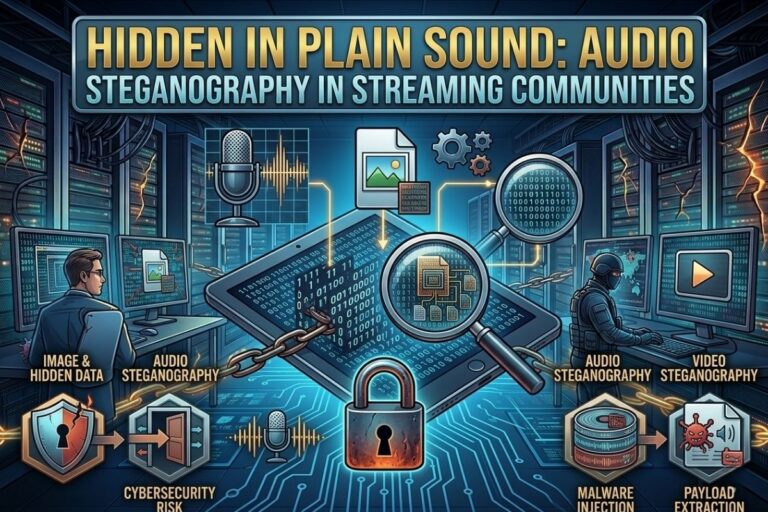
The Part Everyone Misses
Audio Steganography in Streaming Communities is one of those things that sounds theoretical until you actually sit down and think like an attacker for five minutes.
Then it clicks.
You realize you do not need a zero day.
You do not need malware screaming across the network.
You just need a channel nobody is paying attention to.
Sound is that channel.
And while everyone is busy chasing alerts and dashboards, audio is moving freely through systems with almost no inspection.
That is not a coincidence. That is an opportunity.
What Audio Steganography Actually Is
Let me simplify it the way an operator would.
You take data.
You hide it inside sound.
You move it.
You pull it back out somewhere else.
No flags. No noise at the security layer. No one asking questions.
Encryption hides meaning.
Steganography hides existence.
If a defender does not know to look for it, it does not exist to them.
That is the whole game.
Why Streaming Communities Make This Easy
Streaming platforms are not built with this threat in mind.
They are built for performance, scale, and user experience. Not signal level security.
That creates a gap.
Live streams run for hours. That is sustained transmission.
Audio compression smooths things out. It hides imperfections and also hides manipulation.
You have constant background noise. Music, talking, game audio, alerts. That noise becomes cover whether the platform intends it or not.
And most important, nobody in a SOC is saying
we need to analyze Twitch audio for covert payloads.
That assumption is exactly why this works.
📌 Recommended Reading
Canary Tokens: 7 Real-World Attack Patterns ExplainedReal Attack Scenarios
This is where people either get it or they do not.
A livestream can carry embedded command signals. A compromised system listens, decodes, and executes. From the outside, it looks like someone is just watching content.
Voice platforms can carry encoded data. Discord, in game chat, live calls. Data moves through sound and nothing triggers because everything looks normal.
A podcast or stream replay can act as a carrier. On its own it is harmless. Combined with a decoder on the endpoint, it becomes a delivery mechanism.
An insider does not need to plug anything in or upload anything suspicious. Data can be encoded into audio and moved out quietly.
No alerts. No logs pointing to exfiltration. Just normal system behavior on the surface.
Why Most Defenders Miss This
Because the entire defensive model is built around visibility in the wrong places.
We watch packets.
We watch processes.
We watch logs.
We do not watch signal level data inside media.
There is no signature to match here.
There is no obvious spike that screams incident.
There is no payload until someone decides to decode it.
So it slips through. Not because it is perfect, but because it does not fit the model.
How You Actually Start Catching It
You stop thinking in terms of files and start thinking in terms of behavior.
Why is this system interacting with audio continuously when it does not need to.
Why is there background processing tied to audio streams.
Why is something listening when no one is actively using it.
Individually, those questions do not mean much.
Together, they start to form a pattern.
And that is where investigation begins.
At scale, this is not something a human analyst will catch consistently.
Pattern recognition at the signal level is where machine learning starts to earn its place.
The Offensive Reality
If you sit down and model this from an attacker perspective, it becomes obvious why this is attractive.
It is quiet.
It blends in.
It works across platforms without needing heavy customization.
And most importantly, it abuses an assumption that defenders have not challenged yet.
Audio is treated as harmless.
Anything treated as harmless becomes a candidate for abuse.
Where This Is Going
This does not stay niche.
AI generated audio will make embedding data easier and more dynamic.
Deepfake voice streams will not just trick people. They will carry information.
Smart devices will become passive listeners whether users realize it or not.
This moves from clever technique to repeatable tradecraft faster than most people expect.
Why This Matters for What You Are Building
If you are serious about building something under
filecorrupter.org
You do not win by repeating what every other security provider is already doing.
You win by seeing what they are ignoring.
Right now, covert channels inside media are ignored.
Audio based exfiltration is ignored.
Signal level threats are ignored.
That is not a small gap. That is positioning.
If you speak on this consistently and build around these blind spots, you are not just another cybersecurity voice.
You are someone who actually understands where this is going.
Controlled Proof of Concept How This Actually Works
Let’s walk this like an operator, not a textbook.
You do not need anything exotic to pull this off.
You need three things
A payload
An audio carrier
A way to encode and decode
That is it.
Step 1 Prepare the Payload
The payload can be anything
A command string
A small script
A chunk of encoded data
You convert it into binary. That becomes the data you want to hide.
Nothing complex yet.
Step 2 Choose the Audio Carrier
Now you need something that will not raise suspicion.
A livestream
Background music
A podcast clip
The key is simple
It has to look normal and belong in the environment.
If it looks out of place, the whole thing falls apart.
Step 3 Embed the Data
At a high level, you modify tiny parts of the audio signal.
The most common concept is adjusting the least significant bits of the sound data.
These changes are so small that human hearing does not pick them up.
To a listener, the audio sounds exactly the same.
To a system designed to extract it, the data is still there.
Step 4 Transmit Through a Normal Channel
This is where it gets interesting.
You do not send anything suspicious.
You stream the audio.
You upload the file.
You play it during a session.
From a network perspective, everything looks legitimate.
No red flags. No strange protocols.
Just audio moving through allowed channels.
Step 5 Decode on the Receiving End
A preconfigured system listens for that audio.
It knows how to extract the modified bits and reconstruct the original payload.
Once reconstructed, the data can be used however the attacker designed it.
Commands get executed.
Information gets collected.
All triggered by something that looks like normal sound.
What Makes This Dangerous
None of these steps trigger traditional defenses.
There is no obvious malicious file.
There is no exploit firing off.
There is no signature to detect.
Everything happens inside something that is already trusted.
That is the point.
Where Defenders Lose Control
The moment data moves into a medium you are not inspecting, you lose visibility.
Most environments do not inspect audio.
Most tools do not analyze signal level manipulation.
So the entire exchange happens outside your line of sight.
Not because it is invisible.
Because you are not looking there.
FAQ’s
What is hidden data in audio streaming
Hidden data in audio streaming refers to information embedded داخل audio signals using techniques like audio steganography. The data is invisible to human listeners but can be extracted by systems designed to detect it. This allows information to be transmitted without obvious signs of communication.
How does audio steganography work in streaming
Audio steganography in streaming works by modifying small parts of an audio signal to encode data. These changes are subtle enough that the audio sounds normal to users, but a receiving system can decode the hidden information. This can happen in live streams, voice chats, or recorded audio files.
Can hidden data in audio be used for cyber attacks
Yes. Hidden data in audio can be used for covert command and control, data exfiltration, and triggering malicious actions on compromised systems. Because the data is embedded داخل normal audio, it often bypasses traditional security monitoring tools.
Why is audio steganography hard to detect
Audio steganography is hard to detect because it operates at the signal level rather than the file or network level. Most security tools do not analyze audio signals deeply, and the modifications are designed to be imperceptible to human hearing. This makes detection difficult without specialized analysis.
What platforms are vulnerable to audio steganography
Any platform that transmits audio can be used. This includes streaming platforms, voice communication tools, podcasts, and online gaming chat systems. The risk increases in environments where audio is continuous and not monitored.
How can organizations detect hidden data in audio streaming
Organizations can detect hidden data in audio streaming by monitoring abnormal audio processing behavior, analyzing signal patterns, and correlating system activity with audio usage. Advanced detection may involve machine learning models trained to identify anomalies in sound data.
Is audio steganography used in real world attacks
Audio steganography has been explored in research and proof of concept scenarios, and it is considered a viable covert communication method. While not as common as traditional attack vectors, it is gaining attention due to its stealth and low detection rate.
What is the difference between encryption and steganography
Encryption protects the content of data by making it unreadable without a key. Steganography hides the existence of the data entirely by embedding it داخل another medium such as audio. This makes steganography more difficult to detect in certain scenarios.
Final Thought
Audio Steganography in Streaming Communities does not work because it is advanced.
It works because it is ignored.
And in this field, the most effective attacks are usually not the loud ones.
They are the ones sitting right in front of you that nobody thought to question.
😄 Cyber Joke
Why did the hacker hide secrets in music streams?
Because nobody suspects the background playlist! 😄