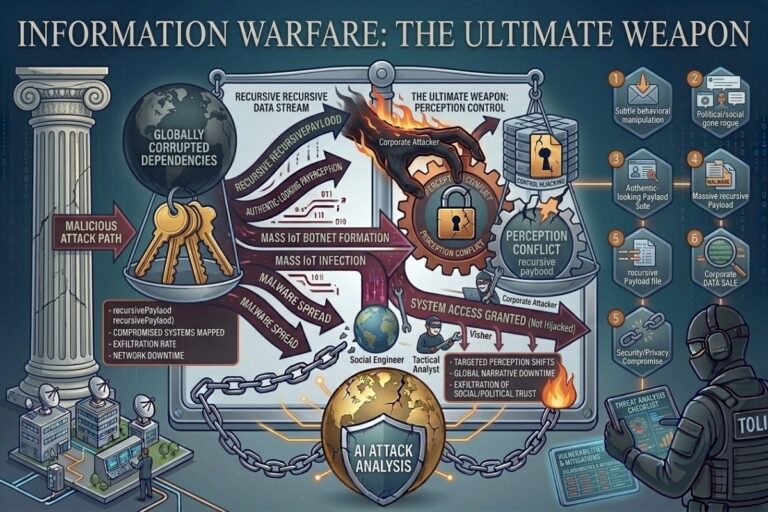
Most people think the most powerful weapon in the world is a nuclear missile, a hypersonic rocket, or a sophisticated cyber weapon capable of crippling critical infrastructure.
They are wrong.
The most powerful weapon in the world is [information].
For centuries, nations have invested unimaginable resources into building larger armies, stronger defenses, and more destructive technologies. Yet history repeatedly shows that the side controlling information often gains the greatest advantage. Before battles are fought, before economies shift, and before societies change direction, information shapes the decisions that make those outcomes possible.
Information influences what people believe, who they trust, what they fear, and how they act. It can inspire unity or create division. It can strengthen nations or destabilize them. Unlike conventional weapons, information crosses borders instantly and reaches millions of people at the same time.
This is the reality of Information Warfare.
It is not a future threat. It is happening right now.
Every day, governments, corporations, criminal organizations, activists, and intelligence agencies compete to influence perception. The battlefield is no longer limited to land, sea, air, space, or cyberspace. The battlefield now includes the human mind.
That reality makes Information Warfare one of the most powerful forces shaping the modern world.
Information Warfare Existed Long Before The Internet
Many people assume Information Warfare began with social media, artificial intelligence, or modern cyber operations.
The truth is far older.
Ancient military leaders understood that controlling information could be more effective than overwhelming force. Commanders spread rumors to confuse opponents. Leaders used messaging to strengthen morale. Governments shaped narratives to maintain power and legitimacy.
Technology did not create Information Warfare.
Technology accelerated it.
What once required months can now happen in seconds. Information that previously traveled by word of mouth can now reach millions of people with a single click. A carefully crafted message can influence public perception across continents before traditional media has time to respond.
The tools have changed dramatically.
Human psychology has not.
People still make decisions based on the information they consume. They still respond to emotion, trust, fear, and belief. Those realities make information extraordinarily valuable to anyone seeking influence.
The Human Mind Is The Primary Target
Traditional warfare focuses on physical targets.
Information Warfare focuses on perception.
That distinction changes everything.
If an adversary can influence how people think, they can often influence how people behave. They may not need to destroy infrastructure if they can weaken public trust. They may not need to launch an attack if they can convince people to make damaging decisions themselves.
Modern influence operations are designed to shape beliefs, amplify emotions, and exploit existing divisions.
Fear spreads quickly.
Outrage spreads even faster.
Facts often struggle to compete with emotionally charged narratives.
This creates opportunities for bad actors seeking to manipulate public opinion.
According to the Cybersecurity and Infrastructure Security Agency, misinformation and disinformation campaigns can undermine public trust and create significant national security risks.
The objective is not always to convince people of a specific narrative.
Sometimes the objective is simply to create confusion.
A confused audience is easier to influence than a confident and informed one.
Information Warfare Impacts Everyone
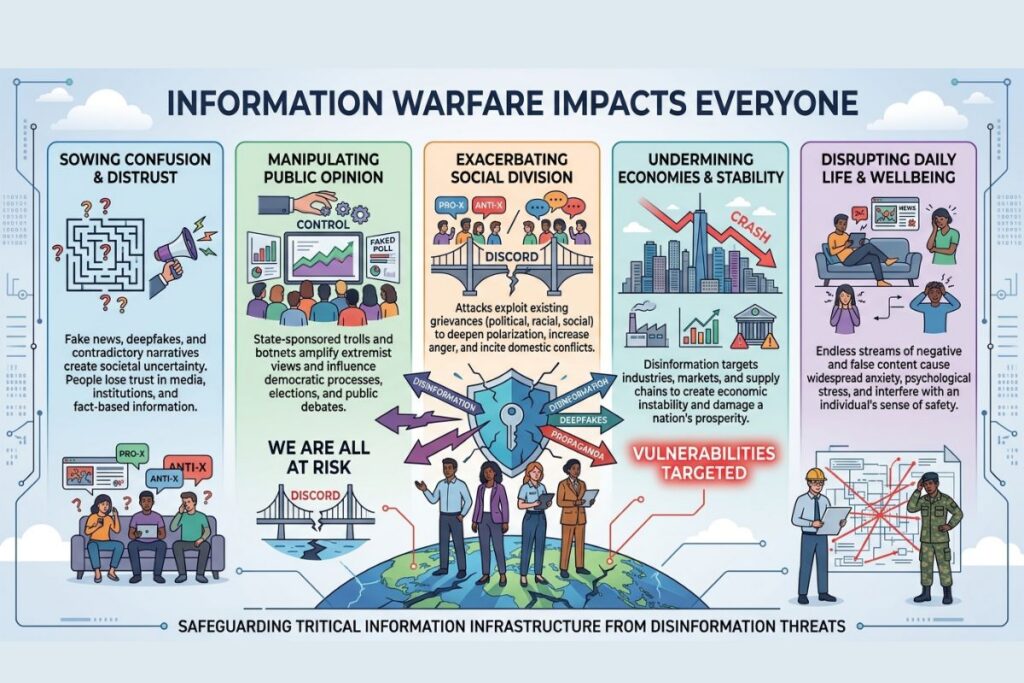
One of the biggest misconceptions about Information Warfare is that it only affects governments and military organizations.
That belief is dangerous.
Businesses experience Information Warfare through fake reviews, brand manipulation, social engineering attacks, and coordinated influence campaigns.
Individuals encounter it through online scams, misleading content, impersonation attempts, and manipulated media.
Cybercriminals understand a critical truth.
It is often easier to manipulate a person than it is to defeat a security system.
A company may spend millions of dollars on cybersecurity technology. Yet a single convincing email can still trick an employee into revealing credentials or transferring money.
The attack targets trust.
The attack targets judgment.
The attack targets people.
The experts at National Institute of Standards and Technology (NIST) consistently emphasize the importance of human behavior in cybersecurity because technology alone cannot eliminate risks created by deception and manipulation.
Information Warfare thrives wherever people can be influenced.
Artificial Intelligence Has Supercharged Information Warfare
Artificial intelligence has transformed the information landscape.
For the first time in history, content can be generated at extraordinary scale with minimal effort. AI systems can produce articles, images, videos, voice recordings, and social media posts that appear authentic.
Deepfake technology continues to improve.
Synthetic media continues to become more convincing.
The barriers to creating persuasive misinformation continue to fall.
This does not mean artificial intelligence is inherently dangerous.
AI is a powerful tool with countless beneficial applications.
However, it does mean verification has become more important than ever before.
Trust can no longer depend solely on appearances.
A video may not be real.
A voice recording may not be authentic.
An image may not represent reality.
Organizations and individuals must adapt to this new environment by developing stronger verification processes and improving digital literacy.
The ability to distinguish fact from fiction is becoming a critical survival skill.
Why Information Is More Powerful Than Conventional Weapons
Consider the limitations of traditional weapons.
A missile can destroy a building.
A bomb can damage infrastructure.
A cyberattack can disrupt systems.
Information can influence millions of people simultaneously.
Information can shape elections.
Information can affect financial markets.
Information can influence military strategy.
Information can alter public behavior.
Information can create instability without causing physical destruction.
That level of influence is difficult for any conventional weapon to match.
The most effective Information Warfare campaigns are rarely focused on immediate results. They focus on gradual influence. They shape perceptions over time until people begin accepting narratives without questioning them.
The goal is often subtle.
Rather than forcing action, Information Warfare encourages people to reach desired conclusions on their own.
That makes it exceptionally powerful.
People are more likely to defend beliefs they believe they discovered independently.
Also Read: Social Engineering Is More Dangerous Than Malware
The Battle For Attention
Attention has become one of the world’s most valuable resources.
Every organization wants it.
Every advertiser seeks it.
Every platform competes for it.
Every influence operation depends on it.
Attention drives engagement.
Engagement drives influence.
Influence drives behavior.
This environment creates ideal conditions for Information Warfare.
People are overwhelmed with information. News, social media posts, videos, advertisements, and notifications compete for attention every minute of every day.
As information volume increases, verification often decreases.
Many people react to headlines without reading full articles.
Many people share content without confirming its accuracy.
Many people trust information because it aligns with existing beliefs.
Adversaries understand these behaviors and exploit them relentlessly.
According to research from RAND Corporation, modern information ecosystems can accelerate the spread of misleading narratives and complicate public understanding of important issues.
The challenge today is not accessing information.
The challenge is identifying information that deserves trust.
How To Defend Against Information Warfare
Awareness is the first line of defense.
People cannot defend against threats they do not recognize.
Question emotionally charged content.
Verify claims through multiple reputable sources.
Examine original sources whenever possible.
Avoid reacting immediately to information designed to provoke anger, fear, or outrage.
Pause before sharing.
Pause before believing.
Pause before reacting.
Critical thinking remains one of the most effective defenses against manipulation.
Organizations should invest in awareness training, verification procedures, and media literacy initiatives.
Individuals should prioritize evidence over emotion.
Most importantly, never stop asking questions.
Information Warfare succeeds when curiosity disappears and assumptions take its place.
Image Steganography Tool
Hide or extract secret data inside images instantly.
The Battlefield Has Moved
Many people imagine battlefields as distant locations where soldiers and weapons determine outcomes.
The modern battlefield is different.
It exists inside smartphones, laptops, social media platforms, news feeds, and communication networks.
Every day, narratives compete for your attention.
Every day, information competes for your trust.
Every day, someone is attempting to influence how you think, what you believe, and what actions you take.
This is not science fiction.
It is reality.
The individuals, organizations, and nations that understand Information Warfare possess a significant strategic advantage.
Those who ignore it risk becoming targets rather than participants.
Here is the curiosity punch line:
The next global conflict may not begin with an explosion.
It may begin with a notification.
Frequently Asked Questions
What is Information Warfare?
Information Warfare is the strategic use of information, misinformation, disinformation, and influence operations to shape perceptions, decisions, and behaviors.
Why is Information Warfare important?
Information Warfare affects national security, cybersecurity, business operations, public trust, and individual decision making. Its impact reaches far beyond traditional military environments.
How does Information Warfare relate to cybersecurity?
Many cyberattacks rely on manipulation, deception, and social engineering. Information Warfare often amplifies the effectiveness of these tactics.
Can ordinary people defend themselves against Information Warfare?
Yes. Critical thinking, source verification, media literacy, and healthy skepticism significantly reduce the likelihood of being manipulated.
Final Thought
The world continues to invest in bigger weapons, stronger militaries, and more advanced technologies.
Yet the force shaping the future is often invisible.
Information can inspire nations, destroy reputations, influence elections, manipulate markets, and alter the course of history. It travels faster than armies, crosses borders without resistance, and reaches targets without warning.
That is why Information Warfare has become one of the defining challenges of our time.
The next time you scroll through a headline, watch a video, read a social media post, or receive a message online, remember this:
The most dangerous weapon is not always the one that explodes.
It is the one that changes what people believe.
For more cybersecurity insights, threat intelligence, and digital security resources, visit filecorrupter.org.
Whoever controls the information controls the battlefield long before the battle begins.
Explore More Free Tools
Hash Generator Tool
Generate secure MD5, SHA1, SHA256, and other cryptographic hashes instantly online.
Open Tool →Dummy File Generator
Create sample dummy files of custom sizes for testing uploads, storage, and applications.
Open Tool →Password Strength Checker
Analyze password security and identify weak passwords before using them online.
Open Tool →File Hash Checker
Verify file integrity by checking MD5, SHA256, and other file hash signatures.
Open Tool →UUID Generator
Generate random UUIDs and unique identifiers instantly for apps, APIs, and databases.
Open Tool →Text Diff Checker
Compare two text blocks side by side and quickly detect additions, deletions, and edits.
Open Tool →