
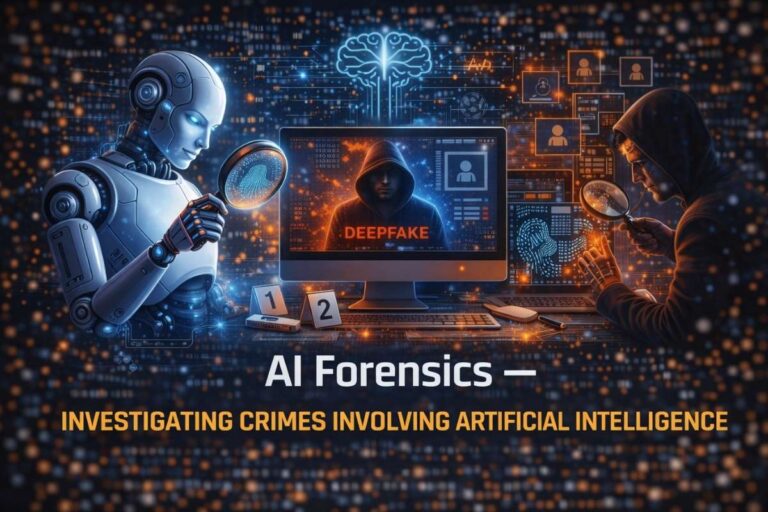
Artificial intelligence has already been involved in criminal activity — the only debate is whether organizations are prepared to investigate it. AI forensics is emerging not as a theoretical discipline, but as a necessary evolution of digital forensics in a world where decisions, actions, and outcomes are increasingly shaped by algorithms.
Traditional digital forensics is grounded in tangible artifacts: logs, files, memory, network traffic. Investigators reconstruct timelines by tracing human interaction with systems. AI changes that model. Decisions may be influenced by training data created years earlier, inference processes that leave minimal traces, or autonomous behavior no single human explicitly approved.
This creates a fundamental shift: investigators are no longer just asking what happened, but why the system behaved the way it did.
AI forensics focuses on examining systems where machine learning models influence outcomes — whether through recommendation engines, autonomous decision-making, or AI-assisted workflows. When harm occurs, investigators must determine whether it was caused by misuse, manipulation, negligence, or emergent behavior. That distinction matters legally, operationally, and ethically.
One of the first challenges in AI forensics is evidence definition. In a traditional breach, evidence is relatively clear. In an AI incident, evidence may include training datasets, model versions, prompt histories, inference outputs, and deployment configurations. Many of these artifacts are ephemeral, overwritten, or never logged at all.
📌 Recommended Reading
Data Chaos Experiments: Corruption, Backups & AutomationChain of custody becomes fragile. If a model is updated automatically, rolled back, or retrained, its prior state may be unrecoverable. If inference logs are disabled for performance or privacy reasons, decision paths disappear. In these scenarios, investigators are left with outcomes but no explainable trail.
AI systems also complicate attribution. Was the harm caused by a malicious actor manipulating inputs? A developer deploying a flawed model? A business decision that prioritized speed over validation? Or an AI system operating within its parameters but producing unintended consequences? AI forensics must navigate technical causality and organizational accountability simultaneously.
Another challenge is context loss. AI models do not store intent. They store patterns. Understanding why a system behaved a certain way requires reconstructing context across data sources, configuration changes, and environmental inputs. This is far more complex than tracing a user action or malicious payload.
Organizations often assume AI incidents can be investigated after the fact. This assumption is dangerous. Forensics requires preparation. Logging, version control, access records, and governance must be in place before an incident occurs. Without forensic readiness, AI systems become black boxes that fail silently and explain nothing.
Regulatory pressure is accelerating this reality. As AI systems influence hiring, lending, healthcare, and security decisions, investigators will be expected to explain outcomes. “The model decided” will not be an acceptable answer. AI forensics will sit at the intersection of cybersecurity, compliance, and legal defense.
Importantly, AI forensics is not anti-AI. It is pro-accountability. Organizations that deploy AI without the ability to investigate its failures are assuming invisible risk. When incidents occur — and they will — the inability to reconstruct events becomes a liability multiplier.
AI forensics demands a mindset shift. Investigators must think beyond endpoints and logs. They must treat models as dynamic actors, data as historical influence, and governance as part of the evidence trail. This is unfamiliar territory for many security teams — and that gap is already being exposed.
The question is no longer whether AI will be involved in investigations. The question is whether organizations will be ready to explain what their AI did, why it did it, and who is responsible when it causes harm.
Final Thought
AI systems do not remove accountability — they redistribute it. When organizations deploy intelligence they cannot investigate, they are not innovating; they are gambling. AI forensics exists to ensure that when intelligence is questioned, answers exist — not excuses.
Q&A
Q: What is AI forensics?
A: AI forensics is the investigation of incidents involving artificial intelligence systems, focusing on model behavior, data influence, and decision outcomes.
Q: How is AI forensics different from digital forensics?
A: Traditional forensics focuses on static artifacts and human actions, while AI forensics must analyze dynamic models, training data, and automated decision processes.
Q: Why is AI forensics becoming important now?
A: Because AI systems increasingly influence critical decisions, and organizations must be able to explain outcomes to regulators, courts, and stakeholders.
Q: Can AI incidents be investigated without preparation?
A: Rarely. Without logging, versioning, and governance controls, forensic reconstruction becomes incomplete or impossible.
😄 Cyber Joke
Why did the AI criminal get arrested?
Because it left a machine learning trail! 😄