
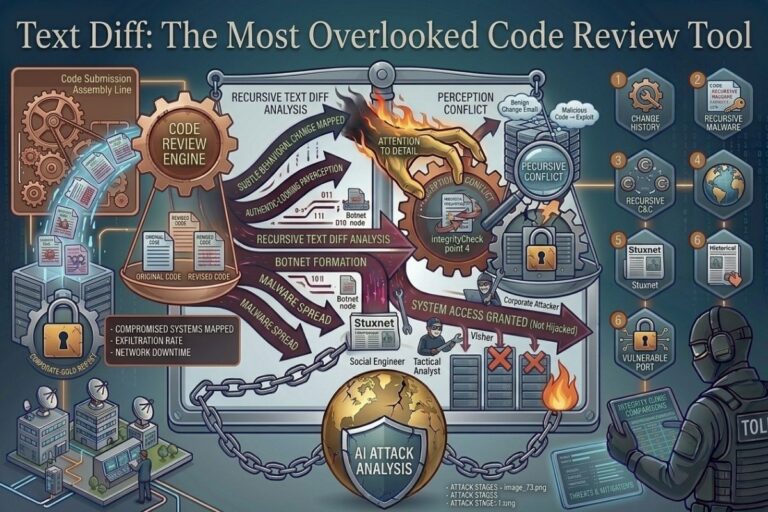
Every software disaster starts with a change.
Not a massive rewrite. Not a complete system overhaul. A change.
Sometimes it is a single line. Sometimes it is one deleted character. Sometimes it is a configuration value that looked harmless during review but created a security gap large enough for attackers to exploit.
That is why a text diff checker for code review remains one of the most important tools in software development. While developers often focus on frameworks, automation platforms, and AI powered coding assistants, the simple act of comparing changes between versions continues to be one of the most effective ways to improve quality and reduce risk.
The reality is straightforward. Developers do not review entire codebases. They review changes. A text diff tool allows those changes to become visible, understandable, and actionable.
The question is not whether developers should use text diff tools.
The question is why so many teams underestimate their importance.
What Is a Text Diff?
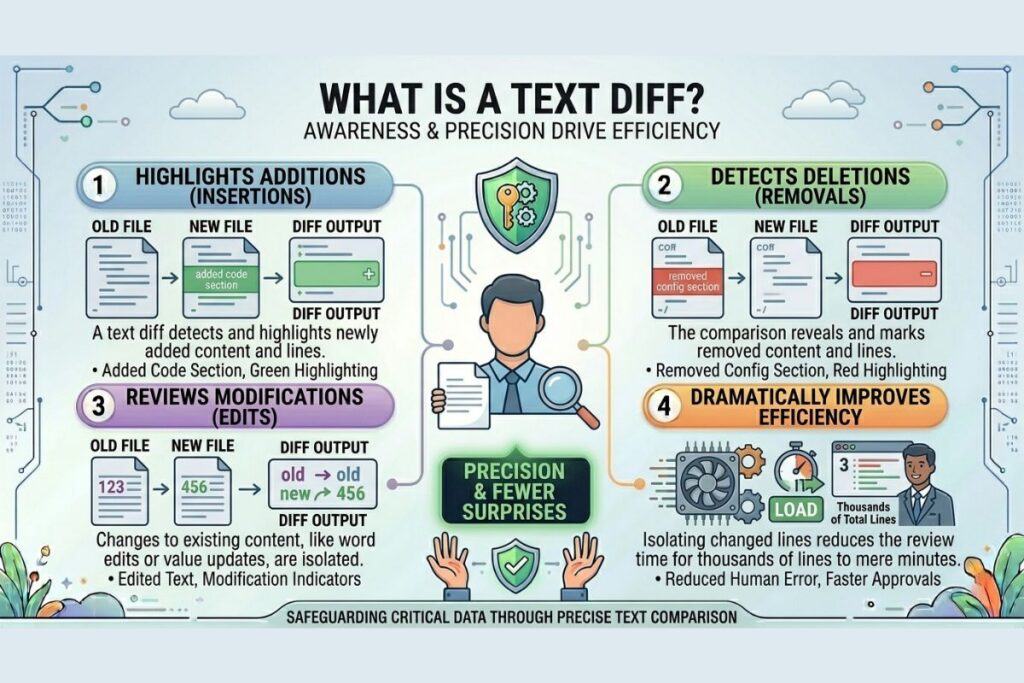
A text diff is a comparison between two versions of a file. It highlights additions, deletions, and modifications so reviewers can quickly identify what changed.
Instead of manually comparing hundreds or thousands of lines, a text diff checker isolates the exact areas that require attention.
Imagine reviewing a file containing 2,000 lines of code.
Without a diff, you must search through the entire file hoping to notice modifications.
With a diff, only the changed lines appear in front of you.
That simple concept dramatically improves efficiency while reducing the likelihood of human error.
Why Code Reviews Depend on Text Diff
Modern development moves fast.
Features are deployed continuously. Bugs are fixed daily. Security patches are released under pressure. Teams collaborate across multiple locations and time zones.
Under these conditions, reviewing every file from beginning to end is impossible.
A text diff checker for code review solves this problem by narrowing the reviewer’s focus to what actually matters.
Reviewers can immediately see:
- New code additions
- Removed functionality
- Configuration changes
- Modified logic
- Updated dependencies
- Security related alterations
This targeted visibility makes code reviews faster and more accurate.
More importantly, it helps reviewers identify risks before they reach production environments.
Use Our Free Tool: Text Diff Checker – Compare Text Online Instantly
Small Changes Create Big Problems
One of the biggest misconceptions in software development is that large changes create the greatest risk.
In reality, some of the most damaging incidents originate from tiny modifications.
A misplaced comparison operator can alter authentication logic.
A deleted validation check can create an injection vulnerability.
A modified access control rule can expose sensitive information.
A changed configuration value can bring down an entire application.
These changes often look insignificant at first glance.
A text diff exposes them.
Without a clear view of modifications, dangerous changes can blend into the surrounding code and escape review entirely.
The Security Value of Text Diff
Cybersecurity professionals understand a simple truth.
Attackers exploit what defenders overlook.
That principle applies directly to code reviews.
Many security vulnerabilities originate during development rather than after deployment. Weak validation, poor authentication controls, insecure configurations, and unsafe dependency changes frequently begin as ordinary code updates.
A text diff checker helps security teams identify:
- Authorization changes
- Authentication modifications
- Input validation updates
- Encryption related adjustments
- Dependency updates
- Logging changes
- Configuration alterations
These areas often represent high value targets for attackers.
By focusing attention on modified sections, reviewers can assess whether a change introduces unnecessary risk.
This is one reason secure development programs consistently emphasize thorough review processes alongside automated security testing.
For additional secure coding guidance, developers can review resources from OWASP.
Why Humans Miss Changes
Developers are skilled problem solvers.
They are not perfect observers.
Human attention naturally declines when reviewing large volumes of information.
As files become longer and projects become more complex, identifying subtle modifications becomes increasingly difficult.
This phenomenon creates what security professionals often call review fatigue.
The reviewer may genuinely believe they inspected the change thoroughly.
In reality, important details may have escaped notice.
A text diff reduces cognitive load.
Instead of processing everything, the reviewer processes only what changed.
That reduction in complexity improves accuracy and increases the likelihood that important issues will be detected.
Also Read: The File Integrity Check Most People Skip
Text Diff and Team Collaboration
Software development is rarely a solo activity.
Teams collaborate constantly through pull requests, commits, and review cycles.
A text diff creates a shared understanding of changes.
Developers can discuss specific modifications rather than entire files.
Review comments become more precise.
Feedback becomes more actionable.
Approval decisions become more informed.
This transparency improves communication while reducing misunderstandings.
In many organizations, text diff tools serve as the foundation of the entire review process.
Platforms such as Git rely heavily on diff based workflows because they provide a practical way to manage collaborative development at scale.
Catching Bugs Before They Become Expensive
Software defects become more costly as they move through the development lifecycle.
A bug identified during review might take minutes to fix.
The same bug discovered in production could require hours of investigation, emergency patches, customer communication, and reputational recovery.
Text diff analysis helps shift detection earlier.
Reviewers can identify:
- Logic errors
- Unintended deletions
- Broken conditions
- Incorrect variable assignments
- Missing safeguards
- Faulty configurations
Finding these issues before deployment saves both time and money.
Organizations that prioritize effective review processes often experience lower maintenance costs and improved software reliability.
The Rise of AI Does Not Replace Text Diff
Artificial intelligence is transforming software development.
AI assistants can generate code, identify bugs, and recommend improvements.
Despite these advances, text diff remains essential.
Why?
Because AI generated code still introduces changes.
Those changes must still be reviewed.
Whether a line of code originates from a human developer or an AI system, reviewers need visibility into what changed and why.
A text diff provides that visibility.
In many cases, AI actually increases the importance of review processes because larger volumes of code can be produced more quickly.
The faster code is generated, the more critical it becomes to review modifications carefully.
Choosing a Text Diff Checker for Code Review
Not all tools offer the same capabilities.
When evaluating a text diff checker for code review, consider features such as:
- Clear visual highlighting
- Side by side comparison
- Version tracking
- Collaboration support
- Large file handling
- Integration with development workflows
- Security and privacy protections
The goal is not simply to compare files.
The goal is to make changes obvious enough that reviewers can understand them immediately.
Even the most advanced development environment loses value if reviewers cannot clearly see what has changed.
Developers interested in traditional comparison utilities can also explore GNU Diffutils.
Why This Matters More Than Ever
Software now powers critical infrastructure, healthcare systems, financial services, transportation networks, and communication platforms.
The consequences of overlooked changes have never been greater.
A missed modification can lead to:
- Data breaches
- Service outages
- Financial losses
- Compliance violations
- Reputation damage
As development cycles accelerate, the ability to review changes efficiently becomes increasingly important.
Text diff tools may not generate headlines.
They may not attract the same attention as artificial intelligence platforms or cutting edge frameworks.
Yet they continue to perform one of the most important functions in software development.
They reveal what changed.
And in cybersecurity, visibility is everything.
FAQs
What is a text diff checker for code review?
A text diff checker for code review compares two versions of a file and highlights additions, deletions, and modifications. This helps developers review changes quickly and accurately.
Why are text diff tools important for security?
They help reviewers identify changes that may introduce vulnerabilities, weaken security controls, or alter sensitive configurations before code reaches production.
Can a text diff checker find bugs automatically?
Most diff tools focus on showing changes rather than detecting bugs. However, they help reviewers locate potential problems much faster by highlighting modified sections.
Do AI coding tools eliminate the need for text diff reviews?
No. AI generated code still requires review. Text diff tools remain essential because they show exactly what was added, removed, or modified.
Final Thought
The most dangerous software changes are rarely the obvious ones.
They are the changes nobody noticed.
A single line can introduce a vulnerability. One deleted condition can break security. One overlooked modification can trigger an outage that costs thousands or even millions of dollars.
That is why the humble text diff remains one of the most powerful tools in software development.
It does not write code. It does not generate headlines. It does not promise revolutionary innovation.
It simply shows the truth.
And when it comes to code reviews, seeing the truth is often the difference between shipping secure software and creating tomorrow’s incident report.
The next major bug in a software project may already exist. The only question is whether someone notices the change before it goes live.
Explore more cybersecurity insights at FileCorrupter.org.
Explore More Free Tools
Hash Generator Tool
Generate secure MD5, SHA1, SHA256, and other cryptographic hashes instantly online.
Open Tool →Dummy File Generator
Create sample dummy files of custom sizes for testing uploads, storage, and applications.
Open Tool →Password Strength Checker
Analyze password security and identify weak passwords before using them online.
Open Tool →File Hash Checker
Verify file integrity by checking MD5, SHA256, and other file hash signatures.
Open Tool →UUID Generator
Generate random UUIDs and unique identifiers instantly for apps, APIs, and databases.
Open Tool →Text Diff Checker
Compare two text blocks side by side and quickly detect additions, deletions, and edits.
Open Tool →