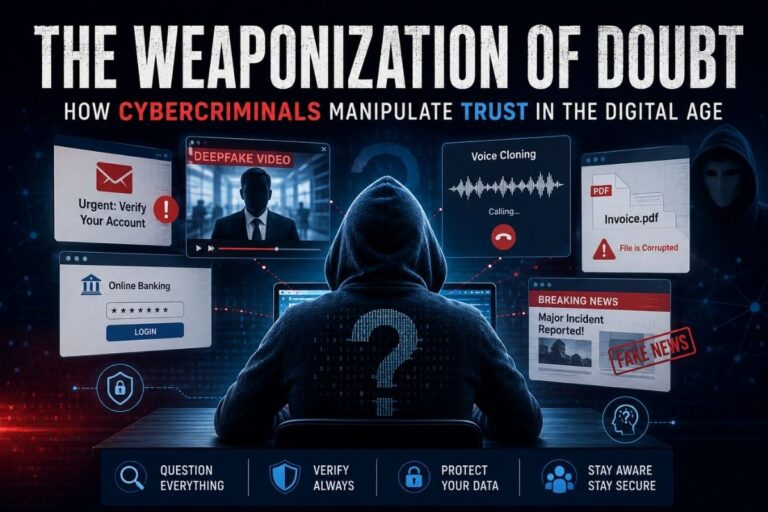
Not long ago, cybercrime was largely associated with viruses, ransomware, and stolen passwords. If you kept your antivirus software updated and avoided suspicious downloads, you were considered reasonably safe online. Today, the threat landscape has changed dramatically. Cybercriminals no longer focus solely on attacking computers—they increasingly target something far more vulnerable: human trust.
Modern cyberattacks are often designed to make people question what is real. A convincing email that appears to come from your bank, a video of a CEO making an announcement that never happened, or a phone call that perfectly mimics a family member’s voice can all create uncertainty. Instead of forcing their way into systems, attackers manipulate emotions and decision-making.
This strategy is known as the weaponization of doubt. Rather than persuading someone with an obvious lie, cybercriminals create just enough uncertainty that victims make mistakes on their own. A moment of hesitation, fear, or urgency can be enough to convince someone to click a malicious link, transfer money, reveal sensitive information, or download an infected file.
The rise of artificial intelligence has made these attacks even more convincing. AI tools can generate realistic emails, clone voices, create lifelike images, and produce deepfake videos in minutes. As a result, distinguishing between genuine and fake digital content has become increasingly difficult.
The consequences extend far beyond financial fraud. Businesses lose millions of dollars to phishing attacks, organizations suffer reputational damage from misinformation, and individuals become victims of identity theft because they trusted something that looked authentic.
Understanding how doubt is deliberately created is becoming just as important as understanding malware or ransomware. In today’s digital world, cybersecurity is no longer only about protecting devices—it is also about protecting your ability to recognize truth from deception.
In this article, we’ll explore what the weaponization of doubt means, how cybercriminals manipulate trust, why AI has made these attacks more dangerous, and what practical steps individuals and organizations can take to defend themselves.
What Is the Weaponization of Doubt?
The phrase “weaponization of doubt” describes the deliberate use of uncertainty, confusion, and misinformation to influence people’s decisions. Instead of convincing someone that a false statement is unquestionably true, the goal is often much simpler: make them uncertain enough that they hesitate, make poor decisions, or lose confidence in reliable information.
Imagine receiving two emails within a few minutes. The first appears to come from your bank and warns that suspicious activity has been detected on your account. Shortly afterward, you receive another message claiming the first email was fraudulent and directing you to a different website for verification.
Which one is genuine?
Many people would hesitate. That moment of uncertainty is exactly what attackers want. Once doubt replaces confidence, victims are more likely to click links, provide personal information, or make rushed decisions.
In cybersecurity, this tactic is especially powerful because people often rely on instinct when they feel pressured. Attackers understand this and design their campaigns to create confusion rather than certainty.
Also Read: Corrupted File vs Damaged Storage: What’s the Difference?
Doubt Is Often More Effective Than Lies
At first glance, spreading false information and creating doubt may seem like the same thing, but they work differently.
A direct lie attempts to convince someone of a specific falsehood. If the lie is poorly constructed or easily disproved, it quickly loses its effectiveness.
Creating doubt is different. It doesn’t require people to believe something entirely false. Instead, it encourages them to question information they would normally trust.
For example:
- Is this email really from my employer?
- Is this payment request genuine?
- Did my colleague actually send this attachment?
- Is this news article authentic?
- Is this video real or AI-generated?
When people cannot confidently answer these questions, attackers gain an advantage.
Why Cybercriminals Use Doubt
Cybercriminals have learned that exploiting human psychology is often easier than exploiting software vulnerabilities.
Breaking into a secure computer network may require advanced technical skills, expensive tools, and weeks of planning.
Convincing someone to voluntarily reveal their password through a convincing phishing email can take only a few minutes.
By creating uncertainty, attackers encourage victims to bypass their usual caution.
Someone who would normally verify an email may skip the verification because they fear their account will be locked. An employee who usually confirms payment requests may rush to complete a transaction because the message appears urgent.
In many successful cyberattacks, technology plays only a supporting role. The primary target is human judgment.
Why Doubt Is Such a Powerful Cyber Weapon
Cybersecurity experts often describe people as the weakest link in security—not because they lack intelligence, but because humans naturally rely on emotions, experience, and trust when making decisions.
Cybercriminals understand these psychological patterns remarkably well.
Rather than attempting to defeat sophisticated security systems, they focus on influencing the person sitting behind the keyboard.
Doubt Slows Decision-Making
Imagine receiving an email stating that your company’s cloud storage account has been compromised.
You don’t immediately know whether the message is genuine.
Should you ignore it?
Should you report it?
Should you change your password?
Should you click the provided verification link?
During those few moments of uncertainty, attackers hope you’ll choose the quickest option rather than the safest one.
Many phishing campaigns succeed because victims act before they have enough information.
Doubt Weakens Trust
Trust is essential for almost every online interaction.
We trust:
- Banking websites
- Government portals
- Online shopping platforms
- Workplace communication tools
- Email providers
- Cloud storage services
Once attackers begin impersonating these trusted organizations, people start questioning whether any communication is genuine.
Over time, this erosion of trust creates confusion that benefits cybercriminals.
Ironically, even legitimate security warnings may eventually be ignored because users become overwhelmed by uncertainty.
Doubt Creates Emotional Pressure
Fear is one of the strongest motivators in cybercrime.
Messages such as:
- “Your account will be suspended.”
- “Unauthorized login detected.”
- “Payment failed.”
- “Tax refund pending.”
- “Immediate verification required.”
are designed to trigger anxiety.
When emotions take control, logical thinking often takes a back seat.
Instead of carefully examining the email address or website, victims focus on resolving the perceived problem as quickly as possible.
Doubt Encourages Impulsive Actions
Most people know they shouldn’t click suspicious links.
Yet thousands do so every day.
Why?
Because attackers create situations where waiting feels riskier than acting.
If someone believes their salary payment is delayed, their business account has been compromised, or their family member is in danger, they are far more likely to respond immediately.
Cybercriminals understand that urgency reduces careful thinking.
The less time victims spend verifying information, the greater the chances of a successful attack.
Use Our Tools – Intentionally Corrupt Files
Corrupt PDF File Online Create damaged PDF files for testing and recovery purposes.
Corrupt Word File Online Intentionally corrupt DOC and DOCX files for software testing.
PDF Corruption Tool Generate corrupted PDF documents directly in your browser.
How Cybercriminals Manipulate Trust
Trust is one of the most valuable assets in the digital world. Every online transaction, email conversation, cloud service, and financial payment depends on the assumption that the person or organization on the other end is genuine.
Cybercriminals exploit this assumption. Instead of breaking trust directly, they imitate it so convincingly that victims lower their guard without realizing they’re interacting with an attacker.
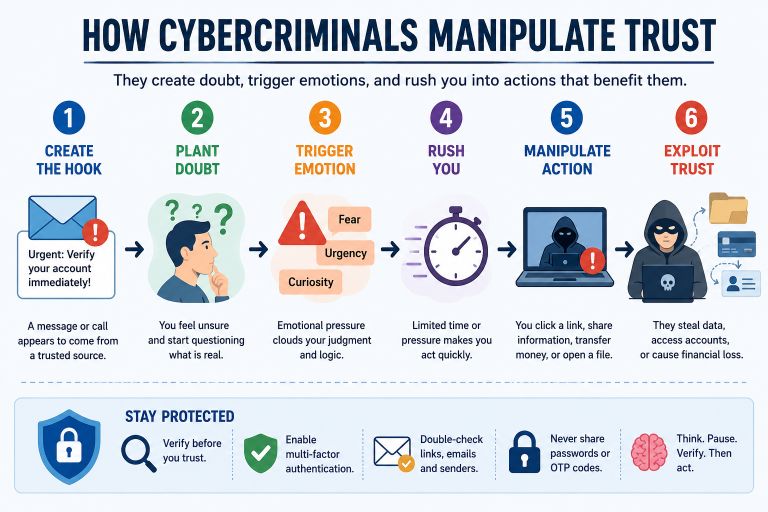
Over the years, these techniques have evolved from poorly written scam emails to highly personalized attacks powered by artificial intelligence. Today, manipulating trust has become one of the most effective strategies in cybercrime.
Phishing Emails
Phishing remains one of the most successful cyberattack methods because it targets human behavior rather than technical weaknesses.
Attackers send emails that appear to come from trusted organizations such as banks, delivery companies, government agencies, cloud service providers, or employers.
Common examples include:
- Password reset requests
- Account verification notices
- Fake invoices
- Tax refund notifications
- Package delivery updates
- Payroll messages
The emails often look authentic, complete with company logos, branding, and professional language.
The goal is simple: convince the recipient to click a malicious link, download an infected attachment, or provide sensitive information.
AI-Generated Phishing Emails
Traditional phishing emails were often easy to identify. They contained spelling mistakes, awkward grammar, and generic greetings like “Dear Customer.” As cybersecurity awareness improved, people became better at spotting these warning signs.
Artificial intelligence has changed that.
Modern AI tools can generate emails that read like they were written by a native speaker. They can adapt the tone, structure, and vocabulary to match a specific organization, making fraudulent messages far more convincing.
Imagine receiving an email that appears to come from your company’s HR department. It addresses you by name, mentions your recent promotion, references your department, and asks you to review an updated employee handbook. Every detail feels familiar, leaving little reason to question its authenticity.
In reality, the email was generated automatically using publicly available information gathered from professional networking sites, company websites, and social media profiles.
Because these emails are personalized and professionally written, employees are far more likely to trust them than the obvious phishing attempts of the past.
Deepfake Videos
Video has traditionally been considered one of the strongest forms of evidence. Seeing someone speak on camera naturally creates confidence that the event actually happened.
Deepfake technology challenges that assumption.
Using artificial intelligence, attackers can generate realistic videos that closely imitate a person’s facial expressions, voice, and mannerisms. While creating a convincing deepfake once required specialized knowledge and significant computing power, today’s AI tools have made the process faster and more accessible.
Imagine a company’s CEO appearing in a video announcing a major restructuring, a new investment opportunity, or an urgent financial decision. Employees who watch the video may have little reason to suspect it isn’t genuine.
Even if the deception is uncovered later, the initial confusion can lead to poor decisions, financial losses, or reputational damage.
The real danger isn’t just that people believe the fake video—it’s that they begin questioning every legitimate video they see afterward.
AI Voice Cloning
Human voices have long been associated with identity. Hearing the familiar voice of a family member, colleague, or manager often creates an immediate sense of trust.
AI voice cloning takes advantage of this instinct.
With only a short audio sample, modern AI systems can generate speech that closely resembles a person’s voice. Attackers have used this technology in scams involving emergency requests, financial transfers, and fake customer support calls.
Consider a finance manager who receives a call that sounds exactly like the company’s CEO. The caller explains that an urgent payment must be completed before the end of the day to secure an important business deal.
The request sounds genuine. The voice is familiar. The urgency feels real.
Without taking a moment to verify the request through another communication channel, the employee authorizes the payment—only to discover later that the call came from a criminal using AI-generated speech.
This type of fraud demonstrates that trust based solely on recognition is no longer sufficient.
Fake Websites
One of the oldest techniques in cybercrime remains one of the most effective.
Attackers create websites that closely resemble legitimate services such as banks, online retailers, government portals, or cloud platforms. These fake websites often copy logos, colors, layouts, and branding so accurately that many users fail to notice the difference.
The only clue may be a slightly altered web address.
For example:
- A missing letter
- An extra character
- A different domain extension
- A subtle spelling variation
Visitors who overlook these details may enter usernames, passwords, payment information, or personal data directly into an attacker’s system.
Modern AI tools have made building convincing fake websites easier than ever. Within minutes, criminals can replicate the appearance of trusted services and distribute links through email, text messages, or social media.
Manipulated Documents
Not every cyberattack involves malicious software.
Sometimes, attackers simply alter documents to influence decisions.
Examples include:
- Edited invoices requesting payment to a fraudulent bank account.
- Modified contracts containing hidden changes.
- Fake employment offer letters.
- Forged tax documents.
- Altered screenshots used to support false claims.
At first glance, these documents appear perfectly legitimate. Company logos, formatting, signatures, and branding often look authentic.
Because people naturally trust professionally presented documents, they may not question their accuracy until it’s too late.
Whenever sensitive decisions depend on digital documents, verifying the source and authenticity is essential.
Corrupted File Scams
Corrupted files can also be used as part of a broader social engineering attack.
Imagine receiving an invoice from a supplier you’ve worked with for years. When you try to open the attached PDF, an error message appears stating that the file is damaged.
You reply and request another copy.
A few minutes later, you receive a second email apologizing for the “technical problem” and attaching a replacement file.
This time, however, the attachment contains malware or links to a malicious download.
Because you’ve already interacted with the sender and requested a replacement, your level of trust has increased. The attacker uses the initial corrupted file to establish credibility before delivering the real payload.
This technique demonstrates that cybercriminals don’t always rely on sophisticated hacking. Sometimes they manipulate expectations and routine business processes to lower a victim’s defenses.
Also Read: Corrupted File vs Damaged Storage: What’s the Difference?
The Psychology Behind Digital Manipulation
Technology enables cyberattacks, but psychology makes them successful.
Cybercriminals spend considerable time studying how people think, react under pressure, and make decisions. Rather than targeting software vulnerabilities alone, they exploit predictable patterns in human behavior.
Understanding these psychological triggers makes it easier to recognize manipulation before it leads to a costly mistake.
Authority Bias
People naturally trust individuals and organizations they perceive as authoritative.
Messages appearing to come from:
- Employers
- Banks
- Government agencies
- Technology companies
- Law enforcement
- Educational institutions
receive less scrutiny than messages from unknown senders.
Attackers frequently impersonate these trusted entities because authority encourages compliance.
Fear
Fear reduces critical thinking.
Messages claiming that an account will be suspended, legal action is pending, or confidential data has been exposed are designed to create anxiety.
When people feel threatened, they often prioritize immediate action over careful verification.
Urgency
Urgency is another common tactic.
Attackers frequently include phrases such as:
- “Immediate action required.”
- “Your account expires today.”
- “Respond within 30 minutes.”
- “Final notice.”
Artificial deadlines discourage people from slowing down and checking whether the request is genuine.
Curiosity
Curiosity can be just as powerful as fear.
Unexpected messages like:
- “Confidential salary report”
- “Your interview results”
- “Private photos”
- “Updated employee list”
encourage recipients to open attachments or click links simply to satisfy their curiosity.
Social Proof
People often assume something is safe because others appear to trust it.
Cybercriminals exploit this tendency by claiming:
- Thousands of customers have already updated their accounts.
- Other employees have completed the requested action.
- Many users have verified their information.
The implication is that if everyone else is doing it, it must be legitimate.
Familiarity
The more familiar something appears, the less likely people are to question it.
Using company logos, employee names, email signatures, or references to recent events creates a false sense of authenticity.
Attackers know that people rarely verify information that feels routine.
Real-Life Examples of the Weaponization of Doubt
The concept of the weaponization of doubt becomes much easier to understand when viewed through everyday situations. In many cases, the attack succeeds not because the technology is advanced, but because uncertainty influences the victim’s decisions.
Example 1: The Fake Bank Security Alert
A customer receives an email stating that unusual activity has been detected on their bank account. The message includes official branding, a convincing logo, and a warning that online banking access will be suspended unless the account is verified immediately.
Concerned about losing access to their funds, the customer clicks the link and enters their login credentials on a fraudulent website.
The attacker never needed to break into the bank’s systems. They simply created enough doubt for the victim to act without verification.
Example 2: The AI Voice Call
Late one afternoon, an employee in the finance department receives a phone call from someone who sounds exactly like the company’s managing director.
The caller explains that an urgent payment must be processed before the banks close for the day.
The employee recognizes the voice and wants to be helpful, but something feels slightly unusual. Instead of authorizing the transfer immediately, they end the call and verify the request through the company’s internal messaging system.
The managing director confirms they never made the call.
A simple verification step prevented a potentially significant financial loss.
Example 3: The Deepfake CEO Announcement
On a Monday morning, employees at a multinational company notice a video circulating in their internal chat groups. In the video, the CEO appears to announce a major restructuring plan that includes layoffs, office closures, and immediate changes to company policies.
The video looks authentic. The voice matches the CEO’s, the facial expressions appear natural, and the company’s logo is displayed in the background.
Within hours, employees begin discussing the announcement, managers receive concerned phone calls, and rumors spread across social media.
Later that day, the company confirms that the video was entirely AI-generated.
Although the truth eventually emerged, the damage had already been done. Employee morale suffered, customers questioned the company’s stability, and journalists began requesting official statements.
The attackers never needed to access the company’s network. They simply created doubt that disrupted normal business operations.
Example 4: The Fake Job Offer
Rohan had been searching for a new job for several months when he received an email from what appeared to be a well-known technology company.
The message congratulated him on being shortlisted and invited him to complete the final verification process. It included a professionally designed offer letter, company branding, and links to a website that looked almost identical to the organization’s official careers page.
Excited by the opportunity, Rohan uploaded copies of his identity documents, updated his personal information, and paid a small “background verification fee.”
A week later, he discovered that the company had never contacted him.
The attackers had created an entire recruitment process using fake websites, forged documents, and convincing communication. The scam succeeded because everything appeared trustworthy.
Example 5: The Corrupted Invoice
A purchasing manager receives an invoice from a long-term supplier. When attempting to open the attached PDF, the document displays an error indicating that the file is damaged.
The manager replies, asking for another copy.
A few minutes later, a second email arrives with an apology for the “technical issue” and includes a replacement attachment.
Because the manager expected the follow-up email, there is little reason to question it. This time, however, the attachment contains malware that silently installs itself on the company computer.
The initial corrupted file wasn’t the real attack—it was used to establish trust and make the second message appear legitimate.
This type of social engineering demonstrates how attackers combine technical tactics with human psychology.
Example 6: Fake Customer Support
After experiencing login problems, a user searches online for customer support for a popular cloud storage service.
Among the search results is a website that closely resembles the official support page. The phone number listed connects the user to someone claiming to be a technical support representative.
The representative politely explains that the account needs immediate verification and asks the user to install remote access software so they can “resolve the issue.”
Believing they are speaking with genuine support staff, the user grants remote access to their computer.
Within minutes, sensitive documents, saved passwords, and financial information have been copied.
The attacker didn’t exploit a software vulnerability. They exploited trust.
How AI Is Accelerating the Weaponization of Doubt
Artificial intelligence has dramatically changed the scale and sophistication of cybercrime.
What once required teams of experienced attackers can now be automated using AI-powered tools capable of generating convincing text, images, audio, and video within minutes.
This doesn’t mean AI itself is dangerous. Like many technologies, it can be used for both beneficial and harmful purposes. The concern lies in how cybercriminals are adopting AI to make deception more convincing and more difficult to detect.
AI Can Personalize Attacks
Traditional phishing campaigns often relied on sending the same email to thousands of recipients.
AI enables attackers to tailor messages to specific individuals by incorporating details gathered from public sources, such as professional profiles, company websites, or social media posts.
An email that references your job title, recent conference attendance, or employer is naturally more convincing than a generic message.
Fake Content Can Be Produced at Scale
Creating realistic fake documents, images, or videos once required significant time and technical expertise.
Today, AI tools can generate large volumes of convincing content quickly.
This allows attackers to launch campaigns targeting many organizations simultaneously while maintaining a high level of realism.
Language Barriers Are Disappearing
Older phishing emails were often filled with grammatical errors and awkward wording.
Modern AI writing tools produce clear, professional communication in multiple languages.
As a result, poor grammar is no longer a reliable indicator of fraud.
Voice and Video Are No Longer Reliable Proof
For many years, hearing someone’s voice or seeing them on video was considered strong evidence of authenticity.
AI-generated voices and deepfake videos challenge that assumption.
Organizations increasingly recognize that sensitive requests should never rely solely on voice recognition or video appearances. Independent verification has become essential.
AI Increases Speed
Cybercriminals can now generate thousands of customized emails, fake websites, support conversations, and fraudulent documents within a short period.
This speed allows attacks to evolve rapidly and adapt to current events, making them harder to anticipate.
Who Is Most at Risk?
No individual or organization is completely immune to cyber threats because modern life depends heavily on digital technology. Anyone who uses online banking, shops online, communicates through email, or spends time on social media can become a target of cybercriminals attempting to manipulate trust. However, the level of risk often depends on the type of information being handled, the security measures in place, and the value attackers see in a potential victim.
Individuals are frequently targeted through phishing emails, fake websites, fraudulent messages, and social engineering attacks designed to steal passwords, financial information, or personal data. Small businesses also face significant risks because they often lack dedicated cybersecurity teams and advanced security infrastructure, making them attractive targets for business email compromise, ransomware, and financial fraud.
Large enterprises remain high-value targets due to the enormous amount of sensitive customer information, intellectual property, and financial transactions they manage every day. Government agencies face persistent attacks aimed not only at stealing confidential information but also at spreading disinformation, disrupting public services, and undermining trust in public institutions. Educational institutions are similarly vulnerable because they support thousands of students, faculty members, and staff while storing extensive personal and research data across large, decentralized networks.
Healthcare organizations continue to be among the most targeted sectors because hospitals and medical providers rely on uninterrupted access to patient records and critical digital systems. A successful cyberattack can delay medical treatment, expose sensitive health information, and create life-threatening situations. Financial institutions also remain constant targets since banks, payment processors, and investment firms manage valuable financial assets, making them attractive to cybercriminals seeking immediate monetary gain through fraud, account takeovers, or sophisticated social engineering campaigns.
Ultimately, the greatest risk is not limited to a specific industry or profession. Any person or organization that relies on digital communication, stores valuable information, or conducts financial transactions online can become a target if adequate cybersecurity awareness and protective measures are not in place.
Warning Signs That Someone Is Trying to Manipulate You
Cybercriminals rely on patterns that repeat across many attacks. Learning to recognize these warning signs can significantly reduce your risk.
Be cautious if you notice any of the following:
- Unexpected requests for urgent action.
- Emails creating fear or panic.
- Attachments you were not expecting.
- Links that don’t match the sender’s official website.
- Requests for passwords or verification codes.
- Messages claiming unusual payment instructions.
- Generic greetings instead of your name.
- Slightly misspelled domain names.
- QR codes asking you to log in immediately.
- Voice calls requesting confidential information without prior notice.
- Messages that discourage independent verification.
- Documents that seem unusually confidential or unexpected.
None of these signs automatically indicate fraud, but they should encourage you to slow down and verify the information before responding.
How to Protect Yourself from Trust-Based Cyber Attacks
Cybercriminals are constantly refining their techniques, but the good news is that many attacks can be prevented through simple habits. While no security measure offers complete protection, combining awareness with good cybersecurity practices significantly reduces the chances of becoming a victim.
Verify Before You Trust
One of the most effective defenses is also one of the simplest: never act solely on first impressions.
If you receive an unexpected email requesting sensitive information, a payment, or a file download, pause before responding. Verify the request through an independent communication channel.
For example:
- Call the sender using a trusted phone number.
- Contact your bank through its official website or mobile app.
- Confirm payment requests with your finance team.
- Ask your colleague directly if they actually sent the attachment.
Taking a few extra minutes to verify information can prevent costly mistakes.
Enable Multi-Factor Authentication (MFA)
Passwords alone are no longer enough.
If an attacker steals your password through phishing or another scam, multi-factor authentication adds another layer of protection by requiring a second verification step.
Although MFA isn’t foolproof, it makes unauthorized account access much more difficult.
Examine Websites Carefully
Before entering login credentials or payment information, look closely at the website.
Check:
- The domain name
- HTTPS encryption
- Company branding
- Contact information
- Certificate details (when appropriate)
A website that looks professional isn’t necessarily legitimate.
Treat Unexpected Attachments with Caution
Not every attachment is dangerous, but unexpected files deserve extra attention.
Before opening them:
- Confirm the sender.
- Verify the purpose of the attachment.
- Scan files with reputable security software if appropriate.
- Be especially cautious with compressed archives and executable files.
Even documents such as PDFs or Office files can be used as part of phishing campaigns.
Keep Software Updated
Operating systems, browsers, office applications, and security software regularly receive updates that fix known vulnerabilities.
Delaying updates gives attackers more opportunities to exploit weaknesses that have already been discovered.
Automatic updates can help reduce this risk.
Train Employees Regularly
Technology alone cannot stop social engineering.
Organizations should provide ongoing cybersecurity awareness training covering:
- Phishing recognition
- Password security
- AI-generated scams
- Safe file handling
- Business email compromise
- Incident reporting procedures
Regular practice helps employees respond confidently when suspicious situations arise.
Slow Down Before Acting
Many successful cyberattacks depend on urgency.
Whenever you receive a message demanding immediate action, ask yourself:
- Why is this request so urgent?
- Can I verify this another way?
- Does the request make sense?
- Would I normally receive this type of communication?
Pausing for even a minute can prevent hours—or even months—of recovery work.
Also Read: What Is File Corrupter?
Why Digital Trust Will Become the Next Cybersecurity Battlefield
For many years, cybersecurity focused primarily on protecting networks, servers, and devices.
Today, the challenge has become much broader.
Artificial intelligence has made it possible to generate realistic emails, voices, videos, documents, and websites at unprecedented speed. As these technologies continue to improve, verifying authenticity will become increasingly important.
Future cybersecurity strategies will rely not only on stronger encryption and firewalls but also on technologies that help establish trust.
These may include:
- Digital signatures
- Verified sender identities
- Cryptographic document validation
- Secure email authentication
- AI-powered deepfake detection
- Content authenticity standards
- Zero Trust security frameworks
Organizations are already investing in systems that verify identity before granting access or approving sensitive actions.
The principle behind Zero Trust is simple: never assume trust based on appearance alone—always verify.
This mindset applies equally to emails, documents, phone calls, videos, and websites.
As AI-generated content becomes more convincing, digital trust will become one of the defining cybersecurity challenges of the coming decade.
Frequently Asked Questions
What is the weaponization of doubt?
The weaponization of doubt is the deliberate use of uncertainty, misinformation, or deception to influence people’s decisions. In cybersecurity, attackers create confusion to make victims trust fake emails, websites, phone calls, or documents.
Why do cybercriminals create doubt instead of simply lying?
Creating uncertainty is often more effective than telling an obvious lie. When people become unsure about what is genuine, they are more likely to make rushed or emotional decisions that attackers can exploit.
How does artificial intelligence contribute to the weaponization of doubt?
AI can generate realistic emails, voice recordings, videos, websites, and documents that closely resemble legitimate communications, making it increasingly difficult to distinguish authentic content from fraudulent material.
What is social engineering?
Social engineering is the manipulation of people into revealing confidential information or performing actions that benefit an attacker. It relies on psychology rather than technical hacking.
How can I recognize a phishing email?
Look for unexpected requests, urgent language, suspicious links, unusual attachments, or messages asking for passwords or financial information. When in doubt, verify the request through an official communication channel.
What is the best defense against the weaponization of doubt?
Developing the habit of verifying information before acting is one of the strongest defenses. Combining critical thinking with good cybersecurity practices greatly reduces the likelihood of becoming a victim.
Conclusion
Cybersecurity is no longer just about protecting computers from malicious software. Increasingly, it is about protecting people from manipulation.
The weaponization of doubt represents a shift in how cybercriminals operate. Instead of relying solely on technical exploits, they exploit uncertainty, urgency, and trust to influence human behavior. Whether through phishing emails, AI-generated voices, deepfake videos, fake websites, or manipulated documents, the goal remains the same: to make victims act before they think.
Artificial intelligence has amplified this challenge by making deceptive content faster to produce and more convincing than ever before. As a result, traditional signs of fraud—such as poor grammar or low-quality visuals—are becoming less reliable indicators.
The most effective defense is not fear but awareness. By verifying unexpected requests, questioning unusual situations, using multi-factor authentication, and fostering a culture of careful decision-making, individuals and organizations can significantly reduce their exposure to trust-based cyberattacks.
In the years ahead, the ability to evaluate digital information critically will become as important as installing antivirus software or creating strong passwords. Trust will remain essential to the digital world—but trust should always be accompanied by verification.
Remember: In cybersecurity, confidence should come from evidence, not assumptions. When something feels urgent, unusual, or too convincing, pause, verify, and then decide. That simple habit may be your strongest defense against the weaponization of doubt.
References
Harvard Kennedy School Belfer Center for Science and International Affairs
https://www.belfercenter.org/topics/science-technology/cyber-security
National Institute of Standards and Technology
Cybersecurity and Infrastructure Security Agency