

If you’ve been following conversations around online safety, digital investigations, or ethical hacking, chances are you’ve come across the name Ryan Montgomery.
Unlike many cybersecurity professionals who stay behind the curtain, Ryan Montgomery has built visibility by actively exposing online threats and educating people about how the internet really works—from both the defensive and offensive sides.
This article breaks down who Ryan Montgomery is, what he actually does, and why his work matters—especially in a time when cyber threats are no longer limited to big corporations but affect everyday users.
Who Is Ryan Montgomery?

Ryan Montgomery is best known as a cybersecurity specialist and ethical hacker who focuses heavily on real-world digital threats. His work sits at the intersection of:
- Cybersecurity
- Open-source intelligence (OSINT)
- Digital investigations
- Online threat exposure
What makes him different from a typical cybersecurity analyst is his public-facing approach. Instead of operating quietly in enterprise environments, he actively demonstrates how cybercriminals operate—often in ways that are easy for non-technical audiences to understand.
That visibility is a big reason why searches for “Ryan Montgomery” have been steadily increasing.
What Does Ryan Montgomery Actually Do?
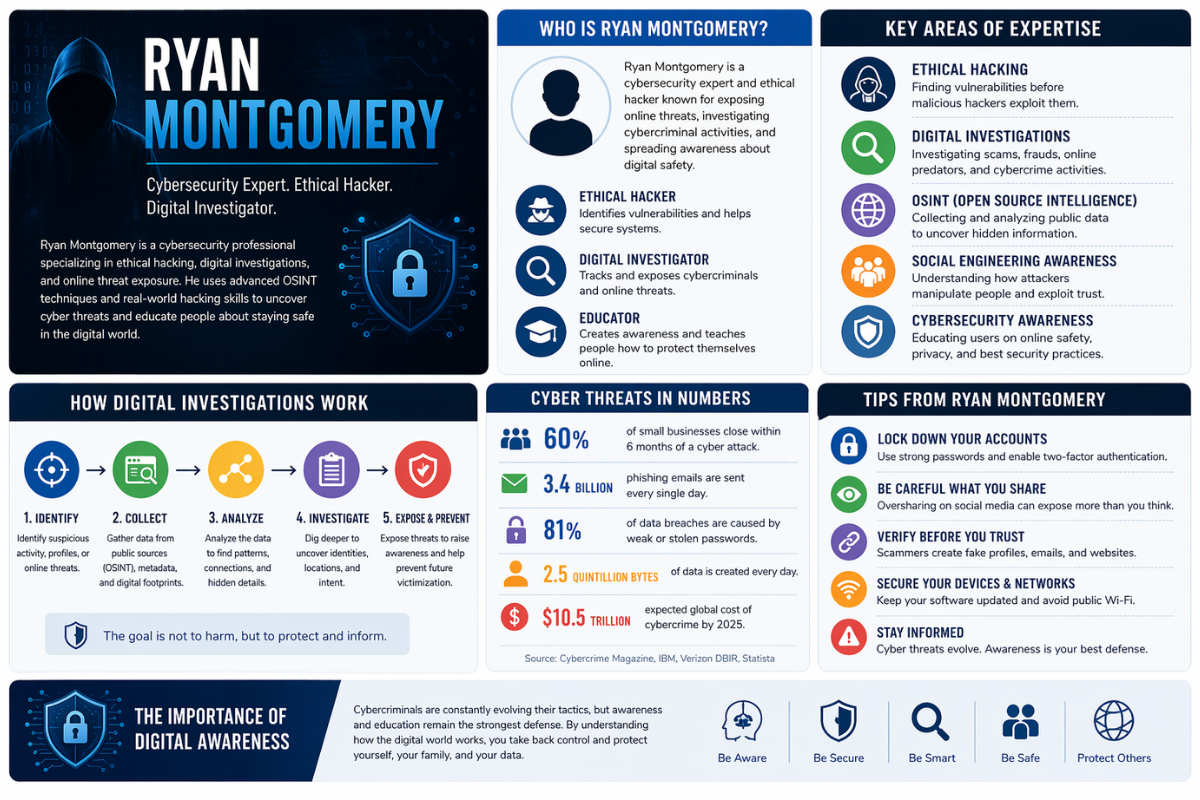
Let’s cut through the vague titles. In practical terms, Ryan Montgomery’s work revolves around identifying and exposing digital risks.
1. Ethical Hacking
At the core, he operates as a white-hat hacker—someone who uses hacking techniques for defensive and investigative purposes.
This includes:
- Finding vulnerabilities in systems
- Demonstrating how attacks can happen
- Helping prevent real-world exploitation
Unlike black-hat hackers, the goal here is protection, not damage.
2. Digital Investigations
This is where things get more interesting.
Ryan Montgomery is known for tracking:
- Online predators
- Scammers and fraud networks
- Suspicious digital activity
Using publicly available data (OSINT), metadata, and behavioral patterns, he pieces together digital identities in ways most people wouldn’t even think of.
3. Cybersecurity Awareness
One of his biggest contributions is education.
He regularly highlights:
- How easily personal data can be exposed
- Why social media privacy matters
- How scammers manipulate people psychologically
This is important because most cyber incidents don’t happen due to complex hacks—they happen due to human error and lack of awareness.
Why Ryan Montgomery Is Gaining Attention
There are thousands of cybersecurity professionals. So why is Ryan Montgomery standing out?
1. Real-World Demonstrations
Instead of theoretical discussions, he often shows:
- How someone can be tracked online
- How fake profiles operate
- How quickly data can be exposed
2. Bridging Technical and Non-Technical Audiences
Most cybersecurity experts speak in jargon:
- “Zero-day vulnerabilities”
- “Exploit chains”
- “Privilege escalation”
Ryan simplifies this without dumbing it down.
3. Focus on Everyday Users
A lot of cybersecurity content is enterprise-focused.
Ryan Montgomery’s work is different. It answers questions like:
- Can someone track me from my social media?
- How do scammers find targets?
- Is my personal data already exposed online?
Key Areas of Expertise
To understand his authority, you need to look at the domains he operates in.
Cyber Threat Intelligence
He analyzes patterns behind cyber threats, not just individual incidents.
This includes:
- Identifying scam networks
- Understanding attacker behavior
- Mapping digital footprints
OSINT (Open Source Intelligence)
OSINT is a major part of modern investigations.
It involves collecting data from:
- Public databases
- Social media
- Online records
- Metadata
Ryan Montgomery uses OSINT techniques to demonstrate how much information is publicly accessible—and how it can be misused.
Social Engineering Awareness
Most cyber attacks don’t start with code. They start with people.
Social engineering includes:
- Phishing emails
- Fake identities
- Psychological manipulation
His work often highlights how attackers exploit trust rather than technology.
Lessons You Can Learn From His Work
Even if you’re not in cybersecurity, there are practical takeaways.
1. Your Digital Footprint Is Bigger Than You Think
Most people underestimate how much of their data is publicly accessible.
Basic things like:
- Old accounts
- Public posts
- Reused usernames
can be stitched together to form a detailed profile.
2. Privacy Is Not Default
Platforms don’t prioritize your privacy—you have to configure it yourself.
That includes:
- Social media settings
- Data sharing permissions
- Account security
3. Awareness Is Your First Line of Defense
You don’t need to be a hacker to stay safe.
But you do need to:
- Recognize suspicious behavior
- Avoid oversharing
- Verify before trusting
Is Ryan Montgomery Legit?
This is a common search query—and a fair one.
Based on available information and public activity, Ryan Montgomery is recognized as a cybersecurity professional working in ethical hacking and digital investigations.
However, like with any public figure in cybersecurity:
- Always verify claims
- Look at real work, not just titles
- Focus on demonstrated expertise
That’s the standard approach in this industry.
Final Thoughts
The rise of Ryan Montgomery reflects a broader shift in how people engage with cybersecurity.
It’s no longer just an enterprise concern—it’s personal.
His work stands out because it:
- Makes invisible threats visible
- Translates technical risks into real-life scenarios
- Pushes awareness beyond the tech community
Explore More Cybersecurity Tools & Guides
Real Cybersecurity Tips by Ryan Montgomery
Learn practical, real-world cybersecurity strategies to protect your personal data, accounts, and online identity.
Read Guide →Online File Corrupter Tool
Corrupt files instantly for testing uploads, validation errors, and system behavior—100% client-side and secure.
Try Tool →File Hash Checker
Generate and verify file hashes like MD5, SHA-1, and SHA-256 to ensure integrity and detect tampering.
Check Now →Password Strength Checker
Analyze your passwords instantly and understand how secure they are against brute-force attacks.
Test Password →Text Diff Checker
Compare two texts side-by-side and detect differences instantly—perfect for developers and editors.
Compare Text →UUID Generator Tool
Generate unique identifiers instantly using browser-based cryptography—fast and reliable.
Generate UUID →