Civilian Hackers rarely think about becoming lawful targets.
Most worry about getting caught.
Most worry about prosecution.
Most worry about prison.
Very few worry about what international humanitarian law says happens when civilians directly participate in cyber hostilities.
They should.
The internet has convinced millions of people that cyber warfare is somehow different from traditional warfare. It feels distant. It feels detached. A person can sit in a bedroom, a coffee shop, or an office building thousands of miles from a conflict zone and still influence events occurring on the other side of the world. That distance creates an illusion of safety.
The reality is far less comfortable.
According to the Tallinn Manual 2.0, civilians are not prohibited from directly participating in cyber operations amounting to hostilities. Yet for such time as they participate, they lose protection from attack.
Read that again.
The rule does not tell people they cannot join the fight.
The rule explains what happens after they do.
That distinction matters more than most people realize.
For Civilian Hackers, the issue is not whether participation is allowed. The issue is whether they understand the consequences of crossing a line that many do not even know exists.
Civilian Hackers and the Invisible Battlefield
War has always involved a distinction between those who fight and those who do not.
International humanitarian law was built around that principle. Soldiers participate in hostilities. Civilians are generally protected from attack.
Cyber warfare complicated that framework.
Today, a highly skilled civilian can launch disruptive cyber operations without ever wearing a uniform. A volunteer can target government systems. A patriotic hacker can attack foreign networks. A hacktivist can interfere with military communications.
The keyboard has created a new pathway to participation.
What makes the situation remarkable is that the law does not automatically prohibit such participation.
This is where many people misunderstand the discussion.
The Tallinn Manual 2.0 does not spend its time asking whether civilians can participate. Instead, it focuses heavily on the consequences when they do.
That is a very different conversation.
A civilian who enters the battlefield does not magically remain outside the conflict simply because they are not enlisted in a military organization.
The battlefield may recognize their actions even if they do not recognize the battlefield.
Also Read: The Day Your Backup Fails Is Not the Day It Breaks
The Rule Most Hackers Never Hear
One sentence from Tallinn Manual 2.0 should make every technically skilled individual stop and think.
Civilians are not prohibited from directly participating in cyber operations amounting to hostilities, but they forfeit their protection from attacks for such time as they so participate.
Notice what is absent from that statement.
There is no prohibition.
There is no warning label.
There is no requirement that someone wear a uniform before becoming involved.
There is only a consequence.
That consequence is the temporary loss of protection.
For many readers, that realization creates a pause.
The discussion is no longer about malware, exploits, penetration testing, or technical capability.
The discussion becomes personal.
What happens when your actions transform your legal status during an armed conflict?
That question deserves far more attention than it receives.
Distance Does Not Create Immunity
One of the greatest misconceptions in cybersecurity is the belief that physical distance creates legal distance.
It does not.
A missile launched from one country can affect another.
A cyber operation launched from one country can do the same.
The physical location of the keyboard does not automatically change the nature of the activity.
Many Civilian Hackers assume that because they are not standing on a traditional battlefield, they remain completely insulated from the consequences associated with conflict.
History suggests otherwise.
As cyber capabilities continue to influence military and national security operations, the distinction between physical and digital participation becomes increasingly blurred.
The internet has expanded the battlefield.
It has not eliminated it.
Use Our Corrupter Tools: File Corrupter – Corrupt Any File Online in Seconds
Patriotism Can Become Participation
One of the most fascinating aspects of modern cyber conflict is the rise of volunteer participation.
When international crises emerge, online communities often mobilize rapidly. Individuals begin conducting cyber operations that they believe support a political cause, national interest, or ideological objective.
Some view themselves as digital volunteers.
Others view themselves as defenders.
Still others see themselves as activists.
The legal analysis, however, may focus less on motivation and more on conduct.
Good intentions do not automatically determine legal status.
A person may believe they are helping.
The law may view the situation differently.
That reality creates a difficult tension.
Many Civilian Hackers see themselves as spectators who occasionally intervene.
International humanitarian law may view certain actions as direct participation in hostilities.
Those are not always the same thing.
When Does a Keyboard Become a Weapon?
This is where the conversation becomes genuinely uncomfortable.
Most people understand when a rifle becomes part of a conflict.
Few understand when a laptop does.
The answer is not always simple.
Cyber operations vary dramatically in purpose, effect, and impact.
Some activities are clearly protected forms of expression.
Others may be intelligence gathering.
Others may cross into actions that directly affect military operations or national infrastructure.
The Tallinn Manual spends significant effort examining these distinctions because they matter.
The legal consequences often depend on the nature of the conduct itself.
For cybersecurity professionals, this creates an important lesson.
Technical capability and legal consequence are not separate discussions.
They are increasingly connected.
The more powerful cyber operations become, the more significant those legal questions become.
Why This Matters to the Cybersecurity Community
Many cybersecurity articles focus on tools.
Others focus on vulnerabilities.
Some focus on breaches.
Very few focus on status.
Yet status may be one of the most important concepts in modern cyber conflict.
A skilled operator can spend years mastering technical techniques while never considering how international humanitarian law views their actions during armed conflict.
That gap in awareness creates risk.
Understanding these issues does not require someone to agree with every interpretation or legal position.
It simply requires acknowledging reality.
Cyber operations do not exist in a legal vacuum.
The consequences of participation extend beyond technology.
That is why cybersecurity professionals should pay attention to discussions surrounding the Tallinn Manual 2.0 and related legal frameworks.
The future battlefield will not be occupied solely by soldiers.
It will include networks, infrastructure, software, and individuals operating behind screens.
The Illusion of Being Just a Civilian
Perhaps the most dangerous assumption a person can make is believing that labels alone determine reality.
A person may call themselves a civilian.
A government may call them a civilian.
An online community may call them a civilian.
Yet certain actions can alter how the law evaluates their participation during armed conflict.
That is the core lesson.
The distinction is not always about identity.
It is often about conduct.
This is why the phrase “Civilian Hackers” deserves serious attention.
It captures a category of people who possess the capability to influence conflicts without formally joining military organizations.
Technology has empowered individuals in ways that previous generations could scarcely imagine.
The legal implications of that empowerment are still being debated, analyzed, and refined.
Ignoring those implications does not make them disappear.
The Bigger Question Nobody Wants to Ask
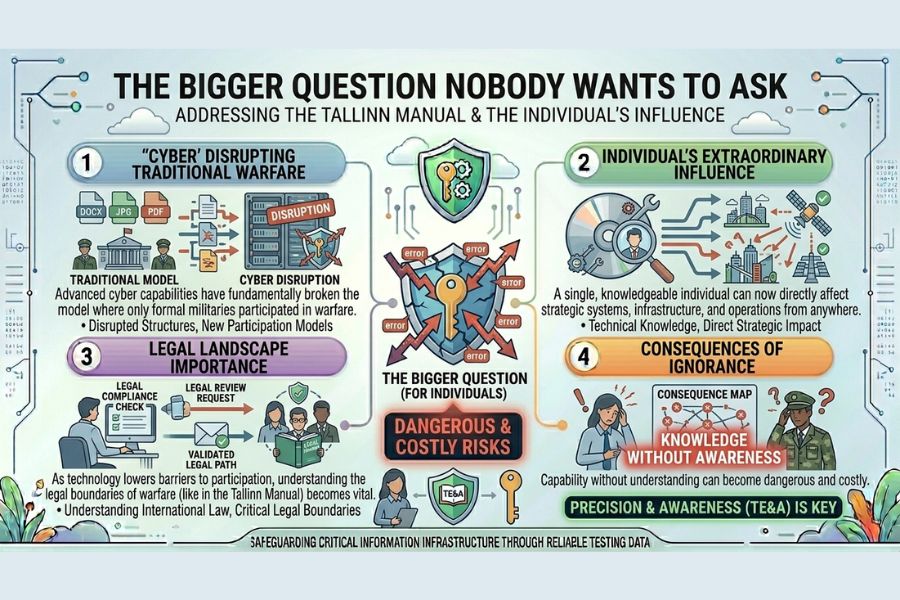
The Tallinn Manual forces readers to confront a question that many would rather avoid.
What happens when ordinary people gain extraordinary influence over armed conflict?
For centuries, participation in warfare was largely associated with formal military structures.
Cyber capabilities disrupted that model.
Today, an individual with sufficient knowledge may affect systems, communications, infrastructure, and operations from virtually anywhere.
That reality creates opportunities.
It also creates consequences.
The uncomfortable truth is that technology has lowered barriers to participation while simultaneously raising the importance of understanding the legal landscape.
Knowledge without awareness can become dangerous.
Capability without understanding can become costly.
Frequently Asked Questions
Does Tallinn Manual 2.0 prohibit civilians from participating in cyber hostilities?
No. The discussion generally focuses on the consequences of participation rather than establishing a blanket prohibition against such actions.
Why are Civilian Hackers relevant to international humanitarian law?
Because certain cyber activities conducted during armed conflict may affect how the law evaluates a civilian’s status and protections.
Does physical distance protect someone from legal consequences?
No. The fact that cyber operations occur remotely does not automatically eliminate legal considerations associated with participation in hostilities.
Why should cybersecurity professionals care about the Tallinn Manual?
Because cyber operations increasingly intersect with national security, armed conflict, and international law. Understanding those intersections is becoming more important every year.
Final Thought
Nobody stops Civilian Hackers from joining a war.
That is the part many people find surprising.
The more important part is what follows.
The Tallinn Manual 2.0 highlights a reality that deserves far more attention within the cybersecurity community. Participation may be possible, but participation is not consequence free.
The internet may feel separate from the battlefield.
The law suggests otherwise.
The most dangerous moment is not when someone learns how to join the fight.
The most dangerous moment is when they assume there is no difference between watching a war and becoming part of one.
Because the battlefield does not care whether you wear a uniform.
It only cares whether you joined the fight.
For more cybersecurity analysis and commentary, visit filecorrupter.org.
References
Tallinn Manual 2.0 on the International Law Applicable to Cyber Operations
https://www.cambridge.org
International Committee of the Red Cross
https://www.icrc.org
NATO Cooperative Cyber Defence Centre of Excellence
https://ccdcoe.org