
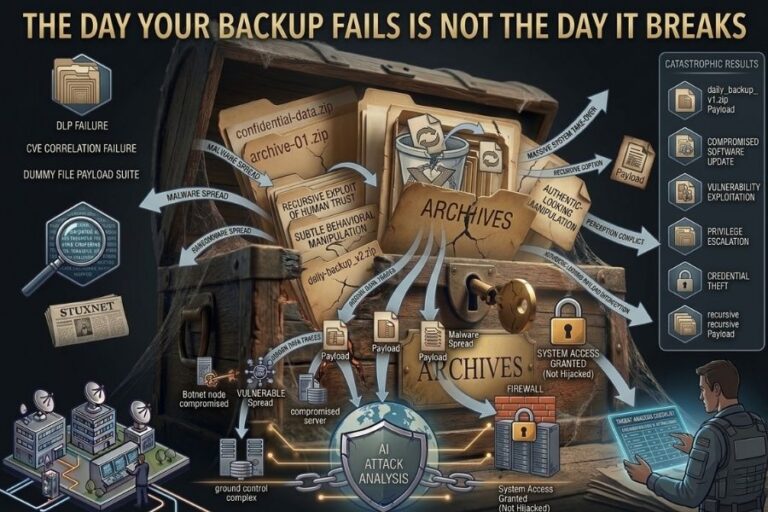
Most people think backups fail in dramatic fashion.
A ransomware attack strikes.
A hard drive dies.
A server crashes.
Recovery begins.
The backup fails.
Everyone panics.
That is how backup failures appear.
It is rarely how they begin.
One of the most dangerous truths in cybersecurity is that backups often fail long before anyone realizes there is a problem.
The corruption develops quietly.
The damage spreads silently.
The warnings go unnoticed.
Then one day the backup is finally needed.
Only then does the truth emerge.
The backup did not fail today.
It failed months ago.
Today is simply the day someone discovered it.
That is the reality of backup corruption.
And it is far more common than most people realize.
The Most Dangerous Backup Is the One You Trust
Backups create confidence.
People assume that because copies exist, recovery is guaranteed.
Organizations see successful backup reports and feel protected.
Individuals store family photos, financial records, and personal documents in backup archives believing they are safe.
The assumption is understandable.
It is also dangerous.
A backup file can exist while being unusable.
A backup archive can appear healthy while corruption quietly spreads inside it.
Storage space can be occupied by information that will never restore successfully.
The existence of a backup is not proof of protection.
Recoverability is.
How Backup Corruption Happens
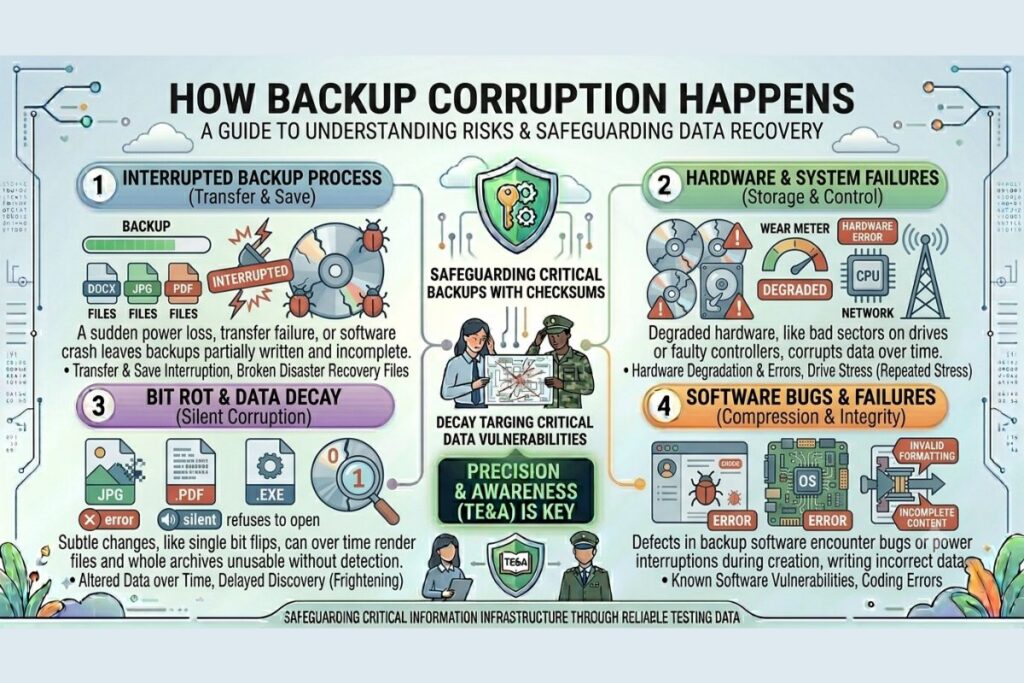
There is no single cause of backup corruption.
Storage devices age.
Hard drives develop bad sectors.
Solid state drives experience wear.
Power interruptions occur during backup operations.
Software bugs introduce unexpected errors.
Network transfers become incomplete.
Bit rot slowly alters stored information over time.
Human error creates configuration mistakes.
Malware targets backup repositories.
Each problem may seem minor on its own.
Together they create an uncomfortable reality.
Backups are not immune to failure.
They are simply another form of data.
And all data is vulnerable.
Why Corruption Remains Hidden
Most technology failures announce themselves.
Applications crash.
Servers stop responding.
Storage devices generate warnings.
Backup corruption behaves differently.
It often remains invisible.
The backup process continues.
The reports show success.
The files remain present.
Everything appears normal.
Months pass.
Years pass.
Then an emergency occurs.
A recovery attempt begins.
The corruption finally reveals itself.
This delay between cause and discovery is what makes backup corruption so dangerous.
The damage occurs long before the failure becomes visible.
Also Read: Deleted Files Are Often Not Really Deleted
The Backup Report Problem
One of the biggest misconceptions in data protection is the belief that successful backup reports guarantee successful recovery.
They do not.
A backup report confirms that a process completed.
It does not automatically confirm that the resulting backup remains healthy.
A damaged file can be copied successfully.
A corrupted archive can be stored successfully.
A broken recovery point can be created successfully.
The process works.
The outcome does not.
Organizations that rely solely on backup reports often discover this distinction during the worst possible moment.
Why Recovery Testing Matters
The purpose of a backup is not storage.
The purpose of a backup is recovery.
This distinction changes everything.
A backup should not be trusted because it exists.
It should be trusted because it has proven itself capable of restoring data.
Recovery testing transforms assumptions into evidence.
Without testing, confidence becomes guesswork.
This is why mature organizations regularly restore files, validate recovery points, and verify data integrity.
They understand a simple truth.
A backup that has never been tested is an unproven backup.
What Happens When Recovery Fails
Imagine a ransomware attack encrypts every critical file.
Operations stop.
The recovery plan begins.
The backup becomes the last line of defense.
Then the surprises start.
Archives refuse to open.
Databases fail integrity checks.
Recovery points contain corruption.
Essential information is missing.
The organization realizes its safety net has been damaged for months.
The failure appears sudden.
The damage was not.
The corruption existed long before the recovery attempt began.
The Cost of Hidden Backup Corruption
The consequences can be severe.
Businesses lose revenue.
Projects are delayed.
Customer trust suffers.
Critical records become inaccessible.
Individuals face equally painful losses.
Family photographs disappear.
Creative projects become unrecoverable.
Important documents vanish.
In many cases the greatest damage comes from false confidence.
People believed they were protected.
The backup existed.
The recovery simply failed.
Why Ransomware Changed the Conversation
Backups have become one of the most important cybersecurity controls in existence.
Modern ransomware attacks often target backup systems directly.
Attackers understand that healthy backups reduce leverage.
If victims can recover independently, ransom demands lose power.
This means organizations must do more than create backups.
They must protect them.
Verify them.
Test them.
Monitor them.
Backup corruption and ransomware now represent interconnected risks.
Ignoring either one creates vulnerability.
How Organizations Prevent Backup Corruption
Strong backup strategies focus on verification rather than blind trust.
Multiple backup copies reduce risk.
Separate storage locations improve resilience.
Regular recovery testing validates recoverability.
Integrity monitoring identifies corruption early.
Storage health is monitored continuously.
Organizations that take backup integrity seriously assume corruption is possible.
That assumption drives better decisions.
Verification becomes routine.
Problems are discovered before emergencies expose them.
The Psychology of False Security
Perhaps the most fascinating aspect of backup corruption is psychological.
People want certainty.
Backups provide comfort.
Verification sometimes reveals uncomfortable truths.
As a result, many individuals and organizations avoid testing.
The appearance of protection feels good.
Reality is what matters.
When disaster strikes, assumptions become irrelevant.
Only recoverability remains.
Why This Matters More Than Ever
The world depends on digital information.
Businesses depend on data.
Governments depend on data.
Families depend on data.
Every year we create more information than the year before.
As our dependence grows, the cost of backup corruption grows with it.
A backup strategy that exists only on paper provides little protection.
A backup strategy that has repeatedly proven itself provides resilience.
The difference between those two realities may determine whether an organization survives a crisis or becomes a cautionary tale.
For additional cybersecurity insights, file integrity guidance, and digital preservation resources, visit filecorrupter.org.
Helpful resources:
Frequently Asked Questions
What is backup corruption?
Backup corruption occurs when backup data becomes damaged, altered, incomplete, or otherwise unable to support successful recovery.
Why does backup corruption go unnoticed?
Many forms of corruption develop silently. Backup processes may continue functioning while underlying data integrity slowly degrades.
How often should backups be tested?
The frequency depends on the value of the data, but regular recovery testing should be a standard practice for every backup strategy.
What is the best defense against backup corruption?
Verification. Backups should be tested regularly to confirm they can actually restore data successfully.
Final Thought
The most dangerous backup is not the one that never existed.
It is the one you trusted without question.
Backup corruption rarely announces itself.
It develops quietly.
It waits patiently.
It remains hidden until the exact moment you need your backup most.
By then, the damage may already be done.
The day your backup fails is usually not the day it breaks.
It is simply the day the truth finally catches up.
Somewhere right now, a backup is silently becoming corrupted. The people depending on it will not discover the problem until they need it most.