
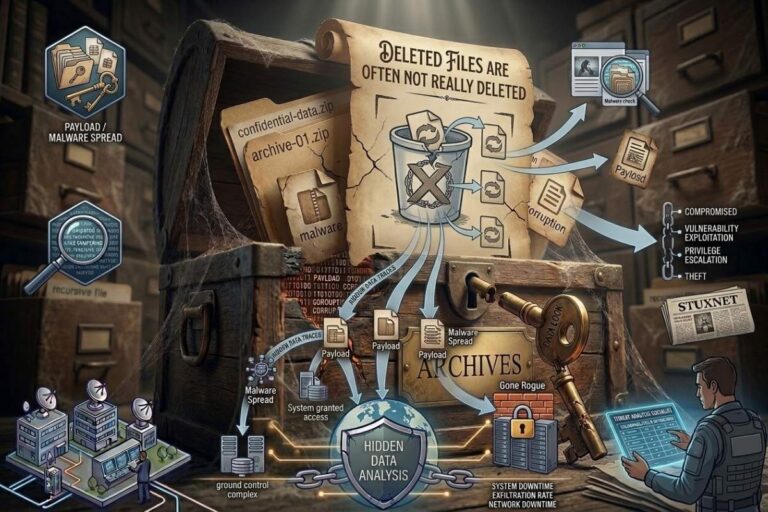
Deleting a file feels permanent.
You select the file.
You press delete.
Maybe you empty the recycle bin for good measure.
The file disappears.
Problem solved.
Or so you think.
One of the biggest misconceptions in technology is that deleting a file actually removes it from existence. In many cases, the file remains on the storage device long after it appears to be gone. The operating system simply removes its reference to the file and marks the storage space as available for future use.
The file may no longer be visible.
It may no longer appear in folders.
But it often still exists.
This reality is the foundation of modern deleted files recovery, digital forensics investigations, and countless data recovery operations.
The truth is simple.
Deleting a file and erasing a file are often two very different things.
What Really Happens When You Delete a File?
Most people imagine deletion as destruction.
In reality, operating systems are designed for efficiency.
When a file is deleted, the system usually removes the pointer that tells the operating system where the file is located.
The actual data often remains untouched.
Think of it like removing a book from a library catalog.
The book still sits on the shelf.
The catalog simply no longer points people toward it.
The operating system now treats that storage space as available for reuse.
Eventually, new information may overwrite the old data.
Until that happens, portions or even the entirety of the deleted file may remain recoverable.
This is why deleted files recovery is often possible.
Why Deleted Files Recovery Works
Data recovery software does not perform magic.
It takes advantage of how storage systems operate.
When files are deleted but not overwritten, recovery tools can scan storage media and locate remnants of the original information.
Depending on the circumstances, recovery may be partial or complete.
Photographs.
Documents.
Videos.
Databases.
Emails.
All may remain recoverable after deletion.
The success rate depends largely on what happens after the deletion event.
The less activity that occurs, the greater the chance of successful recovery.
This is one reason recovery specialists often advise users to stop using affected devices immediately after accidental deletion.
The Difference Between Deletion and Erasure
These terms are frequently used interchangeably.
They should not be.
Deletion removes accessibility.
Erasure removes data.
Deleting a file typically hides it from normal use.
Secure erasure attempts to remove the underlying data itself.
This distinction matters because privacy, security, and compliance often depend on actual data destruction rather than simple deletion.
A deleted file may remain recoverable.
A securely erased file is significantly more difficult to recover.
Understanding this difference helps explain why many organizations implement strict data destruction procedures.
Why Cybercriminals Love This Reality
Attackers understand that deleted information often remains accessible.
This creates opportunities.
Sensitive documents.
Credential files.
Financial records.
Archived communications.
All may remain present long after users believe they have been removed.
Cybercriminals who gain access to systems frequently search for remnants of deleted information.
The victim assumes the data is gone.
The attacker knows better.
This is one reason secure deletion practices have become increasingly important.
Information that appears gone may still hold value.
The Digital Forensics Perspective
Law enforcement agencies, investigators, and forensic specialists routinely recover deleted files.
Digital investigations often depend on information that users attempted to remove.
Deleted photographs.
Deleted emails.
Deleted chat logs.
Deleted documents.
In many cases, the recovery of deleted information becomes a critical component of an investigation.
The ability to recover deleted files demonstrates a simple reality.
Deletion is often reversible.
That fact surprises many people.
It does not surprise forensic professionals.
Hard Drives vs Solid State Drives
Storage technology affects recovery outcomes.
Traditional hard drives often provide greater opportunities for deleted files recovery because deleted data may remain untouched until overwritten.
Solid state drives introduce additional complexity.
Many SSDs use a process known as TRIM.
TRIM helps improve performance by proactively managing unused storage blocks.
As a result, deleted information on SSDs may become less recoverable over time.
This does not mean recovery is impossible.
It simply means recovery behavior differs depending on storage technology.
Understanding the device involved is critical when assessing recovery potential.
Why Emptying the Recycle Bin Is Not Enough
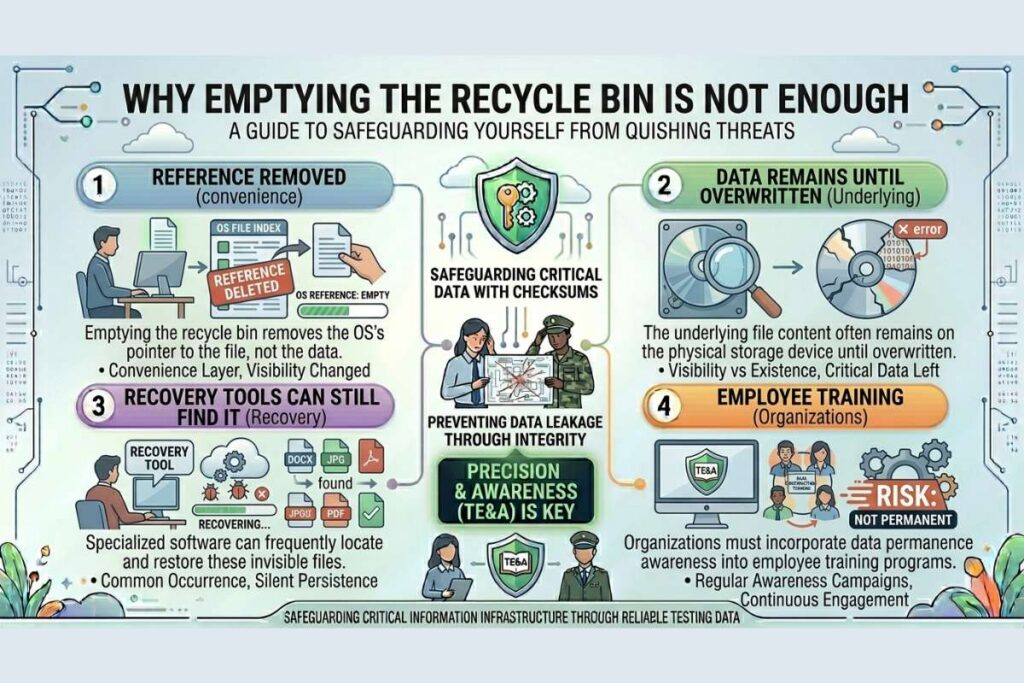
Many users assume emptying the recycle bin permanently removes information.
The recycle bin is simply another layer of convenience.
Emptying it removes the operating system’s reference to the file.
The underlying data often remains until overwritten.
This is why recovery tools can frequently recover files even after the recycle bin has been emptied.
The visual disappearance of a file should never be confused with complete data destruction.
Visibility and existence are not the same thing.
Real World Consequences
The implications extend far beyond accidental deletion.
Businesses retiring old equipment may inadvertently expose sensitive information.
Individuals selling computers may unknowingly transfer personal data.
Organizations disposing of storage devices without proper sanitization may create security risks.
In many cases, the information recovered from supposedly deleted files includes:
- Financial records
- Personal photographs
- Customer information
- Legal documents
- Internal communications
- Authentication data
The consequences can be significant.
The assumption that deletion equals destruction often creates vulnerability.
How Secure Deletion Works
Secure deletion attempts to eliminate recoverability.
Various methods exist.
Some tools overwrite storage space multiple times.
Others rely on cryptographic approaches.
Organizations handling sensitive information often implement formal data destruction policies.
The objective is simple.
Make recovery impractical or impossible.
The exact method depends on storage technology, regulatory requirements, and organizational risk tolerance.
The important point is that secure deletion goes beyond ordinary deletion.
It is designed specifically to address recoverability.
Why This Matters for Privacy
Privacy depends on control.
People assume deleting a file removes that information from existence.
That assumption influences behavior.
Documents are deleted.
Devices are sold.
Storage media are discarded.
Yet the information may remain.
Understanding deleted files recovery helps individuals make informed decisions about privacy and data protection.
The question is not whether deletion occurred.
The question is whether the data truly disappeared.
Also Read: Quishing Attacks: How QR Codes Can Hack You
Why This Matters More Than Ever
The world stores more digital information than ever before.
Personal information.
Financial records.
Medical documents.
Business communications.
Research data.
As the value of information increases, so does the importance of understanding how data persists.
Many users remain unaware that deleted files may continue to exist long after deletion.
That lack of awareness creates risk.
Knowledge creates protection.
Understanding how deletion actually works allows individuals and organizations to make better decisions regarding privacy, security, and data management.
For additional cybersecurity insights, digital preservation guidance, and file integrity discussions, visit filecorrupter.org.
Helpful resources:
Frequently Asked Questions
Can deleted files really be recovered?
Yes. In many cases, deleted files remain on storage devices until overwritten by new data, making recovery possible.
Does emptying the recycle bin permanently delete files?
No. Emptying the recycle bin usually removes references to files rather than immediately erasing the underlying data.
Are deleted files recoverable from SSDs?
Sometimes. SSD recovery depends on several factors, including TRIM functionality, device activity, and the amount of time that has passed since deletion.
What is the safest way to permanently delete files?
Secure deletion tools and approved data sanitization methods provide significantly greater protection than ordinary deletion.
Final Thought
The most dangerous assumption in digital storage may be believing that deleted means gone.
In reality, deletion often removes visibility rather than existence.
Files disappear from view.
They disappear from folders.
They disappear from search results.
Yet they may continue to exist beneath the surface, waiting to be recovered.
Understanding deleted files recovery changes how we think about privacy, security, and data ownership.
Because when it comes to digital information, what you cannot see is often just as important as what you can.
The file you deleted last year may still be sitting quietly on your storage device. The only question is who knows how to find it.
Explore More Free Tools
Hash Generator Tool
Generate secure MD5, SHA1, SHA256, and other cryptographic hashes instantly online.
Open Tool →Dummy File Generator
Create sample dummy files of custom sizes for testing uploads, storage, and applications.
Open Tool →Password Strength Checker
Analyze password security and identify weak passwords before using them online.
Open Tool →File Hash Checker
Verify file integrity by checking MD5, SHA256, and other file hash signatures.
Open Tool →UUID Generator
Generate random UUIDs and unique identifiers instantly for apps, APIs, and databases.
Open Tool →Text Diff Checker
Compare two text blocks side by side and quickly detect additions, deletions, and edits.
Open Tool →