
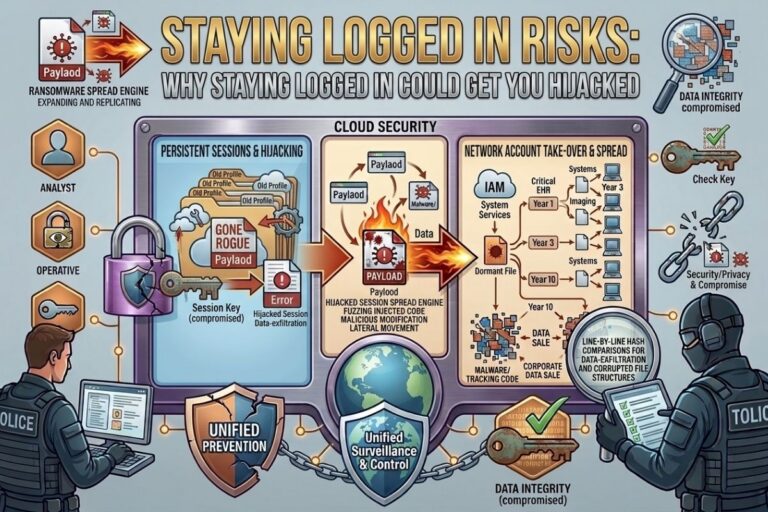
Cybercriminals love convenience almost as much as users do.
Every day, millions of people click the “Keep Me Logged In” button without thinking twice about what it actually means. Most users see it as harmless. Convenient. Efficient. Nobody enjoys typing passwords repeatedly throughout the day.
But convenience has a dark side.
One of the most underestimated cybersecurity threats today involves persistent login sessions and the dangerous exposure they create. Modern attackers are no longer obsessed with brute-forcing passwords the way they were years ago. Today’s cybercriminals understand something many users still fail to recognize:
Stealing access is often easier than stealing credentials.
That is why Staying Logged In Risks have become a serious issue in modern cybersecurity. Attackers increasingly target session cookies, authentication tokens, browsers, and active login sessions because those areas often provide faster and quieter access into accounts.
The longer a session remains alive, the longer attackers have to weaponize it.
At FileCorrupter.org, we are a group of ethical hackers with real-world experience, offensive security knowledge, and diverse technical talents across the cybersecurity landscape. We do not believe in watered-down cyber advice. We believe in understanding how attackers actually think, move, and exploit weakness before they strike.
Because attackers do not always need your password anymore.
Sometimes all they need is your session.
Understanding Staying Logged In Risks
Most websites keep users logged in through session tokens or authentication cookies stored inside the browser. These tokens tell the website that you have already been authenticated, allowing you to bypass the login screen during future visits.
That sounds convenient until you understand what attackers are really targeting.
If a threat actor steals your session token, they may gain access to your account without ever knowing your password. In some situations, they may even bypass Multi-Factor Authentication completely because the authentication process has already been completed by the legitimate user.
This is exactly why Staying Logged In Risks have become more dangerous over the last several years.
According to the OWASP Session Management Cheat Sheet, session management weaknesses remain one of the most significant security concerns affecting modern web applications.
Persistent sessions create larger attack windows. That gives attackers more time to:
- steal session data
- hijack accounts
- impersonate users
- bypass authentication controls
- remain undetected
Cybersecurity is no longer just about passwords.
Identity and session security now sit at the center of modern attacks.
Image Steganography Tool
Hide or extract secret data inside images instantly.
Why Staying Logged In Risks Are Growing
Years ago, attackers focused heavily on password cracking. That landscape changed dramatically once cybercriminals realized browsers had become treasure chests full of authentication data.
Modern browsers store:
- session cookies
- authentication tokens
- saved credentials
- autofill data
- browsing sessions
To attackers, this information is incredibly valuable.
Infostealer malware has exploded across underground cybercrime communities because stealing browser session data is often more efficient than traditional hacking techniques. Malware families such as RedLine, Vidar, and Raccoon Stealer specifically target browser-stored authentication information.
Why?
Because users stay logged into everything.
Bank accounts. Cloud dashboards. Email platforms. Cryptocurrency exchanges. Business applications. Social media. Corporate portals.
The browser has evolved into a digital identity hub.
And attackers know it.
According to CISA Cybersecurity Guidance, credential theft malware and session compromise continue to represent major cybersecurity threats affecting individuals and organizations worldwide.
Most users still think the password is the primary target.
Modern attackers know better.
📌 Recommended Reading
The Cloud Isn’t Secure — Your Configuration IsStaying Logged In Risks and Session Hijacking
One of the most dangerous Staying Logged In Risks is session hijacking.
When a user logs into a website, the server creates an active authenticated session. If attackers successfully steal the session token associated with that session, they may inherit the same access level as the legitimate user.
No password required.
This is why session hijacking has become one of the most effective attack strategies in cybersecurity.
Attackers commonly steal sessions through:
- phishing attacks
- malware infections
- malicious browser extensions
- cross-site scripting attacks
- compromised public networks
- browser vulnerabilities
Once attackers gain access to the active session, they may immediately access:
- email accounts
- banking platforms
- business systems
- cloud storage
- financial services
- social media accounts
This is where users misunderstand the threat landscape.
Many people believe Multi-Factor Authentication makes them immune to compromise. MFA is critical, but it does not eliminate Staying Logged In Risks entirely. MFA primarily protects the login process itself. If attackers hijack an already authenticated session after MFA verification occurs, they may bypass additional verification prompts completely.
That is why cybersecurity professionals strongly recommend shorter session lifetimes for sensitive accounts.
Convenience always comes with tradeoffs.
Staying Logged In Risks on Public Computers
Persistent login sessions become even more dangerous on shared or public systems.
Unfortunately, users constantly remain logged into accounts on:
- hotel business centers
- airport kiosks
- school computers
- shared office workstations
- library systems
Many people wrongly assume closing the browser logs them out automatically.
That assumption gets people compromised every single day.
If the session remains active, the next user may inherit direct access to sensitive accounts without needing credentials at all.
Cybersecurity is not always about elite hackers performing advanced attacks from dark rooms filled with monitors.
Sometimes compromise happens because users underestimate basic operational security.
That is the uncomfortable truth.
The National Institute of Standards and Technology, commonly known as NIST Cybersecurity Framework, continues to emphasize strong authentication and session security practices because persistent login exposure significantly increases risk.
The longer authentication sessions remain active, the more opportunity attackers have to exploit them.
How Staying Logged In Risks Affect Stolen Devices
A stolen smartphone or laptop becomes far more dangerous when important accounts remain logged in.
Especially email accounts.
Email remains one of the most powerful targets in cybersecurity because it often acts as the gateway into everything else. Once attackers gain access to email, they may begin resetting passwords, intercepting recovery messages, and expanding access into additional platforms.
That escalation can happen incredibly fast.
This is why cybersecurity professionals recommend:
- device encryption
- biometric authentication
- inactivity locks
- remote wipe capabilities
- secure password management
The objective is simple:
reduce attacker opportunity before they can weaponize active sessions.
Because once attackers establish persistence inside your digital identity ecosystem, containment becomes far more difficult.
How to Reduce Staying Logged In Risks
You do not need to become paranoid.
You need to become smarter.
The first step is understanding that modern cyberattacks increasingly focus on trust exploitation instead of brute-force hacking. Attackers target convenience because convenience lowers resistance.
Avoid staying logged into highly sensitive platforms whenever possible, especially:
- banking accounts
- healthcare systems
- cryptocurrency platforms
- corporate dashboards
- primary email accounts
Use Multi-Factor Authentication everywhere, but understand its limitations. Keep browsers updated regularly. Remove browser extensions you do not fully trust. Avoid using persistent login sessions on public or shared devices.
Most importantly, start thinking like an attacker.
Ask yourself:
“If someone stole this device right now, what could they access immediately?”
That question alone changes how people approach cybersecurity.
The reality is simple.
Staying Logged In Risks are no longer theoretical. Session hijacking, browser compromise, and authentication theft are active attack methods used by cybercriminals every single day.
The internet trained users to prioritize convenience.
Attackers adapted accordingly.
At FileCorrupter.org, we believe cybersecurity should sound real because real attackers do not operate inside fantasy worlds filled with corporate buzzwords and fake security jargon. We are ethical hackers who understand that the best defense starts with understanding how modern attacks actually happen.
Swagger in cybersecurity is not pretending to know everything.
Swagger is understanding the game before the attacker makes their move.
Frequently Asked Questions
Is it dangerous to stay logged into websites?
Yes. Staying logged into websites can increase the risk of session hijacking, browser cookie theft, and unauthorized account access if your device or browser becomes compromised.
What happens when you click “Keep Me Logged In”?
Websites store authentication data such as session cookies or tokens in your browser so you can remain logged in without re-entering your password during future visits.
Can hackers steal active login sessions?
Yes. Cybercriminals can steal active sessions through malware, phishing attacks, malicious browser extensions, browser vulnerabilities, or insecure public networks.
Can hackers bypass Multi-Factor Authentication?
In some cases, yes. If attackers steal an already authenticated session token after MFA verification occurs, they may gain access without triggering another MFA prompt.
Is it safe to stay logged into accounts on public computers?
No. Staying logged into accounts on shared or public computers creates major security risks because another user may inherit access if the session remains active.
Explore More Free Tools
Hash Generator Tool
Generate secure MD5, SHA1, SHA256, and other cryptographic hashes instantly online.
Open Tool →Dummy File Generator
Create sample dummy files of custom sizes for testing uploads, storage, and applications.
Open Tool →Password Strength Checker
Analyze password security and identify weak passwords before using them online.
Open Tool →File Hash Checker
Verify file integrity by checking MD5, SHA256, and other file hash signatures.
Open Tool →UUID Generator
Generate random UUIDs and unique identifiers instantly for apps, APIs, and databases.
Open Tool →Text Diff Checker
Compare two text blocks side by side and quickly detect additions, deletions, and edits.
Open Tool →