
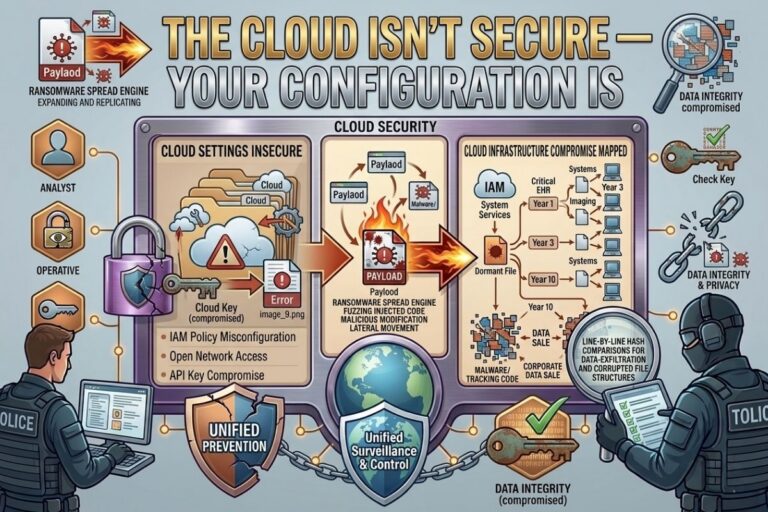
Cloud Security has become one of the most misunderstood concepts in modern cybersecurity. Companies move their infrastructure to the cloud believing platforms like Amazon Web Services (AWS), Microsoft Azure, and Google Cloud automatically protect them from cyber threats. That assumption has created one of the most dangerous security mindsets in the digital era.
The cloud itself is not inherently secure.
Your configuration is.
That distinction matters more than most organizations realize.
From an ethical hacker’s perspective, cloud environments are filled with opportunities. Attackers are not intimidated by cloud infrastructure because they understand a harsh reality many businesses still ignore: most successful cloud breaches are not caused by sophisticated hacking techniques. They happen because organizations misconfigure their own environments, expose sensitive credentials, fail to enforce identity controls, and neglect basic cybersecurity discipline.
Hackers know something many companies refuse to admit.
Human error is the real vulnerability.
The cloud did not eliminate security risks. In many ways, it amplified them. Organizations now manage enormous attack surfaces connected directly to the internet, often with weak oversight and inconsistent visibility. One exposed storage bucket, one compromised administrator account, or one poorly configured firewall can expose millions of records within minutes.
Cybercriminals understand this perfectly.
That is why attackers aggressively target cloud infrastructure.
At FileCorrupter.org, we believe organizations need to stop treating cloud adoption like a magic security upgrade. The cloud is powerful, scalable, and efficient, but power without security discipline creates dangerous consequences.
Hackers are not always “breaking in.”
Sometimes they are simply logging into systems companies failed to secure properly.
The Dangerous Illusion of Cloud Security
One of the biggest misconceptions in cybersecurity is the belief that cloud providers are fully responsible for protecting customer environments. That assumption creates a false sense of safety that attackers love to exploit.
Cloud providers secure their infrastructure. They protect physical data centers, hardware, foundational networking, and virtualization layers. However, customers remain responsible for securing their own configurations, identities, applications, permissions, and data.
That separation is known as the shared responsibility model.
Cloud Security=Provider Infrastructure Security+Customer Configuration Security
The problem is many organizations misunderstand where their responsibilities begin.
Businesses rush into cloud adoption prioritizing speed, scalability, and convenience while security becomes secondary. Executives want rapid deployment. Developers want flexibility. Remote accessibility becomes a business necessity. Unfortunately, security controls often fail to evolve at the same pace.
Hackers depend on this imbalance.
Attackers know many organizations migrated to the cloud faster than they developed proper cloud security strategies. That creates enormous opportunities for exploitation.
Ethical hackers constantly observe companies making the same dangerous mistakes repeatedly. Weak identity management, excessive permissions, exposed APIs, forgotten cloud assets, and publicly accessible databases remain common across industries. These are not advanced vulnerabilities. They are preventable failures caused by poor security hygiene.
The cloud provider cannot protect organizations from negligence.
That responsibility belongs entirely to the customer.
Image Steganography Tool
Hide or extract secret data inside images instantly.
Why Hackers Love Cloud Environments
Cloud infrastructure has become incredibly attractive to cybercriminals because it centralizes valuable data, applications, and services inside highly connected environments. From a hacker’s standpoint, cloud ecosystems offer efficiency.
Instead of targeting isolated systems individually, attackers can compromise identities, permissions, or configurations that unlock access to massive environments at scale.
That changes everything.
Traditional cybersecurity focused heavily on defending network perimeters. Cloud computing transformed that model entirely. Today, identity has become the new perimeter. If attackers gain access to privileged cloud accounts, they often gain direct access to infrastructure, sensitive information, and internal systems without ever needing traditional malware-based intrusion methods.
Hackers aggressively target weak credentials because they know password reuse, missing multi-factor authentication, and excessive user permissions remain widespread problems. Many organizations continue prioritizing convenience over security discipline, and attackers exploit that weakness constantly.
Once attackers gain access to cloud identities, the damage escalates quickly.
They may deploy ransomware across cloud workloads, exfiltrate sensitive customer information, create persistence mechanisms, disable logging systems, or move laterally across environments while remaining undetected. In some cases, attackers leverage compromised cloud resources to launch additional attacks against other organizations.
The frightening reality is that attackers do not always need advanced technical skill to compromise cloud infrastructure.
Sometimes they simply need organizations to be careless.
📌 Recommended Reading
5 Deadly Healthcare Cybersecurity Failures ExposedMisconfigurations Are the Real Threat
The majority of cloud security failures begin with misconfiguration.
Publicly exposed storage buckets continue to leak sensitive information across the internet because administrators fail to properly configure access permissions. Hackers actively scan for these exposures using automated tools capable of identifying vulnerable resources within minutes.
In many cases, attackers are not “hacking” anything at all.
They are discovering information companies accidentally left exposed.
Sensitive customer records, financial documents, healthcare data, internal communications, and proprietary business information have all been compromised because organizations failed to secure their cloud storage correctly.
Cloud environments create flexibility, but flexibility without oversight becomes dangerous.
Misconfigured firewalls and security groups create additional risk. Organizations frequently expose remote administrative services, databases, and internal applications directly to the internet without realizing how quickly attackers can discover them. Automated internet-wide scanning has made exposed infrastructure incredibly easy to identify.
Hackers constantly search for weak entry points because they know someone eventually forgets to secure something properly.
That is the reality of modern cybersecurity.
The cloud does not forgive careless configuration.
Identity Is the Most Valuable Target
Modern attackers understand that compromising identities is often easier than exploiting software vulnerabilities.
That is why cloud security increasingly revolves around Identity and Access Management (IAM). If attackers gain access to cloud credentials with elevated privileges, they can manipulate infrastructure legitimately while blending into normal activity.
This is where many organizations make critical mistakes.
Employees frequently receive permissions far beyond what they actually need. Administrative privileges become widespread because restricting access feels inconvenient or time-consuming. Over time, environments become cluttered with over-permissioned accounts capable of creating serious security exposure.
Hackers love excessive permissions because privilege escalation becomes dramatically easier.
A compromised low-level account inside a poorly managed cloud environment can sometimes escalate into full administrative control. Once attackers obtain elevated privileges, they can quietly move through systems, access sensitive resources, and establish persistence before defenders even realize an intrusion occurred.
The principle of least privilege remains one of the most important defenses in cloud security.
Users should only have access to the specific resources required for their responsibilities.
Nothing more.
Unfortunately, many organizations continue ignoring this principle because convenience often wins over discipline.
Attackers know it.
That is why identity-based attacks continue increasing across cloud platforms worldwide.
Exposed Credentials Are a Goldmine for Attackers
API keys and cloud credentials have become some of the most valuable assets attackers search for online.
Developers accidentally expose secrets inside public repositories, unsecured configuration files, source code, and development environments more often than most organizations realize. Platforms like GitHub have become hunting grounds for cybercriminals searching for leaked credentials connected to cloud infrastructure.
Once attackers obtain valid cloud credentials, they can often bypass traditional security defenses entirely because they appear to be legitimate users.
That is what makes credential compromise so dangerous.
Attackers may create malicious cloud resources, steal sensitive data, deploy malware, mine cryptocurrency, or quietly maintain persistence within environments for extended periods. In many cases, compromised credentials remain active long after exposure because organizations fail to rotate or monitor them properly.
Ethical hackers understand a critical truth about cloud environments:
Authentication failures often create more damage than technical vulnerabilities.
Strong cloud security requires continuous credential management, aggressive monitoring, secure secrets storage, and strict identity enforcement. Organizations that neglect these areas dramatically increase their exposure to attack.
One exposed credential can compromise an entire environment.
Hackers know this better than most businesses do.
Visibility Determines Survival
One of the most overlooked aspects of cloud security is visibility.
Organizations cannot defend what they cannot see.
Many businesses migrate infrastructure into the cloud without implementing sufficient monitoring, centralized logging, or real-time alerting. That creates dangerous blind spots attackers exploit aggressively.
Modern cybercriminals often prioritize stealth instead of immediate destruction. Remaining hidden inside cloud environments allows attackers to gather intelligence, establish persistence, and prepare larger attacks over time.
Without proper visibility, organizations may never notice suspicious activity until significant damage has already occurred.
Effective cloud security requires continuous monitoring, behavioral analytics, automated detection systems, and mature incident response planning. Security teams need visibility into authentication events, privilege escalation attempts, abnormal resource activity, and suspicious behavioral patterns.
Cloud environments move fast.
Attackers move faster.
Organizations operating without visibility place themselves at a severe disadvantage.
The Human Problem Behind Cloud Security
Technology alone will never solve cybersecurity problems.
Human behavior remains one of the largest vulnerabilities inside cloud environments. Misconfigurations, weak credentials, poor operational discipline, and security negligence continue driving the majority of successful cloud breaches.
Hackers understand human behavior exceptionally well.
They know organizations become careless when prioritizing speed over security. They know employees reuse passwords. They know administrators grant excessive permissions to avoid operational friction. They know developers sometimes expose credentials accidentally.
Cybercriminals do not need perfection.
They only need mistakes.
That is what makes cloud security so unforgiving.
The cloud amplifies both efficiency and risk simultaneously. Organizations capable of maintaining strong security discipline can build highly resilient environments. Organizations lacking discipline create opportunities attackers are eager to exploit.
The cloud itself is not the enemy.
Complacency is.
Frequently Asked Questions About Cloud Security
Why do hackers target cloud environments?
Hackers target cloud environments because they contain massive amounts of centralized data, remote accessibility, and identity-based access controls that are often poorly configured. Many attackers know organizations moved to the cloud faster than they developed mature cloud security strategies.
Is cloud computing more secure than traditional infrastructure?
Cloud computing can be more secure than traditional infrastructure, but only when organizations properly configure permissions, monitoring, identity controls, and security policies. Poor cloud configuration creates serious cybersecurity risks regardless of the cloud provider being used.
What is the biggest cloud security mistake companies make?
One of the biggest cloud security mistakes organizations make is assuming the cloud provider handles all security responsibilities. In reality, businesses remain responsible for securing identities, configurations, applications, and sensitive data inside their cloud environments.
What are common cloud security vulnerabilities?
Common cloud security vulnerabilities include exposed storage buckets, weak identity management, leaked API keys, excessive user permissions, missing multi-factor authentication, and poorly configured firewalls.
How do ethical hackers test cloud security?
Ethical hackers test cloud security by identifying misconfigurations, weak permissions, exposed credentials, insecure APIs, and vulnerable cloud services. The goal is to discover weaknesses before malicious attackers exploit them.
Final Thoughts
Cloud Security is not about blindly trusting technology platforms to protect organizations automatically. It is about understanding that every configuration decision carries security consequences.
The cloud provider secures the infrastructure.
You secure everything else.
That distinction separates resilient organizations from vulnerable ones.
Most successful cloud breaches do not happen because attackers possess unstoppable technical genius. They happen because organizations fail to enforce identity controls, monitor their environments, secure credentials, and maintain proper configuration discipline.
Hackers understand this reality clearly.
Organizations should too.
The cloud is powerful, but power without security awareness creates exposure at massive scale. Businesses that continue treating cloud adoption like an automatic security upgrade will continue becoming targets for attackers who understand exactly where the real weaknesses exist.
And those weaknesses are usually human.
For more cybersecurity analysis, ethical hacking insights, and digital security discussions, visit FileCorrupter.org.
Explore More Free Tools
Hash Generator Tool
Generate secure MD5, SHA1, SHA256, and other cryptographic hashes instantly online.
Open Tool →Dummy File Generator
Create sample dummy files of custom sizes for testing uploads, storage, and applications.
Open Tool →Password Strength Checker
Analyze password security and identify weak passwords before using them online.
Open Tool →File Hash Checker
Verify file integrity by checking MD5, SHA256, and other file hash signatures.
Open Tool →UUID Generator
Generate random UUIDs and unique identifiers instantly for apps, APIs, and databases.
Open Tool →Text Diff Checker
Compare two text blocks side by side and quickly detect additions, deletions, and edits.
Open Tool →