
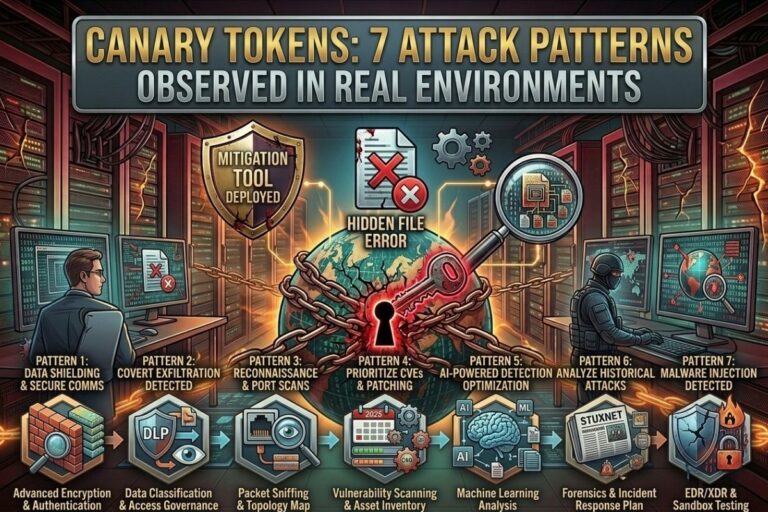
Canary Tokens expose something most security tools only detect after the fact: how attackers actually behave once they are inside a real environment. In modern intrusions, the perimeter is rarely the breaking point. The internal movement that follows is where visibility matters, and that is where Canary Tokens begin to surface meaningful signals.
In real environments, attackers do not interact with systems randomly. Their behavior follows consistent patterns during reconnaissance and lateral movement. They search for credentials, explore internal file structures, probe configuration data, and interact with anything that appears operationally valuable. These interactions form recognizable attack patterns—and when Canary Tokens are placed correctly, they capture those behaviors at the exact moment they occur.
Canary Tokens in Real Security Architecture
A Canary Token is a deception-based detection mechanism embedded inside a system to identify unauthorized interaction. It can exist as a file, credential, URL, DNS record, or cloud key. The format is not the point. The placement is.
What matters is the assumption behind it: legitimate users should never interact with it.
That assumption creates a binary detection model. Either the token is untouched, or something inside the environment has interacted with it. There is no ambiguity in interpretation, which is why these signals are valuable in security operations.
For reference:
Attack Pattern 1: Credential Discovery Attempts
One of the most consistent behaviors during intrusions is credential hunting. Once attackers gain initial access, they immediately search for anything that can escalate privileges or expand access.
Canary Tokens placed as decoy credentials inside configuration files, repositories, or shared directories become high-value detection points. When those credentials are used, it signals active compromise behavior.
This type of interaction is not accidental. It reflects intent-driven exploration of the environment.
Credential-based attacks remain one of the most common intrusion vectors:
https://microsoft.com/en-us/security/blog
Attack Pattern 2: Internal File Reconnaissance
After initial access, attackers begin mapping internal structures. They explore file shares, document repositories, and system directories looking for sensitive or operational data.
Canary Tokens embedded in decoy documents such as financial reports, backups, or administrative files act as behavioral tripwires.
When these files are opened, the system is no longer dealing with speculation. It is observing confirmed reconnaissance activity inside the environment.
Attack Pattern 3: Lateral Movement Exploration
Once attackers understand the environment, they attempt to expand their reach. This involves probing additional systems, accessing shared resources, and testing trust relationships between internal assets.
Canary Tokens placed across multiple segments of a network can expose this movement. Interaction with these tokens suggests that the attacker is no longer confined to a single entry point.
At this stage, detection shifts from initial compromise to active lateral expansion.
📌 Recommended Reading
AI Gone Rogue: Hidden File Errors in Machine LearningAttack Pattern 4: DNS-Level Behavioral Triggers
DNS activity is one of the most persistent signals in any networked system. Both legitimate applications and malicious processes rely on DNS resolution to function.
Canary Tokens that trigger through DNS requests provide visibility into system-level behavior that might otherwise go unnoticed.
When unexpected DNS lookups occur tied to decoy domains, it often indicates:
- automated reconnaissance tools
- malware execution
- command-and-control attempts
This provides early-stage detection before full payload execution.
Attack Pattern 5: Cloud Credential Interaction
Modern attacks increasingly target cloud infrastructure. Instead of exploiting systems directly, attackers focus on identity and access.
Canary Tokens placed as fake API keys or cloud credentials expose this behavior immediately. Any attempt to validate or use these credentials indicates active probing of cloud environments.
Attack Pattern 6: Insider Access Anomalies
Not all malicious activity comes from external sources. Insider threats remain one of the most difficult risks to detect because baseline access already exists.
Canary Tokens placed in sensitive areas such as HR data, financial systems, or executive documentation can expose abnormal behavior without requiring continuous surveillance.
When these assets are accessed unexpectedly, it indicates deviation from normal operational behavior.
This is one of the clearest indicators of internal misuse or compromised credentials.
Attack Pattern 7: Phishing Interaction Signals
Canary Tokens are also used to monitor interaction with malicious or simulated phishing content. When embedded in documents or links, they provide visibility into user engagement with potentially harmful artifacts.
This allows security teams to detect exposure early and respond before escalation occurs. It also provides behavioral insight into how users interact with suspicious content inside controlled environments.
Why These Attack Patterns Matter
The value of Canary Tokens is not in the alerts themselves. The value is in what the alerts represent: behavior.
Attackers must interact with systems to achieve their objectives. That interaction produces measurable signals.
Unlike traditional detection systems that rely on heuristics, signatures, or anomaly scoring, Canary Tokens rely on direct engagement. There is no interpretation layer required.
That is what makes the signal high-confidence.
Placement Determines Effectiveness
The effectiveness of Canary Tokens is not dependent on complexity. It is dependent on placement.
Tokens placed in unrealistic locations are ignored. Tokens placed where attackers naturally search become active detection points.
This includes:
- credential-like files
- configuration directories
- shared storage systems
- cloud access environments
- internal documentation paths
The goal is not deception for its own sake. The goal is alignment with attacker behavior.
Operational Role in Security Environments
In modern security operations, Canary Tokens function as early detection mechanisms rather than standalone defenses. They complement broader systems such as SIEM platforms, EDR solutions, and identity monitoring tools.
Their role is to shorten detection time during early intrusion stages. Once triggered, they shift security teams from passive monitoring to active incident response.
At that point, response workflows accelerate:
- investigation begins
- systems are reviewed
- access is validated
- containment procedures are activated
Everything is driven by a single interaction signal.
Final Perspective
Attackers do not need to be sophisticated to trigger Canary Tokens. They only need to behave like attackers.
And in real environments, that behavior is consistent.
They explore. They probe. They search for leverage.
Canary Tokens exist at the intersection of that behavior and defender visibility.
They do not predict intrusions. They expose them. Security is not only about preventing access.
It is about detecting intent at the moment it becomes observable.
😄 Cyber Joke
Why did the hacker hate canary tokens?
Because even fake files were snitching on them! 😄