QR codes are everywhere.
They appear on restaurant tables, parking meters, product packaging, advertisements, business cards, utility bills, and payment terminals.
Most people see them as convenient shortcuts.
Scan.
Tap.
Continue.
No typing required.
That convenience is exactly what makes them dangerous.
Cybercriminals have discovered that QR codes offer something attackers love: trust. People are far more likely to scan a QR code than click a suspicious email link. They assume the code is legitimate. They assume the destination is safe.
Those assumptions have created one of the fastest growing phishing techniques in cybersecurity.
It is called QR code phishing quishing.
And it is turning ordinary QR codes into powerful attack tools.
What Is QR Code Phishing Quishing?
Quishing combines two words:
QR code and phishing.
Traditional phishing attacks rely on emails, text messages, fake websites, and social engineering tactics to trick victims into revealing sensitive information.
Quishing uses QR codes to accomplish the same objective.
Instead of clicking a suspicious link, the victim scans a code.
The QR code redirects the victim to a malicious website where credentials, payment information, authentication tokens, or personal data can be stolen.
The attack feels safer because the victim actively initiates the interaction.
That perception of safety is exactly what attackers exploit.
Why QR Codes Are So Effective
Most people have learned to be cautious with email links.
Organizations conduct phishing awareness training.
Browsers display warnings.
Email platforms filter suspicious messages.
QR codes bypass many of these protections.
When someone scans a QR code, they often skip the evaluation process entirely.
The code feels neutral.
It looks harmless.
It contains no visible warning signs.
Users rarely stop to ask where the code leads before scanning it.
Attackers understand this behavior.
They know people trust QR codes more than traditional links.
That trust creates opportunity.
How Quishing Attacks Work
The process is surprisingly simple.
First, attackers create a malicious website designed to imitate a legitimate service.
This could be:
- A banking login page
- A Microsoft 365 sign in portal
- A cryptocurrency exchange
- A payment processing website
- A cloud storage platform
Next, attackers generate a QR code that directs victims to the fake website.
The QR code is then distributed through various channels.
Victims scan the code.
The fake website appears.
Credentials are entered.
Sensitive information is captured.
The victim often remains unaware that anything has happened.
The attack succeeds because trust replaced verification.
The Rise of QR Codes in Everyday Life
A decade ago, QR codes were relatively uncommon.
Today they are part of daily life.
Restaurants use digital menus.
Retailers use mobile payment systems.
Companies use QR codes for authentication.
Marketing campaigns depend on them.
Public transportation systems use them for ticketing.
The widespread adoption of QR technology has dramatically increased the potential attack surface available to cybercriminals.
Every new QR code creates another opportunity for deception.
Every scan represents a decision.
Unfortunately, many of those decisions occur without scrutiny.
Real World Quishing Scenarios
One of the reasons QR code phishing quishing is so effective is that the attacks often appear completely legitimate.
Imagine arriving at a parking meter.
A QR code directs users to pay online.
You scan it.
A payment page appears.
Everything looks normal.
What you do not realize is that an attacker placed a fraudulent QR code sticker over the legitimate one.
Your payment information is now in criminal hands.
Consider a restaurant menu.
You scan the code on the table.
Instead of viewing menu options, you are redirected to a fake login page requesting account credentials.
Or imagine receiving an email that contains a QR code instead of a clickable link.
The email bypasses traditional phishing filters because the malicious destination is embedded inside the image.
The attack succeeds because the QR code appears trustworthy.
Why Mobile Devices Increase Risk
Most QR codes are scanned using smartphones.
This creates unique security challenges.
Mobile devices often display limited URL information.
Users tend to move quickly through mobile interfaces.
Verification becomes less common.
Attention decreases.
Attackers take advantage of this environment.
A victim may briefly see a suspicious domain name before a website loads.
Many users never notice.
Others ignore the warning signs because they expect the destination to be legitimate.
The smaller screen and faster interaction speed create ideal conditions for deception.
The Psychology Behind Quishing
Cybersecurity is rarely just about technology.
It is often about human behavior.
Quishing works because it leverages trust, convenience, and urgency.
People trust physical objects.
A QR code on a restaurant table feels legitimate.
A QR code on a parking meter appears official.
A QR code on product packaging seems trustworthy.
Attackers understand this psychological shortcut.
The victim assumes legitimacy because the code exists in a trusted environment.
The criminal never needs to hack the victim.
The victim willingly participates in the attack.
What Attackers Want
Not every quishing attack has the same objective.
Different campaigns target different forms of value.
Some attackers seek login credentials.
Others focus on financial information.
Certain campaigns distribute malware.
Others attempt to steal authentication tokens.
Corporate environments face additional risks.
A successful quishing attack may provide access to:
- Business email accounts
- Cloud storage systems
- Internal applications
- Customer information
- Financial records
The consequences can extend far beyond a single device.
How Organizations Are Being Targeted
Businesses are increasingly encountering quishing attacks.
Cybercriminals understand that employees regularly interact with QR codes.
Training materials.
Authentication systems.
Conference badges.
Marketing campaigns.
Internal communications.
All of these environments create opportunities for abuse.
Attackers frequently embed QR codes inside phishing emails because image based attacks often evade traditional security controls.
The employee scans the code.
The attack progresses.
The organization becomes exposed.
This is one reason security teams have begun incorporating quishing awareness into phishing training programs.
Also Read: Power Outages and the Files They Destroy
Warning Signs You Should Never Ignore
Several indicators can help identify suspicious QR codes.
Unexpected requests for credentials deserve scrutiny.
Urgent payment demands should raise concern.
Misspelled domain names are common warning signs.
Poor website design often indicates fraud.
Requests for sensitive information that seem unrelated to the intended service should never be ignored.
Most importantly, users should always pause before scanning.
Convenience should never replace verification.
How to Protect Yourself From QR Code Phishing Quishing
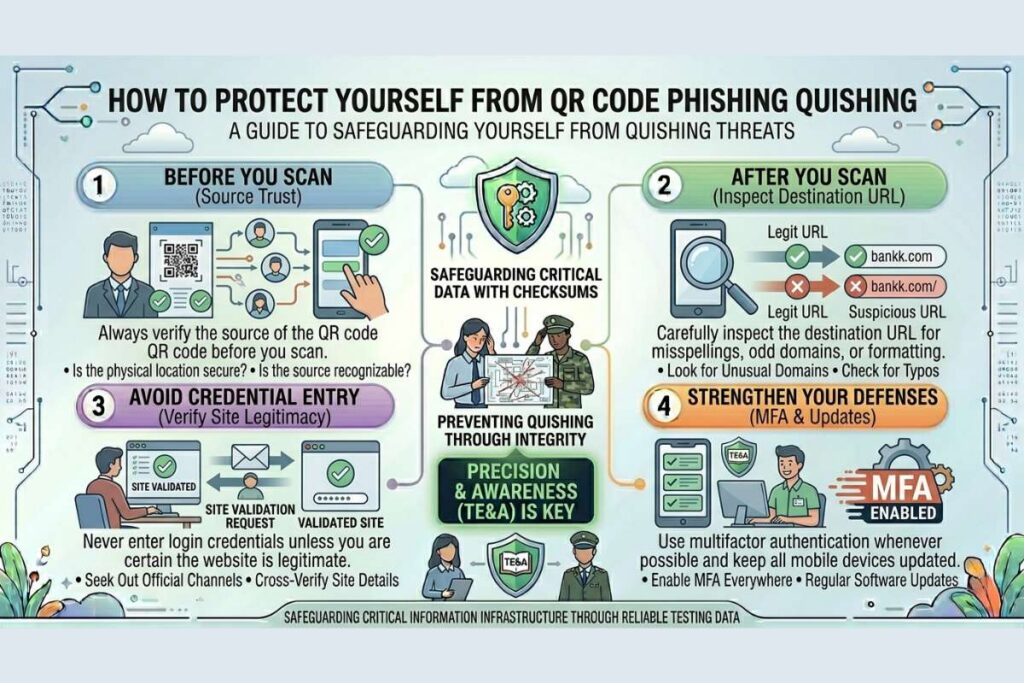
Protection begins with awareness.
Before scanning any QR code, ask whether the source is trustworthy.
After scanning, inspect the destination URL carefully.
Look for unusual domains, misspellings, and suspicious formatting.
Avoid entering credentials unless you are confident the website is legitimate.
Use multifactor authentication whenever possible.
Keep mobile devices updated.
Security software can provide additional protection against known threats.
Organizations should incorporate quishing awareness into employee training programs.
The goal is not to avoid QR codes entirely.
The goal is to verify before trusting.
Why Verification Matters
This theme appears throughout cybersecurity.
Trust without verification creates vulnerability.
The same principle applies to:
- Email attachments
- Software downloads
- Backup files
- Compressed archives
- QR codes
Attackers succeed when people assume legitimacy without confirming it.
Verification interrupts that process.
A few extra seconds spent reviewing a destination URL can prevent account compromise, financial loss, and identity theft.
The most effective security habit is often the simplest one.
Slow down.
Verify.
Proceed only when confidence exists.
Why This Threat Is Growing
QR codes are becoming more common every year.
At the same time, cybercriminals are becoming more creative.
The combination creates a growing problem.
Many security tools were originally designed to inspect traditional links.
QR codes introduce a different delivery mechanism.
As adoption increases, attackers gain more opportunities to exploit trust.
This trend is unlikely to disappear.
If anything, quishing attacks will become more sophisticated.
Understanding the threat today improves resilience tomorrow.
For additional cybersecurity insights and emerging threat analysis, visit filecorrupter.org.
Helpful resources:
Frequently Asked Questions
What is QR code phishing quishing?
QR code phishing quishing is a phishing technique that uses QR codes to direct victims to malicious websites designed to steal credentials, payment information, or other sensitive data.
Are QR codes themselves dangerous?
QR codes are not inherently dangerous. The risk comes from the destination they direct users toward.
Can quishing attacks install malware?
Yes. Some malicious QR codes direct victims to websites that attempt to install malware, spyware, or other malicious software.
How can I verify a QR code is safe?
Review the destination URL before interacting with the website. Avoid entering sensitive information unless you are confident the destination is legitimate.
Final Thought
The most dangerous QR code is not the one that looks suspicious.
It is the one that looks completely legitimate.
QR code phishing quishing succeeds because it exploits trust, convenience, and routine behavior. The attack does not depend on sophisticated malware or advanced hacking techniques.
It depends on a simple assumption.
The assumption that scanning is safe.
Cybersecurity often comes down to a single question.
Do you trust first, or verify first?
The answer may determine whether a scan becomes a convenience or a compromise.
The next QR code you scan could lead exactly where you expect. It could also lead somewhere a cybercriminal wants you to go. The challenge is knowing the difference before you scan.
Explore More Free Tools
Hash Generator Tool
Generate secure MD5, SHA1, SHA256, and other cryptographic hashes instantly online.
Open Tool →Dummy File Generator
Create sample dummy files of custom sizes for testing uploads, storage, and applications.
Open Tool →Password Strength Checker
Analyze password security and identify weak passwords before using them online.
Open Tool →File Hash Checker
Verify file integrity by checking MD5, SHA256, and other file hash signatures.
Open Tool →UUID Generator
Generate random UUIDs and unique identifiers instantly for apps, APIs, and databases.
Open Tool →Text Diff Checker
Compare two text blocks side by side and quickly detect additions, deletions, and edits.
Open Tool →