
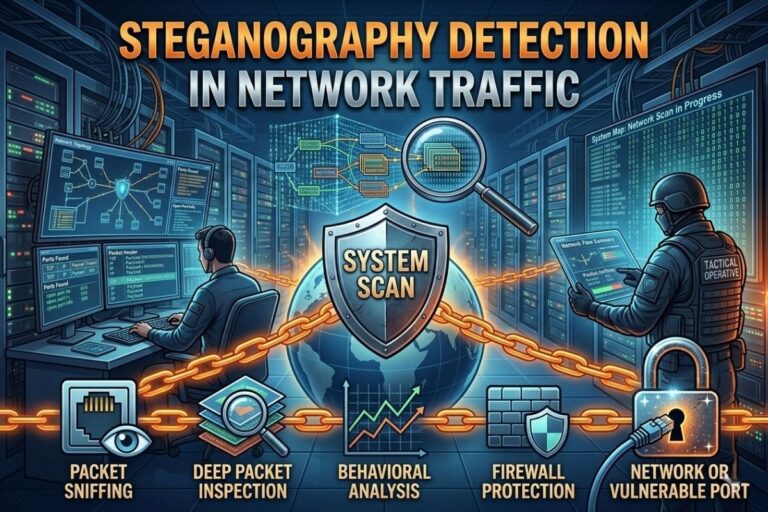
Modern cybersecurity threats are no longer limited to malware signatures or suspicious executables.
They now exist inside normal network traffic.
This is where steganography detection in network traffic becomes critical. Unlike traditional attacks that generate alerts or abnormal behavior, steganographic communication hides inside legitimate-looking data flows. To most systems, everything appears normal.
That assumption is exactly what attackers rely on.
Hacker perspective: If the traffic looks clean at first glance, that doesn’t mean it is clean. It just means you haven’t looked deep enough yet.
What Is Steganography Detection in Network Traffic?
steganography detection in network traffic refers to identifying hidden data embedded within communication channels such as HTTP requests, DNS queries, image transfers, or encrypted payload streams.
Unlike encryption, which makes data unreadable but visible, steganography hides the existence of the data entirely.
That makes detection significantly harder because nothing appears obviously wrong.
To explore how hidden data behaves in controlled environments, you can test steganography mechanisms here:
www.filecorrupter.org
Hacker perspective: The most dangerous payload is the one that never looks like a payload.
1. Packet-Level Inspection
One of the most effective techniques for steganography detection in network traffic is deep packet inspection (DPI).
DPI analyzes packet headers and payloads beyond surface metadata. Hidden data often alters structure at the byte level in subtle ways.
Even when traffic is encrypted or disguised, inconsistencies in formatting can expose anomalies.
Hacker perspective: Every packet tells a story. Most defenders just aren’t reading it carefully enough.
2. Statistical Traffic Analysis
Network traffic follows predictable statistical behavior.
When steganography is introduced, those patterns shift.
By analyzing:
- packet size distribution
- entropy levels
- request frequency
you can identify deviations that suggest hidden communication.
This is especially useful for low-volume covert channels designed to avoid detection thresholds.
📌 Recommended Reading
Malware via Steganography: Hiding Payloads in Images3. DNS Tunneling Detection
DNS is one of the most abused protocols in steganography detection in network traffic.
Attackers encode data inside DNS queries because DNS traffic is almost always allowed.
Detection focuses on:
- unusually long domain strings
- high entropy queries
- abnormal query volume
Hacker perspective: DNS was never designed for secrecy—but attackers turned it into a tunnel anyway.
4. Timing Analysis of Traffic Patterns
Some covert channels encode data using timing rather than payloads.
For example:
- short delay = 0
- long delay = 1
By analyzing packet timing patterns, defenders can detect encoded communication even when data appears normal.
This method is subtle but extremely effective against low-profile attacks.
Image Steganography Tool
Hide or extract secret data inside images instantly.
5. Payload Entropy Analysis
Entropy measures randomness in data.
Normal traffic has predictable entropy ranges.
Steganographic payloads often increase entropy due to encoding or compression.
High entropy in unexpected places—like image transfers or DNS responses—can indicate hidden data.
Hacker perspective: Random-looking data is often the biggest red flag.
6. Protocol Abuse Detection
Attackers often hide data inside trusted protocols:
- HTTP headers
- ICMP packets
- TLS handshake structures
steganography detection in network traffic requires identifying when these protocols behave outside normal expectations.
Examples include:
- abnormal header values
- repeated request patterns
- oversized payload fragments
7. Machine Learning-Based Detection
Modern systems use AI to detect subtle anomalies in traffic behavior.
Machine learning models analyze:
- baseline traffic patterns
- long-term behavioral shifts
- deviations from expected communication flows
These systems are particularly effective against unknown or evolving attack methods.
Why Steganography Works in Network Traffic
The success of steganography detection in network traffic challenges a core cybersecurity assumption: visibility equals awareness.
Attackers exploit:
- trusted protocols
- encrypted channels
- normal behavior baselines
Hacker perspective: The best hiding place is inside something nobody questions.
Real-World Implications
Covert channels are actively used for:
- command-and-control communication
- malware coordination
- stealth data exfiltration
Because they blend into normal traffic, they often bypass traditional security controls.
Defensive Strategy
Effective steganography detection in network traffic requires layered analysis:
- packet inspection
- anomaly detection
- entropy measurement
- behavioral correlation
- protocol validation
No single method is enough.
Defense only works when signals are combined.
Organizations like OWASP emphasize that modern threats require multi-layered detection systems rather than isolated tools.
Final Thoughts
steganography detection in network traffic is not about spotting obvious threats.
It’s about recognizing when something doesn’t belong—even when everything looks normal.
Hacker perspective: The most dangerous traffic isn’t loud. It’s invisible by design.
And in cybersecurity, what you don’t see is often what hits you first.
😄 Cyber Joke
Why did the network analyst suspect hidden data?
Because the traffic was too quiet to be normal! 😄