Technology plays a critical role in protecting businesses from cyber threats, but technology alone cannot stop every attack. Many successful breaches happen because employees unknowingly create security gaps through everyday actions. Weak passwords, unsafe file sharing, and careless email behavior often give attackers the access they need.
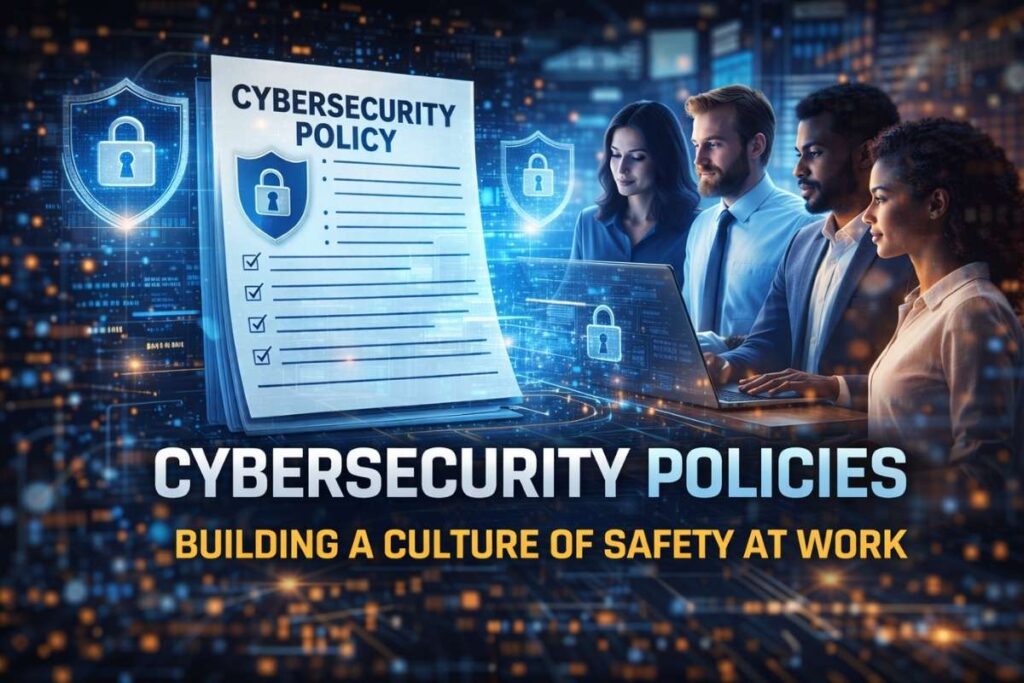
This is why strong SMB cybersecurity policies are essential. Policies create clear rules that define how employees use company systems, how data should be handled, and how security threats should be reported.
Without well-defined SMB cybersecurity policies, organizations rely on individual judgment when dealing with sensitive information. That approach leads to inconsistent behavior and avoidable risk. Clear security policies create consistency and ensure everyone in the organization understands how to protect company resources.
For small businesses trying to strengthen their defenses, implementing structured SMB cybersecurity policies is one of the most effective ways to reduce cyber risk.
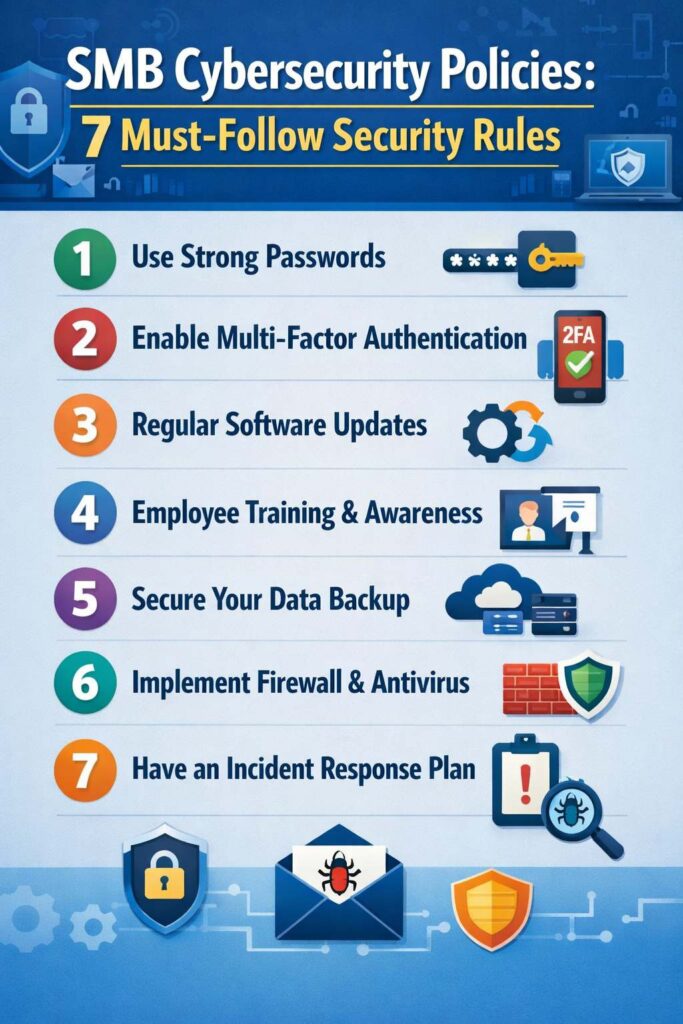
Why SMB Cybersecurity Policies Are Critical
An SMB cybersecurity roadmap provides the strategy for protecting systems, but policies define how that strategy is carried out by employees.
Most cyber attacks do not begin with advanced hacking techniques. Instead, they exploit predictable human mistakes. An employee might click a phishing link, reuse a weak password, or upload sensitive data to an unsecured cloud platform.
Well-designed SMB cybersecurity policies reduce these risks by setting clear expectations for how technology should be used within the organization.
Policies also provide guidance during stressful situations. When employees understand how to respond to suspicious activity or potential breaches, incidents are reported faster and security teams can respond more effectively.
Security policies transform cybersecurity from an abstract concept into practical rules that guide daily behavior.
Password Management in SMB Cybersecurity Policies
One of the most important elements of SMB cybersecurity policies involves password security.
Weak passwords remain one of the easiest entry points for attackers. When employees reuse simple passwords across multiple systems, a single compromised account can quickly escalate into a larger breach.
Strong password policies require employees to create complex passwords that include a combination of letters, numbers, and symbols. Passwords should also be unique for every system used within the organization.
Many businesses are now adopting password managers to simplify secure credential management. These tools allow employees to store strong passwords safely without needing to memorize dozens of credentials.
When implemented correctly, password policies significantly strengthen an organization’s security posture.
📌 Recommended Reading
Steganography Detection in Network Traffic ExplainedMulti-Factor Authentication in SMB Cybersecurity Policies
Multi-factor authentication (MFA) has become a fundamental requirement in modern SMB cybersecurity policies.
MFA requires users to verify their identity using more than just a password. This often involves a secondary authentication method such as a mobile authentication app or security token.
Even if an attacker steals login credentials, MFA can prevent unauthorized access by requiring additional verification. This simple security layer blocks many credential-based attacks that would otherwise succeed.
For small businesses, enforcing MFA across email systems, cloud platforms, and remote access tools is one of the most effective cybersecurity improvements available.
Email Security in SMB Cybersecurity Policies
Phishing attacks remain one of the most common cyber threats facing small businesses. Attackers frequently impersonate trusted contacts or well-known companies to trick employees into revealing credentials or downloading malicious files.
Because of this risk, email security must be addressed directly within SMB cybersecurity policies.
Employees should be trained to verify unexpected requests involving sensitive information or financial transactions. Suspicious attachments should never be opened without confirmation from the sender.
Security policies should also require employees to report suspicious messages immediately so potential phishing campaigns can be investigated quickly.
Clear email security guidelines dramatically reduce the success rate of phishing attacks.
Remote Work Security in SMB Cybersecurity Policies
Remote work has become a permanent part of modern business operations. While it offers flexibility and productivity benefits, it also introduces new cybersecurity risks.
Employees working from home may access company systems through unsecured networks or personal devices. These situations create potential entry points for attackers.
Strong SMB cybersecurity policies should define secure remote work practices. Employees should be required to use secure VPN connections when accessing internal systems. Company devices should be configured with endpoint protection tools and regular software updates.
Remote access controls ensure that employees can work productively without exposing sensitive business systems to unnecessary risk.
Data Protection in SMB Cybersecurity Policies
Data protection is another critical component of SMB cybersecurity policies.
Businesses collect and store large amounts of sensitive information including customer data, financial records, and internal communications. If this data is exposed, the consequences may include regulatory penalties, legal liability, and reputational damage.
Policies should clearly define how sensitive information is stored, shared, and transmitted. Encryption should be used whenever sensitive data is transferred between systems.
Access to sensitive information should also follow the principle of least privilege. Employees should only have access to the data necessary for their job responsibilities.
These controls reduce the risk of both accidental exposure and malicious misuse of company data.
Incident Reporting in SMB Cybersecurity Policies
Even with strong security defenses, cyber incidents can still occur. This is why SMB cybersecurity policies must include clear procedures for reporting suspicious activity.
Employees should know exactly how to respond if they believe a system has been compromised. Suspicious emails, unexpected login alerts, or unusual system behavior should be reported immediately.
Early reporting allows security teams to investigate potential incidents before they escalate into serious breaches. Clear reporting procedures ensure employees do not hesitate when something appears wrong.
Organizations that encourage quick reporting often detect attacks far earlier than those that rely solely on technical monitoring tools.
Image Steganography Tool
Hide or extract secret data inside images instantly.
Training Employees on SMB Cybersecurity Policies
Policies only work if employees understand them. Training plays a crucial role in ensuring SMB cybersecurity policies are followed consistently.
Security awareness training should introduce employees to common cyber threats such as phishing, credential theft, and social engineering. Employees should also learn how the organization’s policies help reduce these risks.
Training sessions should be repeated periodically to ensure new employees understand security expectations and existing employees remain aware of evolving threats.
When employees understand both the rules and the reasons behind them, compliance improves significantly.
External Resources
Small businesses can find cybersecurity guidance through the Cybersecurity and Infrastructure Security Agency (CISA): https://www.cisa.gov/
Another valuable resource for identifying common security risks is the OWASP Top Ten Project: https://owasp.org/
Additional cybersecurity insights and security research can be found at: https://www.filecorrupter.org/
Conclusion
Cybersecurity technology is only one part of protecting a business from digital threats. Human behavior plays an equally important role in determining whether security defenses succeed or fail.
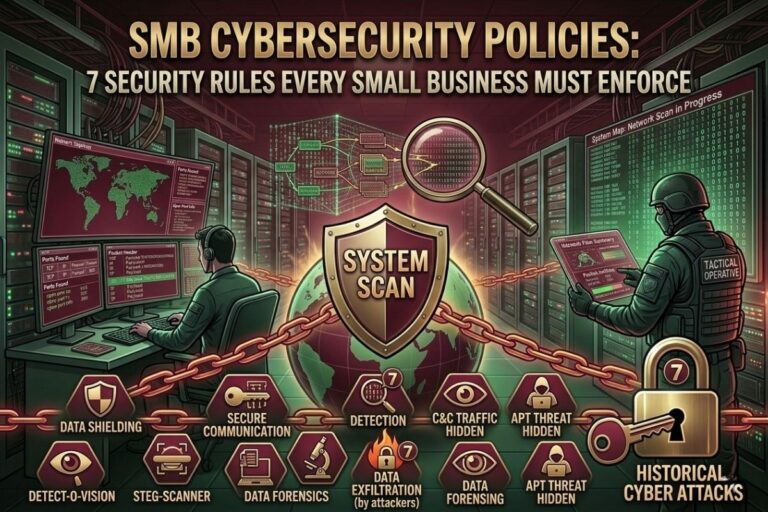
Strong SMB cybersecurity policies establish the rules that guide how employees interact with company systems and sensitive data. By implementing policies for password management, multi-factor authentication, email security, remote work, data protection, and incident reporting, businesses significantly reduce their exposure to cyber threats.
For small businesses building a long-term security strategy, well-defined SMB cybersecurity policies are a critical step toward creating a resilient and secure operating environment.
😄 Cyber Joke
Why did the small business finally create cybersecurity policies?
Because “hope nothing happens” isn’t a security strategy! 😄