
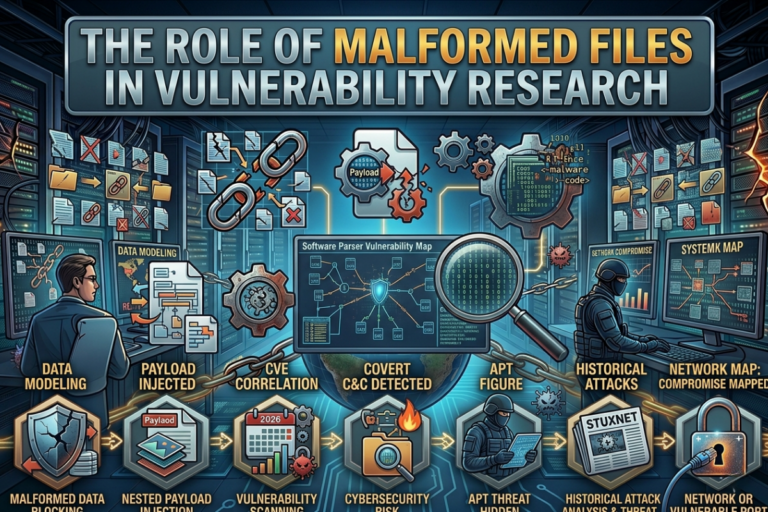
A file can tell you more about a system than a full audit.
Security researchers often start with something simple. They open a file. They modify it. They push it just slightly outside the rules. Then they watch how the software reacts.
This is the point where malformed files start to reveal their real value. They go beyond attack tools and help uncover hidden flaws in software.
If a program cannot safely handle unexpected input, it is already vulnerable. Malformed files help researchers prove that.
Why Malformed Files Are Central to Vulnerability Research
Most software depends on input. Files are one of the most common inputs, and every file is handled by a parser.
Parsers expect structure. When that structure is slightly altered, their behavior can change in ways developers did not expect. This is exactly what researchers look for.
By introducing controlled changes into files, researchers can trigger behavior that normal testing never reaches. This helps uncover file parsing vulnerabilities that stay hidden under standard conditions.
Malformed files are valuable because they:
- Expose weak input validation vulnerabilities
- Reveal how software handles unexpected input
- Trigger hidden memory issues
- Create reliable conditions for testing
- Help identify paths that lead to deeper system compromise
📌 Recommended Reading
Malformed Files: How Hackers Exploit Software ParsersHow Researchers Use Malformed Files to Find Vulnerabilities
Researchers take a valid file and begin to modify it in controlled ways. They may change sizes, headers, object relationships, or embedded data.
Then they observe how the application reacts.
- Controlled File Manipulation
Instead of breaking everything at once, researchers adjust one element at a time. This helps isolate which part of the structure causes a failure.
For example:
- Changing file length fields
- Altering header values
- Injecting unexpected data into structured sections
- Fuzzing as a Discovery Method
One of the most widely used techniques is fuzzing.
In fuzz testing, automated tools generate large volumes of malformed or semi-valid files and feed them into the target application. The goal is simple. Find a crash.
Once a crash is detected, it becomes a signal. Something inside the parser failed.
This approach is highly effective for uncovering:
- Memory corruption vulnerabilities
- Crashes caused by invalid input
- Unexpected execution paths
- Triggering Parser Weaknesses
Parsers often trust internal file structures more than they should. When a malformed file breaks those assumptions, the software may:
- Read beyond allocated memory
- Misinterpret data types
- Process invalid object relationships
These behaviors point directly to parser vulnerabilities.
Researchers use this information to understand how deep the issue goes and whether it can be exploited.
How Malformed Files Reveal Weak Points Across Systems
Malformed file testing is not limited to labs or theory. It directly impacts real systems that people use every day.
- Software Development and Secure Coding
Developers use malformed files to test how resilient their applications are. This helps them fix issues before release.
- Browser and Document Security
Browsers and document viewers process complex file formats. Malformed file testing helps identify weaknesses in these high-risk environments.
- Malware Analysis
Security teams study how attackers use malformed files in real campaigns. This helps improve detection and response strategies.
- Vulnerability Disclosure Programs
Researchers often report findings from malformed file testing through bug bounty programs. Many high-severity vulnerabilities are discovered this way.
Why File-Based Testing Still Breaks Modern Systems
You might expect that modern software has already solved these issues. That is not the case.
There are a few reasons why file-based vulnerabilities continue to surface:
- File formats are complex and difficult to validate fully
- Legacy parsing code still exists in many systems
- Performance is often prioritized over strict validation
- Rare edge cases are easy to miss during development
These gaps create opportunities. Malformed files are one of the most direct ways to uncover them.
How Testing With Malformed Files Builds Safer Systems
Finding vulnerabilities is only part of the story.
Malformed file testing also helps improve software quality. It forces developers to think beyond ideal input. It pushes systems to handle unexpected conditions safely.
This can:
- Strengthen validation logic
- Improve error handling
- Reduce the risk of exploitation
- Build more resilient systems
Final Thoughts
A file does not need to look dangerous to be dangerous.
In vulnerability research, even a small change inside a file can uncover serious flaws in how software handles data. It can reveal gaps in parsing, memory handling, and execution flow that are not visible during normal testing.
That is why malformed files continue to play such an important role.
If your system processes files, the risk is already there. The real value comes from understanding how far that risk can go.
One practical way to explore this is by working directly with altered file structures. File Corrupter lets you experiment with file corruption in a controlled way, so you can see how software reacts and where it starts to break.
Sometimes, the clearest answers come from pushing a file just far enough to expose what is hidden underneath
😄 Cyber Joke
Why do security researchers love malformed files?
Because sometimes breaking software is the best way to improve it! 😄