
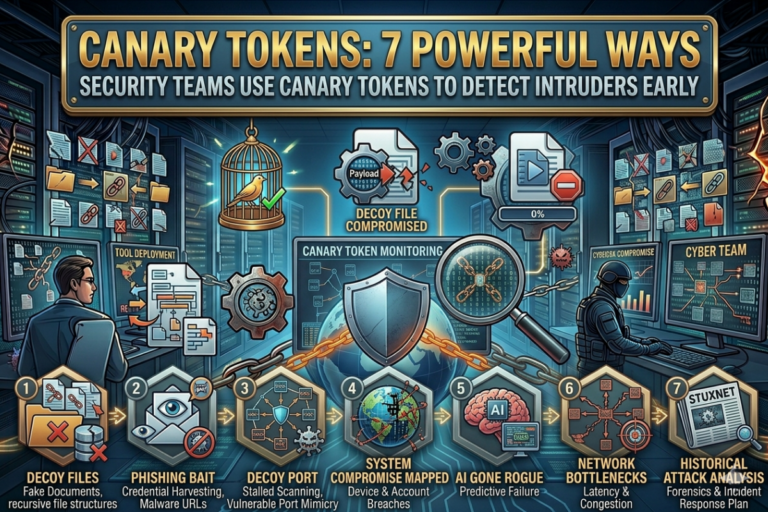
Modern cybersecurity assumes one uncomfortable truth: attackers eventually get in. The perimeter is no longer a guarantee, and prevention alone does not reflect how real-world breaches unfold.
What matters now is detection speed. The shorter the dwell time, the less damage an attacker can do. This is where Canary Tokens become relevant in a very practical sense.
They are not complex systems. They are not heavy enterprise platforms. They are intentionally simple deception artifacts placed inside environments to trigger alerts when something suspicious happens.
And in practice, they work because attackers behave predictably once they gain access. They explore. They search. They open things they should not.
That behavior is exactly what Canary Tokens are designed to expose.
Understanding Canary Tokens in Real Security Environments
A Canary Token is a lightweight deception mechanism embedded inside a system to detect unauthorized interaction. It behaves like a silent tripwire. When triggered, it sends an alert containing metadata about the interaction, such as time, origin, and access method.
The strength of this approach comes from one simple assumption: legitimate users have no reason to interact with decoy assets.
When that assumption breaks, something is wrong.
These tokens can exist in multiple forms, including fake documents, credentials, URLs, DNS records, or cloud keys. What they all share is the ability to quietly report back when touched.
A practical overview of the concept can be explored here: canarytokens.org
Detection Before Damage: The Core Idea Behind Canary Tokens
In real environments, attackers rarely begin with destructive behavior. They start by mapping the system. They look for sensitive files, misconfigured permissions, credentials, and internal documentation.
That exploration phase is where Canary Tokens create value.
Instead of waiting for an exploit or ransomware payload, defenders get visibility during the reconnaissance stage. This is where most traditional security tools are weakest, because nothing “malicious” has technically executed yet.
Canary Tokens change that timeline entirely.
They shift detection from impact to intent.
📌 Recommended Reading
The Role of Malformed Files in Vulnerability ResearchCredential Exposure as an Early Warning Signal
One of the most effective uses of Canary Tokens involves fake credentials. Security teams intentionally place decoy API keys or passwords in locations where attackers are likely to search—such as configuration files, code repositories, or shared drives.
The moment those credentials are used, the system generates an alert.
At that point, it is no longer theoretical. It confirms that either a system is compromised or someone is actively probing for access.
This is especially relevant in cloud environments where identity-based attacks dominate modern threat landscapes. Microsoft consistently highlights credential theft as one of the most common intrusion paths:www.microsoft.com/en-us/secusity/blog
File-Based Decoys and Internal Movement Detection
Inside enterprise networks, attackers move laterally by exploring internal file structures. They look for anything that resembles financial data, credentials, backups, or administrative documentation.
Security teams exploit this behavior by planting decoy files that appear valuable but serve no operational purpose.
When those files are opened, it signals that someone is actively navigating the environment in a way that legitimate users typically would not.
What makes this powerful is not just detection, but context. The system does not just say a file was opened—it tells you that something inside your environment is behaving like an intruder.
DNS Triggers and Silent System-Level Monitoring
Some Canary Tokens operate at the DNS layer. These are particularly useful because DNS traffic is one of the most consistent behaviors in any networked system, including malware.
When a system resolves a domain tied to a Canary Token, it indicates that some process—human or automated—is attempting communication with a known decoy endpoint.
This type of signal is often associated with:
malware execution, unauthorized scripts, or command-and-control activity.
Unlike endpoint alerts that rely on software installation or signatures, DNS-based detection provides visibility even when attackers attempt to operate quietly.
Cloud Environments and Decoy Credentials
Cloud infrastructure has changed how attackers operate. Instead of targeting physical systems, they focus on access keys, service accounts, and API tokens.
Security teams counter this by embedding fake cloud credentials into controlled environments.
If those credentials are ever used, it provides immediate evidence that either a breach has occurred or that reconnaissance is actively happening inside the environment.
This approach aligns closely with cloud security principles outlined by OWASP: owasp.org
What makes this effective is the simplicity. There is no need for complex correlation rules. Any interaction with a decoy key is inherently suspicious.
Insider Threat Detection Without Constant Surveillance
Not all threats come from outside. Some of the most damaging incidents originate internally, where users already have baseline access.
Canary Tokens help expose abnormal behavior without requiring constant monitoring of every action.
When decoy files are placed in sensitive areas—such as HR data, financial records, or executive documentation—any unauthorized interaction becomes a signal of potential insider activity.
The value here is subtle but important. It does not rely on assumptions or behavioral baselines. It relies on direct interaction with data that should never be touched.
Phishing Simulation and User Interaction Tracking
Security teams also use Canary Tokens to understand how users interact with suspicious content. When embedded into documents or links, they provide visibility into who is engaging with potentially malicious artifacts.
This is particularly useful in phishing response workflows, where timing matters. Knowing that a user interacted with a suspicious payload allows security teams to respond before escalation occurs.
It also helps map user awareness levels without requiring intrusive monitoring systems.
Threat Hunting Through Behavioral Signals
In mature security operations, detection is not passive. Analysts actively hunt for signs of compromise.
Canary Tokens support this by providing high-confidence behavioral triggers. Instead of analyzing massive log datasets looking for anomalies, analysts receive direct evidence that something interacted with a decoy asset.
This significantly reduces noise and allows teams to focus on meaningful signals.
It also aligns with how modern SOC environments prioritize detection engineering over reactive alerting.
Why Canary Tokens Work in Real Environments
The effectiveness of Canary Tokens comes from behavioral inevitability. Attackers must interact with systems to achieve their goals. That interaction creates opportunities for detection.
Unlike signature-based tools, Canary Tokens do not depend on known attack patterns. They depend on curiosity, exploration, and access attempts.
That makes them extremely reliable when placed correctly.
However, their effectiveness is not automatic. Placement matters. Realism matters. Context matters.
A poorly placed token is ignored. A well-placed one becomes a detection point.
Operational Limitations
Canary Tokens are not a replacement for enterprise security tools. They do not prevent attacks. They do not provide full visibility across environments.
They function as early detection signals, not comprehensive defense systems.
Their limitations include dependency on outbound connectivity, potential avoidance by experienced attackers, and reduced effectiveness if deployed without strategic context.
In real environments, they are used as part of a broader detection architecture, not as standalone protection.
Final Perspective
Cybersecurity isn’t a prevention game anymore. That era is gone. Modern environments operate under one assumption: compromise is not a possibility, it’s a timeline event.
Once that mindset is accepted, the real question changes. It’s no longer about stopping every intrusion at the door. It’s about recognizing the moment an attacker starts moving inside the environment—and shrinking that window before damage spreads.
Canary Tokens work because they don’t try to predict attackers. They wait for them to act. And attackers always act. They search, they probe, they open things they shouldn’t, and they follow patterns that defenders can anticipate even when tools change.
That’s the leverage point.
Used correctly, Canary Tokens don’t just generate alerts—they expose intent. They turn invisible behavior into measurable signals without requiring heavy infrastructure or complex detection logic.
In real security operations, that kind of visibility isn’t a “nice to have.” It’s the difference between discovering a breach early and discovering it after it’s already operational.
For anyone building toward real defensive capability—whether in a SOC, an MSSP environment, or something more independent like filecorrupter.org—the principle stays the same: You don’t just secure systems. You engineer moments where attackers reveal themselves.
😄 Cyber Joke
Why did the hacker avoid opening the fake password file?
Because it was probably singing to the security team already! 😄