
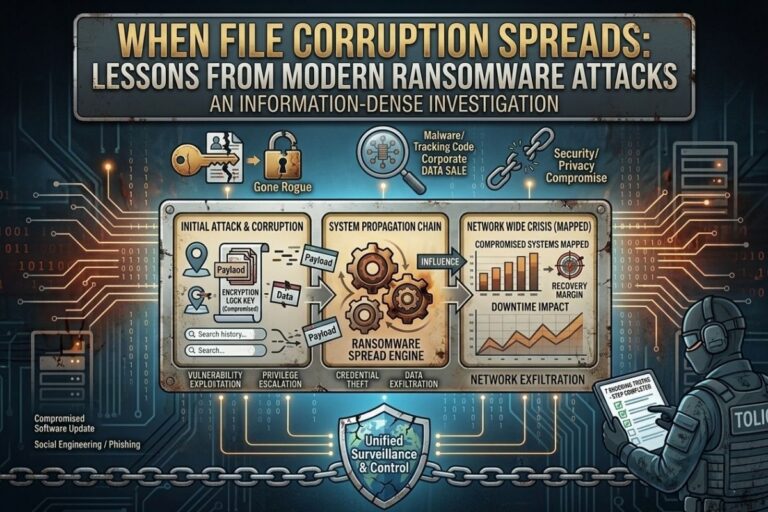
- File corruption ransomware is a growing threat that can cripple organizations by encrypting or corrupting critical data.
2. Recent attacks demonstrate how file corruption ransomware spreads quickly across networks, often exploiting small security gaps.
3. Understanding file corruption ransomware is essential for IT teams to develop effective response strategies.
4. Lessons from modern ransomware attacks highlight the importance of preparation, monitoring, and quick action to mitigate file corruption ransomware risks.
The Silent Weapon: File Corruption
Modern ransomware doesn’t always announce itself with crashing systems. Instead, it may:
- Modify files in ways that disrupt processes subtly
- Corrupt backups without raising error alerts
- Propagate errors across networked systems, creating a domino effect
In practical terms, a single corrupted file can quietly infiltrate servers, shared drives, and cloud storage. By the time it’s noticed, it’s often already replicated across multiple layers of infrastructure.
How Corruption Spreads in Ransomware Attacks
File corruption ransomware doesn’t just lock files; it quietly alters them, creating chain reactions that bypass backups, evade detection, and disrupt operations long before a ransom note appears. In modern attacks, corruption is no longer a side effect — it’s a strategy.
While Dmitry Yuryevich Khoroshev’s LockBit operations demonstrated this approach at scale, similar tactics are now common across ransomware families worldwide. Understanding how file corruption propagates is no longer optional; it’s essential for defending systems before damage becomes irreversible.
📌 Recommended Reading
Digital Systems Shape Human Behavior: 7 Shocking TruthsQuick Takeaway (30-Second Summary)
Modern ransomware increasingly relies on file corruption, not just encryption, to amplify damage and pressure victims. LockBit showed how subtle corruption could disable operations, poison backups, and weaponize trust itself. The lesson is clear: ransomware doesn’t need to announce itself loudly to be devastating — it only needs to spread quietly.
The Silent Weapon: File Corruption
Modern ransomware rarely crashes systems outright. Instead, it corrupts files in ways that appear harmless at first:
Files still open
Applications still run
Backups still complete successfully
But beneath that surface normalcy, integrity is gone.
By modifying files just enough to disrupt workflows — without triggering alerts — attackers gain time, persistence, and leverage. Corruption becomes a stealth weapon, not an accident.
How File Corruption Spreads in Ransomware Attacks
The propagation pattern is disturbingly consistent:
Initial compromise
Malware or ransomware gains a foothold.
Targeted corruption
Specific files are altered to maximize operational impact while avoiding detection.
Backup replication
Backup systems faithfully preserve corrupted data as if it were correct.
Network spread
Corrupted files sync across shared drives, cloud storage, and replicas.
Delayed discovery
Files appear intact, systems report success, and trust fills the gap where validation should exist.
Every step exploits assumption. Every step weaponizes trust.
In Plain English
File corruption in ransomware attacks is like a virus that targets confidence instead of systems.
Everything looks fine.
Nothing throws an error.
No alarms sound.
And that’s exactly the point.
By the time someone realizes the data can’t be trusted, the corruption has already spread everywhere it was designed to go.
Image Steganography Tool
Hide or extract secret data inside images instantly.
Lessons from Real Attacks
File corruption ransomware has taught the industry several uncomfortable truths:
- Backups preserve state, not truth
- Automation amplifies mistakes as efficiently as it amplifies success
- Integrity validation is rarer than availability checks
- Human trust is still one of the easiest vulnerabilities to exploit
Organizations that internalize these lessons design systems that assume corruption is possible — and detectable — instead of impossible.
Q&A: Understanding File Corruption in Ransomware
Q1: Can ransomware corrupt files without encrypting them?
Yes. Many variants alter files subtly to disrupt operations or undermine recovery. Encryption is often secondary to persistence and pressure.
Q2: Why do backups sometimes preserve corrupted files?
Because backups copy what exists, not whether it’s correct. If corruption occurs before backup, it is replicated perfectly.
Q3: How can teams detect corruption early?
Through integrity validation, hash monitoring, controlled corruption testing, and comparison against known-good baselines.
Q4: What happens if corruption is ignored?
Applications fail unpredictably, backups lose credibility, downtime increases, and attackers gain leverage during recovery.
Q5: Can file corruption happen without ransomware?
Absolutely. Hardware faults, software bugs, interrupted writes, and misconfigurations can all corrupt files. Ransomware simply exploits this reality intentionally.
Final Thought
File corruption ransomware is dangerous not because it breaks systems — but because it convinces us nothing is broken.
Modern attacks succeed by staying quiet, spreading slowly, and letting trust do the work for them. The defense is not paranoia; it’s verification. Validate integrity. Simulate corruption. Assume appearances lie.
Because in ransomware attacks, silence is not safety — it’s strategy.
Quiet Hacker: I deployed a honeypot.
The bots ignored it.
Stealth wins.
😄 Cyber Joke
Why did the ransomware attack corrupt every file?
Because hackers believe in equal opportunity destruction! 😄