
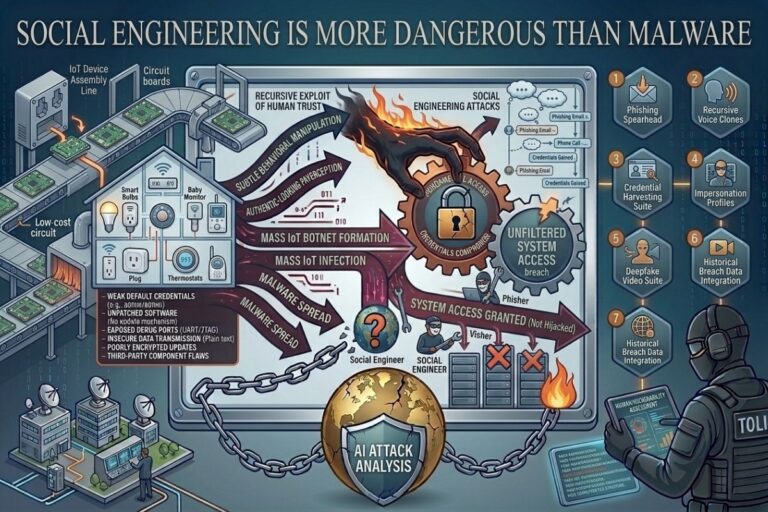
Most people fear malware.
They picture ransomware locking files, spyware stealing data, or malicious code spreading through a network. Those threats are real, and they cause billions of dollars in damage every year.
But what if the greatest cyber threat isn’t a piece of software at all?
What if the most dangerous attack is the one that convinces you to open the door yourself?
That is exactly why social engineering has become one of the most effective weapons in a cybercriminal’s arsenal. Attackers have learned that hacking people is often easier than hacking technology.
Cybercriminals no longer need to break into your systems when they can simply persuade you to hand them the keys.
What Is Social Engineering?
Social engineering is the art of manipulating people into performing actions they normally would not take.
Instead of exploiting a software vulnerability, attackers exploit human emotions.
They target trust.
They target fear.
They target urgency.
They target curiosity.
The attacker’s objective is simple. Convince a person to click a link, reveal sensitive information, transfer money, install software, or grant access.
In many cases, no sophisticated malware is required.
Why Social Engineering Works So Well
Technology continues to improve. Firewalls are stronger. Security tools are smarter. Artificial intelligence is helping organizations detect threats faster than ever before.
Humans, however, remain human.
People become distracted.
People become stressed.
People make mistakes.
An employee may ignore a suspicious attachment ninety-nine times. The attacker only needs them to make a mistake once.
This reality gives cybercriminals a tremendous advantage.
A single convincing email can bypass millions of dollars worth of security technology.
The Human Element Is the Weakest Link
Organizations often spend significant amounts of money protecting systems while investing far less in protecting people from manipulation.
Attackers know this.
They carefully study their targets.
They research executives on social media.
They gather information from public sources.
They learn organizational structures.
They identify employees who may have access to sensitive systems.
Armed with that information, they create highly convincing messages designed to appear legitimate.
The result is an attack that feels authentic because it was built around real information.
Social Engineering Can Lead to Catastrophic Breaches
Many of the most damaging cybersecurity incidents begin with a human mistake.
An employee clicks a malicious link.
A finance manager approves a fraudulent wire transfer.
A help desk representative resets an account for someone pretending to be an executive.
The initial action may seem minor.
The consequences often are not.
Attackers can gain access to networks, steal intellectual property, deploy ransomware, and compromise customer information.
The breach often begins with a simple conversation, email, or text message.
Malware Often Depends on Social Engineering
Here’s a fact many people overlook.
Malware and social engineering are not always separate threats.
In many cases, malware relies on social engineering to succeed.
An attacker sends a convincing email.
The recipient clicks a link.
Malware is downloaded.
The infection begins.
Without the social engineering component, the malware never reaches its target.
This is one of the reasons social engineering deserves more attention. It frequently acts as the gateway to larger attacks.
Also Read: Why Cybercriminals Love Cheap Smart Devices
The Rise of AI Has Made the Problem Worse
Artificial intelligence is changing the threat landscape.
Attackers can now generate highly convincing emails in seconds.
They can create fake voices.
They can create realistic videos.
They can impersonate executives, coworkers, and trusted organizations with increasing accuracy.
The barrier to entry is falling.
Threat actors no longer need exceptional writing skills or extensive technical knowledge to launch persuasive campaigns.
As AI technology improves, social engineering attacks will become even more difficult to identify.
Why Businesses Should Be Concerned
Many organizations focus heavily on technical controls while underestimating human risk.
That approach creates dangerous blind spots.
A company can have strong endpoint protection, advanced monitoring tools, and modern security infrastructure.
If employees are not trained to recognize manipulation tactics, attackers may still gain access.
Cybersecurity is no longer just a technology problem.
It is a people problem.
Organizations that fail to recognize this reality place themselves at significant risk.
How to Defend Against Social Engineering
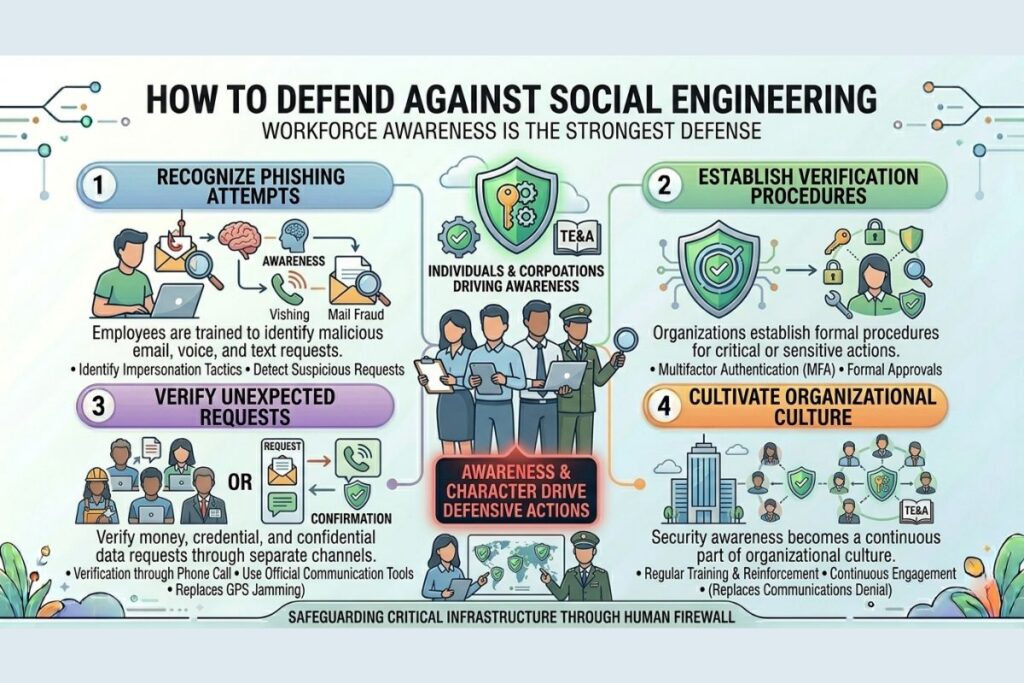
Technology plays an important role, but awareness remains critical.
Employees should be trained to recognize phishing attempts, impersonation tactics, and suspicious requests.
Organizations should establish verification procedures for sensitive actions.
Unexpected requests involving money, credentials, or confidential information should always be verified through separate communication channels.
Security awareness should not be treated as a one-time event.
It should become part of organizational culture.
The strongest defense against social engineering is a workforce that understands how manipulation works.
The Real Lesson
Cybersecurity professionals often focus on vulnerabilities in software.
Attackers increasingly focus on vulnerabilities in people.
That shift changes everything.
The most sophisticated malware in the world may fail if it never reaches its target.
A convincing social engineering attack can succeed with nothing more than a carefully crafted message.
Understanding that reality is essential for individuals, businesses, and security leaders alike.
FAQs
What is the most common form of social engineering?
Phishing remains the most common form of social engineering. Attackers use emails, text messages, and websites designed to appear legitimate in order to steal information or gain access.
Is social engineering more dangerous than ransomware?
In many cases, yes. Social engineering often serves as the entry point that enables ransomware attacks to occur in the first place.
Can cybersecurity software stop social engineering attacks?
Security software can help reduce risk, but it cannot eliminate human error. Employee awareness and verification procedures remain essential.
Why are social engineering attacks increasing?
Attackers recognize that manipulating people is often easier than bypassing technical security controls. The growth of AI-generated content has also made these attacks more convincing.
Final Thought
The cybersecurity industry spends enormous amounts of time discussing malware.
Perhaps it should spend more time discussing people.
Technology can be patched.
Software can be updated.
Human trust is far more difficult to secure.
The next major breach may not begin with malicious code. It may begin with a simple conversation, a convincing email, or a moment of misplaced trust.
The most dangerous cyber weapon on Earth may not be hidden inside a computer. It may be hidden inside a perfectly crafted message.
Explore More Free Tools
Hash Generator Tool
Generate secure MD5, SHA1, SHA256, and other cryptographic hashes instantly online.
Open Tool →Dummy File Generator
Create sample dummy files of custom sizes for testing uploads, storage, and applications.
Open Tool →Password Strength Checker
Analyze password security and identify weak passwords before using them online.
Open Tool →File Hash Checker
Verify file integrity by checking MD5, SHA256, and other file hash signatures.
Open Tool →UUID Generator
Generate random UUIDs and unique identifiers instantly for apps, APIs, and databases.
Open Tool →Text Diff Checker
Compare two text blocks side by side and quickly detect additions, deletions, and edits.
Open Tool →