
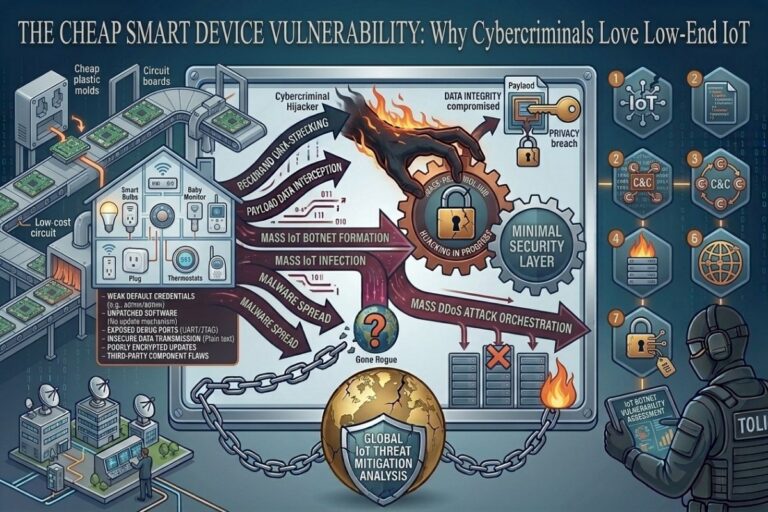
That bargain-priced smart camera sitting on a store shelf may be one of the most dangerous devices you ever bring into your home.
It promises convenience. It promises security. It promises peace of mind.
What it often fails to promise is cybersecurity.
Millions of consumers purchase cheap smart devices every year because they appear to offer incredible value. Smart cameras, video doorbells, baby monitors, smart plugs, and connected appliances can now be purchased for less than the cost of a family dinner. The low price tag makes them attractive, especially when competing products cost significantly more.
The problem is that cybersecurity costs money.
Security engineers cost money.
Software updates cost money.
Penetration testing costs money.
Vulnerability management costs money.
Long-term support costs money.
When manufacturers compete to build the cheapest connected devices on the market, something often gets sacrificed. More often than not, that sacrifice is security.
Cybercriminals know this.
While consumers see affordability, attackers see opportunity.
Every vulnerable smart device connected to the internet represents a potential surveillance tool, botnet recruit, network entry point, or data collection device waiting to be exploited.
The scary part is that many owners never realize they have a problem until after attackers have already found their devices.
At FileCorrupter.org, one of the biggest cybersecurity myths we encounter is the belief that hackers only target large corporations. In reality, attackers frequently go after easy targets. A poorly secured smart device inside a home can be far easier to compromise than a well-defended enterprise network.
The Billion-Dollar Problem Nobody Talks About
The smart home industry has exploded over the past decade.
Consumers can now control lights, locks, cameras, thermostats, appliances, and entertainment systems from their smartphones. Manufacturers have rushed to meet demand, producing thousands of connected products at increasingly lower prices.
Unfortunately, security has not always kept pace.
Many low-cost manufacturers operate on razor-thin profit margins. Their business model depends on selling large volumes of devices as cheaply as possible. That often means cybersecurity receives less attention than product features and marketing.
Consumers rarely compare security features before making a purchase. Most compare price, reviews, and convenience.
As a result, manufacturers have little financial incentive to invest heavily in cybersecurity if consumers are not demanding it.
This creates the perfect environment for vulnerable products to flood the market.
Attackers understand this reality better than most consumers do.
How Hackers Find Vulnerable Smart Devices
Many people imagine hackers manually searching for victims one device at a time.
The reality is far more efficient.
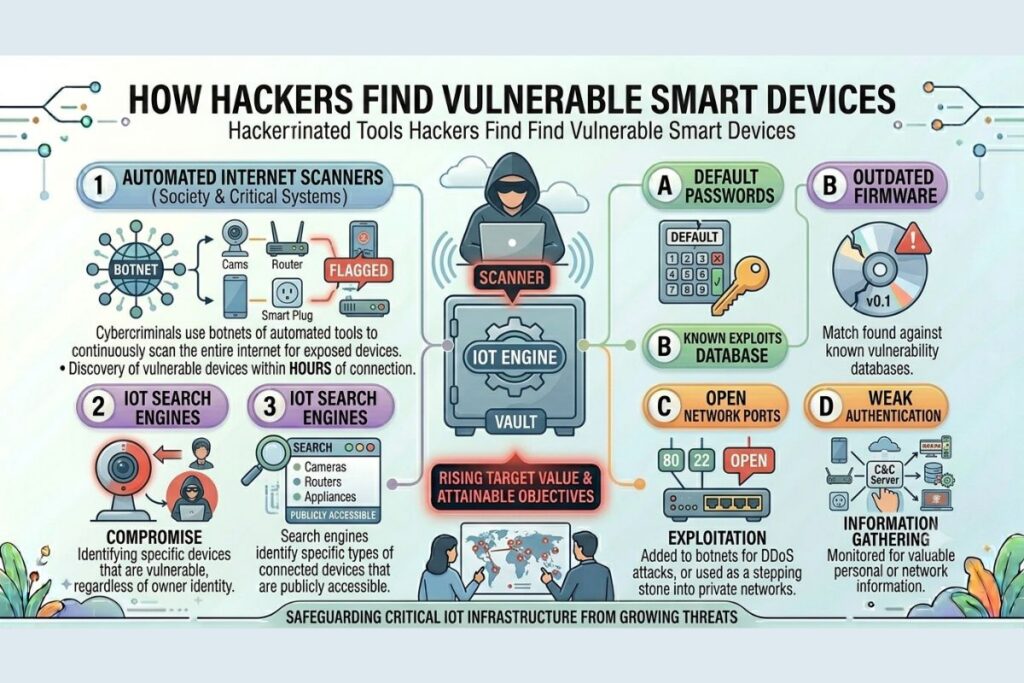
Cybercriminals use automated tools that continuously scan the internet looking for exposed devices. Search engines designed for internet-connected technology can identify cameras, routers, smart appliances, and other devices that are publicly accessible.
A single vulnerable device can be discovered within hours of being connected to the internet.
Attackers often search for:
- Default passwords
- Outdated firmware
- Open network ports
- Weak authentication systems
- Known software vulnerabilities
Once identified, compromised devices may be added to attack infrastructure, monitored for valuable information, or used as stepping stones into larger networks.
The process is largely automated.
The cybercriminal does not need to know who you are.
They simply need to know your device is vulnerable.
Reason #1: Cheap Devices Often Ship With Weak Security
One of the most common problems in low-cost smart devices is poor security design.
Some devices still ship with default usernames and passwords that users never change. Others use weak authentication mechanisms that can be bypassed by attackers.
In some cases, manufacturers prioritize ease of setup over security.
The result is predictable.
Cybercriminals maintain extensive databases containing default credentials for thousands of devices. Automated tools test those credentials against internet-connected devices every day.
If the owner never changed the password, access can be obtained within seconds.
Imagine installing a security camera to protect your property only to discover that an attacker can view the same footage remotely.
It sounds absurd.
Yet incidents like this have occurred repeatedly across the smart device industry.
Reason #2: Security Updates Frequently Disappear
Every software product eventually develops vulnerabilities.
The difference between a secure product and an insecure one often comes down to maintenance.
Responsible manufacturers continuously release updates to address newly discovered weaknesses. Many bargain-priced manufacturers do not.
Some companies abandon products after only a few years. Others disappear entirely.
When support ends, vulnerabilities remain.
Attackers pay close attention to products that no longer receive updates because they know those weaknesses will likely remain unpatched forever.
The official guidance from CISA consistently emphasizes the importance of maintaining updated software because known vulnerabilities remain one of the most common attack vectors used by cybercriminals.
A smart device without ongoing support eventually becomes a cybersecurity liability.
Reason #3: Weak Encryption Can Expose Private Information
Encryption protects information while it travels across networks.
Without strong encryption, data can potentially be intercepted and viewed by unauthorized individuals.
Many low-cost devices have historically used outdated encryption standards or implemented encryption incorrectly.
This can expose sensitive information such as:
Personal account credentials
Video feeds
Audio recordings
Location data
Device settings
Network information
For a cybercriminal, this information can be incredibly valuable.
What appears to be a harmless smart camera or baby monitor may actually provide access to highly personal details about a household.
Privacy violations can quickly become security incidents.
Reason #4: Your Device Could Become Part of a Botnet
One compromised device may not seem significant.
Thousands of compromised devices are another story.
Cybercriminals frequently assemble botnets, which are networks of infected devices controlled remotely by attackers.
Perhaps the most famous example was the Mirai botnet. In 2016, Mirai infected massive numbers of vulnerable Internet of Things devices and helped launch one of the largest distributed denial-of-service attacks ever recorded.
Many infected devices belonged to ordinary consumers who had no idea their hardware had been compromised.
Their devices continued functioning normally while secretly assisting cybercriminal operations.
Botnets can be used to:
Launch denial-of-service attacks
Distribute malware
Scan for new victims
Conduct credential attacks
Support criminal infrastructure
A cheap smart device can become an unwitting participant in cybercrime without the owner’s knowledge.
Also Read: Commercial Satellite Hacking: Could Cybercriminals Hijack Satellites?
Reason #5: One Device Can Open the Door to Your Entire Network
This is arguably the most dangerous risk.
Many cybercriminals do not care about the smart device itself.
They care about what lies beyond it.
Once attackers gain access to a vulnerable device, they often attempt lateral movement. This involves exploring other systems connected to the same network.
That could include:
Personal computers
Smartphones
Network storage devices
Business laptops
Financial records
Sensitive documents
Personal photographs
Imagine leaving a window unlocked in your home.
The burglar does not enter because they want the window.
They enter because the window provides access to everything else inside.
Cheap smart devices often function exactly the same way.
The compromised camera is not necessarily the target.
Your digital life is.
Real Attacks That Already Happened
Some people dismiss smart device security concerns as theoretical.
They are not.
Numerous incidents have demonstrated the risks associated with poorly secured connected devices.
Researchers have repeatedly identified vulnerabilities in smart cameras that allowed unauthorized viewing of video streams.
Baby monitors have been compromised, enabling strangers to communicate through devices intended to protect children.
Routers and connected appliances have been recruited into botnets used to launch large-scale attacks.
Low-cost Android-based streaming devices have even been discovered containing malware before consumers opened the box.
These are not isolated incidents.
They are examples of what happens when security becomes an afterthought.
Cybercriminals consistently target the weakest link.
Cheap smart devices frequently become that weak link.
How to Buy Smart Devices Without Regretting It Later
You do not need to avoid smart technology entirely.
You simply need to shop smarter.
Research the manufacturer before making a purchase.
Look for companies with a proven history of releasing security updates.
Verify whether the manufacturer publishes vulnerability disclosures and maintains active customer support.
Check whether multi-factor authentication is available.
Review independent security assessments whenever possible.
The resources available through the OWASP Foundation can provide valuable insight into common Internet of Things security weaknesses.
After purchasing a device, change default passwords immediately.
Install updates regularly.
Disable unnecessary features.
Avoid exposing devices directly to the internet whenever possible.
Consider placing smart devices on a separate guest network from computers and sensitive systems.
A small amount of cybersecurity planning can significantly reduce your risk.
Frequently Asked Questions
Are cheap smart devices always insecure?
No. Some affordable devices offer excellent security. The key is evaluating the manufacturer’s security practices, update history, and reputation rather than focusing solely on price.
Why do cybercriminals target smart devices?
Smart devices often have weaker security controls than traditional computers and may remain unpatched for long periods, making them attractive targets.
Can a hacked smart device access other devices in my home?
Potentially, yes. Attackers may use a compromised device as a starting point for exploring other systems connected to the same network.
What is the safest way to use smart home devices?
Keep firmware updated, change default passwords, enable multi-factor authentication when available, and place smart devices on a separate network whenever possible.
Final Thought
Every smart device is a computer.
Every computer can be attacked.
The only question is whether the manufacturer invested enough time, money, and effort to make that attack difficult.
Cheap smart devices often provide the wrong answer.
Cybercriminals understand this.
That is why they actively search for vulnerable cameras, doorbells, baby monitors, routers, and connected appliances. They know many manufacturers prioritize low prices over strong security controls.
The next time a smart device seems unbelievably cheap, ask yourself a simple question:
What corners were cut to reach that price?
Because cybersecurity is rarely listed as a feature on the box.
It is usually the feature you discover is missing after the breach.
For more cybersecurity insights, practical security guidance, and real-world threat analysis, visit FileCorrupter.org and stay one step ahead of the criminals looking for their next easy target.
Explore More Free Tools
Hash Generator Tool
Generate secure MD5, SHA1, SHA256, and other cryptographic hashes instantly online.
Open Tool →Dummy File Generator
Create sample dummy files of custom sizes for testing uploads, storage, and applications.
Open Tool →Password Strength Checker
Analyze password security and identify weak passwords before using them online.
Open Tool →File Hash Checker
Verify file integrity by checking MD5, SHA256, and other file hash signatures.
Open Tool →UUID Generator
Generate random UUIDs and unique identifiers instantly for apps, APIs, and databases.
Open Tool →Text Diff Checker
Compare two text blocks side by side and quickly detect additions, deletions, and edits.
Open Tool →