
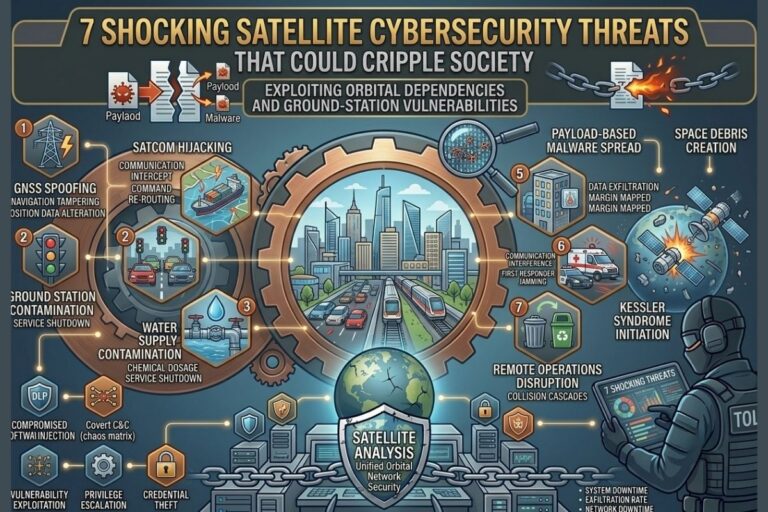
Satellite cybersecurity is no longer a futuristic discussion reserved for military analysts and aerospace engineers. It is rapidly becoming one of the most important cybersecurity issues on Earth. Most people never think about the infrastructure silently orbiting above them every single day, yet modern civilization depends heavily on satellites for communication, banking systems, navigation, weather forecasting, emergency response coordination, internet connectivity, and military operations.
That dependency creates opportunity for attackers.
Hack a satellite, and you do not just steal data. You interfere with navigation systems, military communications, emergency response infrastructure, aircraft routing, weather monitoring, and potentially financial timing systems that modern economies depend on.
That is not science fiction anymore.
That is the modern cybersecurity battlefield.
At filecorrupter.org, we focus on cybersecurity threats that carry real-world consequences. Satellite cybersecurity sits directly at the center of that conversation because attacks against space infrastructure could affect millions of people simultaneously without a single shot being fired.
Most cyberattacks today target organizations, businesses, or individuals. The next generation of cyber warfare may target entire systems civilization relies on daily.
And satellites are one of the biggest targets in sight.
Satellite Cybersecurity Is Becoming a Critical Infrastructure Crisis
Most people associate cybersecurity with stolen passwords, ransomware infections, or social media hacks. While those threats remain serious, cyber warfare is evolving into infrastructure warfare.
Satellites are infrastructure.
GPS navigation systems, shipping routes, aircraft guidance, weather tracking systems, financial synchronization networks, and emergency communication systems all rely heavily on satellite technology. According to CISA’s space systems critical infrastructure guidance, space infrastructure now plays a direct role in national security, economic stability, and public safety.
That means satellite cyberattacks could create ripple effects across entire countries.
This is where cybersecurity becomes more than digital inconvenience.
It becomes societal risk.
Why Nation-State Cyber Groups Are Interested in Satellites
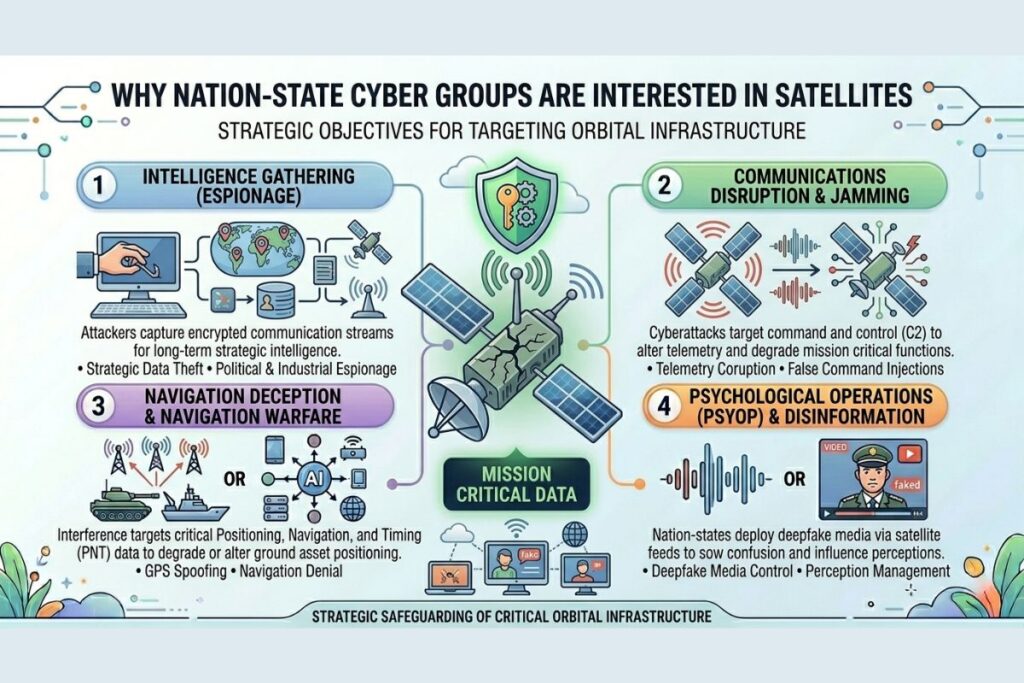
Governments already understand the strategic value of satellite infrastructure. Military operations increasingly depend on satellites for surveillance, reconnaissance, intelligence gathering, communication, navigation, and operational coordination.
That makes satellites attractive targets during geopolitical conflict.
Russia, China, and other major powers continue investing heavily in cyber warfare and anti satellite capabilities. According to NASA cybersecurity initiatives, protecting space systems from cyber threats is now considered an essential national security concern.
A successful cyberattack against satellite infrastructure could:
- disrupt military communication
- interfere with navigation systems
- damage intelligence operations
- create economic instability
- interrupt civilian infrastructure
This is why cybersecurity experts increasingly view space as an active cyber domain rather than a distant technological environment.
The battlefield has expanded beyond Earth.
Also Read: Smart City Cyber warfare: 7 Dangerous Threats Hackers Could Exploit
GPS Spoofing Could Trigger Large-Scale Chaos
One of the most alarming satellite cybersecurity threats is GPS spoofing.
GPS spoofing occurs when attackers manipulate navigation signals to deceive systems into calculating false positioning data. Devices receiving those fake signals believe they are somewhere they are not.
The implications are massive.
Commercial aircraft rely heavily on GPS navigation systems. Cargo ships depend on accurate routing data. Emergency response teams use GPS for deployment coordination. Financial institutions rely on precise satellite timing synchronization to process transactions.
A coordinated GPS spoofing campaign could disrupt transportation, logistics, banking systems, and emergency services simultaneously.
This is not theoretical.
Researchers and security experts have repeatedly demonstrated GPS spoofing vulnerabilities across multiple industries. According to European Space Agency cybersecurity research, protecting navigation systems against cyber interference is becoming increasingly important as digital infrastructure expands globally.
Satellite cybersecurity is no longer optional.
It is foundational.
Ground Stations May Be the Weakest Link
Most people imagine satellite hacking as attackers directly breaching systems orbiting Earth. In reality, ground stations are often more vulnerable.
Ground stations control communication, telemetry, software updates, operational commands, and data transmission for satellite systems. Compromising a ground station could potentially allow attackers to interfere with satellite operations indirectly.
Cybercriminals and nation-state threat actors may target:
- outdated software
- stolen credentials
- phishing attacks
- ransomware infections
- insider threats
- supply chain vulnerabilities
- insecure network architecture
This creates enormous risk because ground infrastructure is often connected to broader enterprise environments.
One compromised employee account could potentially create access pathways into highly sensitive infrastructure systems.
Attackers understand that humans frequently become the weakest cybersecurity layer.
That reality extends into satellite operations as well.
Satellite Internet Expands the Attack Surface
The rapid growth of satellite internet services introduces another major cybersecurity concern.
Commercial satellite internet providers are reshaping global connectivity by expanding internet access into remote regions, maritime environments, military operations, and disaster zones. While this creates tremendous technological advancement, it also dramatically expands the cyberattack surface.
More devices.
More networks.
More endpoints.
More vulnerabilities.
Satellite internet systems may become targets for:
- malware campaigns
- network intrusion attempts
- denial-of-service attacks
- credential theft
- firmware exploitation
- communication interception
Cybercriminals always target systems society depends on most heavily.
As satellite internet adoption increases worldwide, attackers gain stronger incentives to exploit weaknesses in those environments.
The expansion of commercial space technology is happening rapidly, but cybersecurity maturity often struggles to keep pace with innovation.
That imbalance creates opportunity for threat actors.
Emergency Response Systems Could Be Severely Impacted
One of the most disturbing aspects of satellite cybersecurity involves emergency communications.
During hurricanes, earthquakes, wildfires, terrorist attacks, and infrastructure failures, satellite communications often become essential when terrestrial systems fail. Emergency responders depend on resilient communication systems to coordinate rescue efforts, medical support, and disaster response operations.
Now imagine those systems becoming compromised during a crisis.
Communication disruptions during emergencies could:
- delay medical response
- disrupt evacuation coordination
- interfere with rescue operations
- isolate affected regions
- increase casualty risks
This is where cybersecurity becomes deeply human.
Cybersecurity failures are no longer limited to leaked passwords or stolen data. Infrastructure attacks now carry the potential to affect public safety directly.
That reality changes the entire cybersecurity conversation.
Financial Systems Quietly Depend on Satellites
Most people never realize how dependent financial systems are on satellite timing synchronization.
Banks, trading platforms, payment processors, and financial institutions rely on highly precise timing mechanisms to validate transactions and coordinate operations globally. Satellite systems help maintain that synchronization.
Disrupt those signals, and financial instability becomes possible.
Modern economies depend heavily on invisible infrastructure functioning continuously behind the scenes. Satellite cybersecurity protects far more than communication systems alone.
It protects economic stability itself.
That is why cyber warfare targeting infrastructure systems is becoming such a serious global concern.
Attackers increasingly recognize that infrastructure disruption creates far greater impact than isolated data theft.
Private Space Expansion Is Outpacing Cybersecurity
The commercial space industry is growing at extraordinary speed.
Private companies are launching satellites for communications, internet services, imaging systems, defense operations, scientific research, and logistics support. Innovation is accelerating rapidly, but cybersecurity protections do not always evolve at the same pace.
Fast growth often introduces:
- rushed deployments
- misconfigured systems
- inadequate security testing
- inconsistent patch management
- complex third-party integrations
Attackers search aggressively for these weaknesses.
As more organizations enter the commercial space industry, cybersecurity responsibilities expand far beyond government agencies. Private companies now operate critical infrastructure that could become attractive targets for advanced threat groups.
This creates enormous pressure on organizations to prioritize cybersecurity before major incidents occur.
Because once infrastructure becomes deeply integrated into society, vulnerabilities become significantly more dangerous.
Most People Still Underestimate the Threat
Satellite infrastructure feels distant to the average person.
People worry about ransomware, phishing attacks, identity theft, and social media hacks because those threats feel immediate. Space infrastructure feels abstract and disconnected from daily life.
That perception is dangerously inaccurate.
Without satellites:
- GPS systems weaken
- aircraft navigation becomes harder
- emergency communication systems suffer
- banking synchronization degrades
- logistics networks slow down
- weather forecasting becomes less reliable
- military coordination becomes more vulnerable
Satellite cybersecurity is not just about protecting systems orbiting Earth.
It is about protecting the digital foundation modern civilization quietly depends on every single day.
Frequently Asked Questions
What is satellite cybersecurity?
Satellite cybersecurity involves protecting satellites, communication systems, navigation infrastructure, and ground stations from cyberattacks, interference, unauthorized access, and digital disruption.
Can satellites really be hacked?
Yes. Attackers may target satellites directly or compromise supporting infrastructure such as ground stations, communication networks, authentication systems, and operational software.
What is GPS spoofing?
GPS spoofing is a cyberattack where false navigation signals are transmitted to deceive systems into calculating incorrect locations or timing information.
Why are satellites important to critical infrastructure?
Satellites support banking systems, military communication, internet connectivity, weather monitoring, emergency response coordination, navigation systems, and transportation infrastructure worldwide.
Final Thought
Most people still imagine cyber warfare happening inside computers sitting quietly in office buildings.
That mindset belongs to the past.
The future cyber battlefield now extends far beyond Earth itself. Satellites have become deeply integrated into communication systems, military operations, transportation infrastructure, emergency response coordination, financial synchronization, and global connectivity.
That dependency creates vulnerability.
And attackers are paying attention.
The next major cyberattack may not begin inside a corporate server room or government office. It may begin with a signal disruption hundreds of miles above the planet.
Satellite cybersecurity is no longer a futuristic concern.
It is one of the most important cybersecurity conversations modern society needs to start taking seriously right now.
Explore More Free Tools
Hash Generator Tool
Generate secure MD5, SHA1, SHA256, and other cryptographic hashes instantly online.
Open Tool →Dummy File Generator
Create sample dummy files of custom sizes for testing uploads, storage, and applications.
Open Tool →Password Strength Checker
Analyze password security and identify weak passwords before using them online.
Open Tool →File Hash Checker
Verify file integrity by checking MD5, SHA256, and other file hash signatures.
Open Tool →UUID Generator
Generate random UUIDs and unique identifiers instantly for apps, APIs, and databases.
Open Tool →Text Diff Checker
Compare two text blocks side by side and quickly detect additions, deletions, and edits.
Open Tool →