
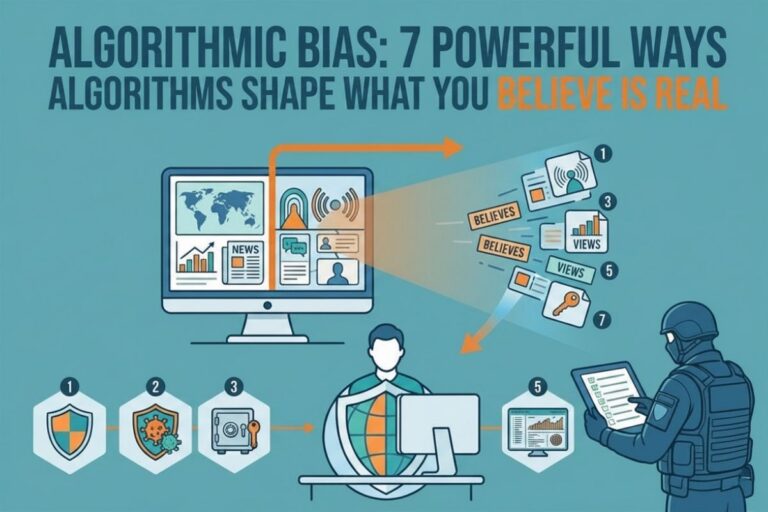
Modern digital life runs on systems most people never see.
Every search result, social media feed, recommended video, and news headline is filtered through layers of computation before it reaches you.
This invisible filtering process is where algorithmic bias begins.
Algorithmic bias is the tendency of automated systems to produce skewed, incomplete, or behavior-influenced outputs based on the data they are trained on and the objectives they are optimized for.
Most people assume the internet is a neutral information space.
It is not.
It is a structured environment shaped by ranking systems, engagement metrics, predictive modeling, and historical data patterns.
And those systems quietly shape what people believe is real.
Algorithmic Bias: Why This Concept Matters More Than Ever
The term algorithmic bias is often misunderstood as a technical flaw.
In reality, it is a structural feature of modern digital systems.
Every major platform relies on algorithms to determine:
- what content appears first
- what gets recommended
- what gets suppressed
- what becomes viral
- what is considered relevant
Search engines like https://www.google.com do not return objective truth. They return ranked relevance based on hundreds of signals including authority, engagement, and behavioral data.
Social platforms do not show all content equally. They prioritize what keeps users engaged.
Streaming services do not suggest everything available. They suggest what you are most likely to watch.
This means every user experiences a different version of reality.
To explore more about digital systems and technology analysis, visit: filecorrupter.org
1. Algorithms Filter Information Before You See It
Before any piece of content reaches a user, it passes through filtering systems.
These systems evaluate:
- relevance scores
- predicted engagement
- user behavior history
- content safety signals
- popularity metrics
This filtering process is where algorithmic bias begins to shape perception.
Two people searching the same topic can receive completely different results.
This is not accidental. It is design.
The system optimizes for engagement, not truth.
📌 Recommended Reading
Why Free Apps Are Never Free 7 Truths About Big Tech Profit2. Personalization Creates Separate Realities
Modern platforms are highly personalized.
Every user has a unique data profile built from:
- search history
- watch behavior
- clicks and interactions
- location data
- device usage patterns
This creates individualized information environments.
Over time, users begin to live inside algorithmically constructed realities.
According to https://www.pewresearch.org, personalization significantly influences how people consume news and form opinions online.
The result is fragmentation of shared reality.
People assume their version of information is universal. It is not.
It is tailored.
3. Engagement Metrics Distort Importance
In traditional systems, importance was determined by editorial judgment and expertise.
In modern systems, importance is often determined by engagement signals.
Algorithms track:
- clicks
- likes
- shares
- comments
- watch time
Content that triggers strong emotional reactions tends to perform better.
This includes:
- outrage
- fear
- controversy
- shock
As a result, emotionally charged content is often amplified more than neutral or balanced information.
This creates a distorted sense of importance.
What is most visible is not always what is most accurate.
It is what performs best.
4. Search Rankings Are Not Neutral Truth Systems
Search engines are often perceived as objective gateways to knowledge.
In reality, search rankings are influenced by complex optimization systems.
These include:
- domain authority
- backlink structure
- user engagement behavior
- content optimization signals
- click-through rates
Websites that understand SEO can outperform more accurate but less optimized content.
This is why entire industries exist around search optimization.
Google’s own documentation confirms that ranking systems are based on relevance signals, not truth validation:
https://developers.google.com/search
This means visibility is engineered. Not absolute.
5. Recommendation Systems Shape Behavior Over Time
Recommendation systems are among the most powerful drivers of algorithmic bias.
Platforms like YouTube, TikTok, Netflix, and Amazon continuously analyze user behavior to predict future engagement.
This creates a feedback loop:
- User interacts with content
- System learns preferences
- System recommends similar content
- User engages further
- System reinforces pattern
Over time, this loop shapes:
- beliefs
- interests
- emotional responses
- worldview
Users believe they are freely choosing content. But their choices are heavily guided by prior system behavior.
This is one of the most subtle forms of algorithmic bias.
6. Data Collection Itself Introduces Bias
Algorithmic bias does not only occur during ranking. It begins at the data collection stage.
Systems primarily collect:
- clicks
- time spent
- interactions
- engagement signals
However, they often fail to capture:
- intent
- context
- emotional meaning
- reasoning behind actions
For example: A user may click on content to criticize it. The system may interpret this as interest.
This creates distorted behavioral signals.
Over time, algorithms optimize based on incomplete representations of human behavior.
7. Artificial Intelligence Amplifies Algorithmic Bias
Artificial intelligence systems depend heavily on training data.
This means they inherit existing biases in digital ecosystems.
AI models learn from:
- historical user behavior
- online content patterns
- engagement-based datasets
If the data is skewed, the model output will reflect that skew.
According to MIT research: https://www.mit.edu
machine learning systems are highly sensitive to training data structure and quality.
This means AI does not eliminate bias. It scales it.
As AI becomes embedded in search engines, recommendation systems, and decision-making tools, algorithmic bias becomes more influential.
Why Algorithmic Bias Matters for the Future of Information
We are entering a world where most information is mediated by automated systems.
This includes:
- search engines
- social media feeds
- AI assistants
- recommendation platforms
- news aggregators
In such an environment, algorithmic bias determines what most people see as reality.
The key issue is not access to information. It is filtration of information.
Understanding this is essential for digital literacy.
Final Thoughts
Algorithmic bias is not a glitch in modern systems.
It is a defining characteristic of how digital environments operate.
Information is:
- collected through limited signals
- filtered through optimization systems
- ranked by engagement models
- and presented through predictive algorithms
As a result, users do not experience raw information. They experience curated reality.
The most important question is no longer whether information exists.
It is how that information was shaped before it reached you.
Because in the digital age, perception is not just influenced by data.
It is structured by algorithmic bias.
😄 Cyber Joke
Why did the algorithm think it was always right?
Because nobody ever clicked the “disagree” button! 😄
Explore More Free Tools
Hash Generator Tool
Generate secure MD5, SHA1, SHA256, and other cryptographic hashes instantly online.
Open Tool →Dummy File Generator
Create sample dummy files of custom sizes for testing uploads, storage, and applications.
Open Tool →Password Strength Checker
Analyze password security and identify weak passwords before using them online.
Open Tool →File Hash Checker
Verify file integrity by checking MD5, SHA256, and other file hash signatures.
Open Tool →UUID Generator
Generate random UUIDs and unique identifiers instantly for apps, APIs, and databases.
Open Tool →Text Diff Checker
Compare two text blocks side by side and quickly detect additions, deletions, and edits.
Open Tool →