
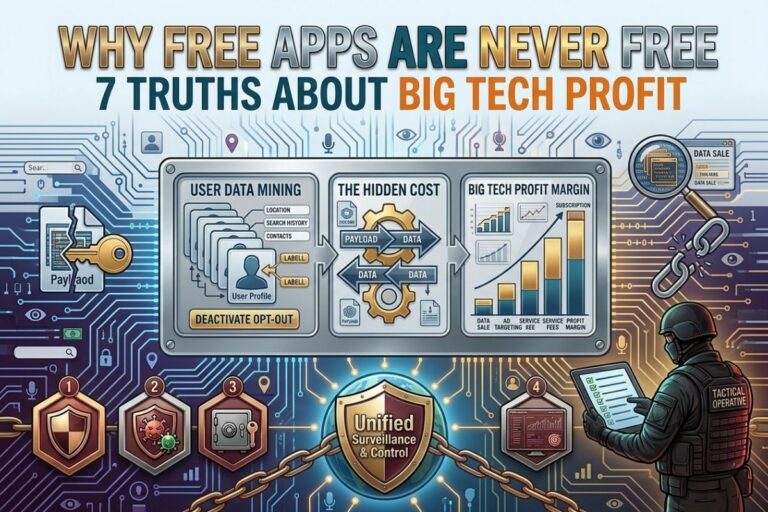
Why free apps are never free is not just a catchy idea. It is the foundation of how the modern internet operates. Every time you download a free application, you are entering a system where value is exchanged in ways that are not immediately visible.
Most people assume free means no cost. In reality, the cost shows up in different forms such as personal data, attention, behavior tracking, and long term digital profiling.
From a cybersecurity perspective, this is one of the most important concepts to understand because it defines how your information flows across digital systems.
Why free apps are never free explained in modern internet economy
To understand why free apps are never free, you need to understand how internet companies actually generate revenue. These platforms are not built on generosity. They are built on monetization systems that extract value continuously from user interaction.
There are three major layers to this system:
First is data collection
Second is behavioral analysis
Third is monetization through advertising or subscription conversion
Each layer builds on the one before it. The more you use an app, the more accurate the system becomes at predicting your behavior.
📌 Recommended Reading
UUID Generator Tool – Free UUID v4 Generator OnlineTruth one: Your data is the real product
When you use a free app, you are generating structured data. This includes location behavior, device information, usage patterns, and interaction history.
This data is extremely valuable because it allows companies to build detailed profiles about individuals.
For example, major platforms describe how they handle user data in their privacy systems here
https://policies.google.com/privacy
and here
https://www.facebook.com/privacy/policy/
The reality is simple. You are not the customer. You are the dataset.
Truth two: Attention is sold to advertisers
Another reason why free apps are never free is attention monetization. Your time inside an app is converted into advertising exposure.
The longer you stay engaged, the more advertisements you see. These ads are not random. They are selected through automated bidding systems that decide which advertiser gets your attention in milliseconds.
This system transforms human attention into a measurable financial product.
Every scroll, tap, and pause has value in this economy.
Truth three: Freemium systems guide user behavior
Many apps use a freemium structure where basic access is free and advanced features require payment.
At first, this seems harmless. However, the design is intentional. Users are introduced to a free version that slowly becomes limiting over time.
Truth four: Behavioral tracking builds digital profiles
Modern apps do not just collect data. They analyze it to predict future behavior.
This includes what you might click, what you might buy, and even what content you are likely to engage with next.
This predictive modeling allows companies to influence user behavior at scale.
Academic research from institutions such as Harvard Cyberlaw explores how digital systems shape user decision-making.
The more you use free apps, the more accurate these predictions become.
Truth five: Algorithms control what you see
Algorithms determine the content you interact with on most platforms.
These systems are designed to maximize engagement, not neutrality.
That means you are shown content that keeps you active longer inside the app. This increases revenue because more attention leads to more advertising opportunities.
The result is a feedback loop where content is continuously optimized to hold your attention rather than inform you objectively.
Truth six: Free apps scale because users provide the fuel
The reason why free apps are never free is because they scale through user participation.
Every new user adds more data. More data improves targeting. Better targeting increases advertising value. Higher advertising value attracts more companies.
This creates a self reinforcing cycle that strengthens the platform over time.
Users are not just participants. They are contributors to the system’s growth.
Truth seven: You are part of the business model
This is the most important truth.
You are not just using the app. You are part of the infrastructure that makes it profitable.
Your behavior, preferences, and interactions are continuously converted into commercial value.
Even if you never spend money, your presence still generates revenue indirectly.
This is the core reason why free apps are never free.
The hidden cost most users never consider
The cost of free apps is not always financial. It often shows up in less visible ways.
These include reduced privacy, increased exposure to targeted manipulation, and long term behavioral influence.
From a cybersecurity standpoint, this raises important questions about control and ownership of personal data.
If you are not controlling your data, someone else is benefiting from it.
How cybersecurity awareness changes everything
Understanding this system is a major advantage in digital safety.
Once you recognize how data flows, you can make more informed decisions about what apps you use and how much information you share.
You can also begin to reduce your exposure by reviewing app permissions, limiting unnecessary installations, and being more intentional about digital engagement.
For more cybersecurity-focused insights and tools, you can explore: filecorrupter.org
The future of internet business models
While advertising driven platforms dominate today, new models are emerging.
These include subscription based services, privacy focused platforms, and user controlled data systems.
Some systems are even exploring decentralized ownership where users retain control over their information.
However, the current dominant model still relies heavily on the principles behind why free apps are never free.
Conclusion: Awareness is digital power
Once you understand why free apps are never free, you start to see the internet differently.
Every interaction becomes part of a larger system of value exchange. Every app becomes a business decision rather than a simple tool.
The key takeaway is not to fear technology, but to understand it.
When you understand the system, you gain control over how you participate in it.
And in the modern internet economy, that awareness is power.
😄 Cyber Joke
Why are free apps so friendly?
Because your personal data is paying the subscription fee! 😄
Explore More Free Tools
Hash Generator Tool
Generate secure MD5, SHA1, SHA256, and other cryptographic hashes instantly online.
Open Tool →Dummy File Generator
Create sample dummy files of custom sizes for testing uploads, storage, and applications.
Open Tool →Password Strength Checker
Analyze password security and identify weak passwords before using them online.
Open Tool →File Hash Checker
Verify file integrity by checking MD5, SHA256, and other file hash signatures.
Open Tool →UUID Generator
Generate random UUIDs and unique identifiers instantly for apps, APIs, and databases.
Open Tool →Text Diff Checker
Compare two text blocks side by side and quickly detect additions, deletions, and edits.
Open Tool →