
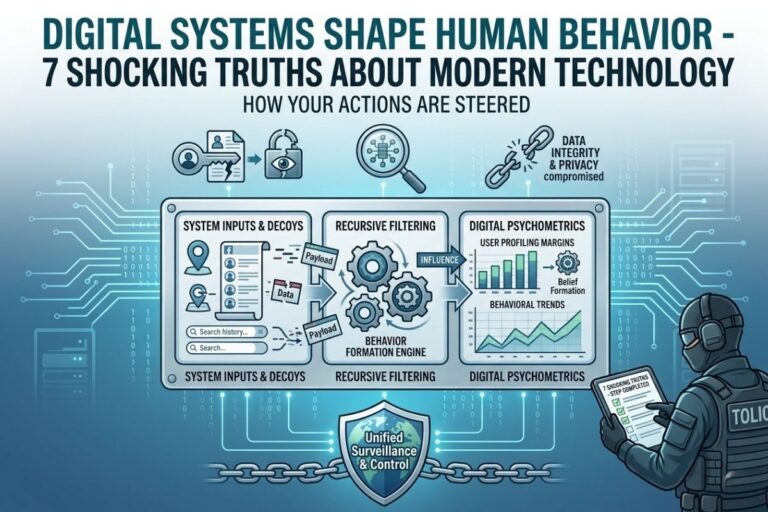
Most people believe technology is neutral.
They assume smartphones, social media platforms, search engines, and digital applications simply respond to human behavior rather than actively shaping it.
That assumption is no longer accurate.
Today’s digital environment is built around behavioral influence.
Modern platforms are engineered to guide attention, increase engagement, predict reactions, and shape decision-making patterns with incredible precision. Most users never notice it happening because the influence is subtle, gradual, and psychologically optimized.
Digital systems shape human behavior
- attention spans,
- emotional responses,
- beliefs,
- habits,
- purchasing behavior,
- social interactions,
- and even identity itself.
This is not conspiracy theory.
It is behavioral engineering built into the architecture of modern technology.
For more technology analysis and digital culture discussions, visit: filecorrupter.org
1. The Attention Economy Was Designed to Capture Human Focus
One of the most powerful ways digital systems shape human behavior is through the attention economy.
Most major platforms are not competing to improve human well-being.
They are competing for time.
Every additional second a person remains on a platform increases advertising opportunities, behavioral data collection, and engagement metrics.
As a result, modern applications are intentionally engineered to maximize user retention.
Examples include:
- infinite scrolling,
- autoplay video,
- personalized recommendations,
- push notifications,
- variable reward systems,
- and emotionally stimulating content.
These features remove natural stopping points and continuously encourage interaction.
According to the American Psychological Association, constant digital stimulation can significantly impact concentration, emotional regulation, and mental fatigue.
The problem is not simply screen time.
The problem is that digital systems increasingly determine where human attention goes every day.
Attention eventually shapes thought patterns.
Thought patterns shape behavior.
📌 Recommended Reading
Algorithmic Bias: 7 Ways Algorithms Shape Reality2. Algorithms Prioritize Engagement Over Truth
Most users assume algorithms are designed to provide accurate or balanced information.
In reality, algorithms primarily optimize engagement.
Platforms measure:
- clicks,
- watch time,
- comments,
- reactions,
- shares,
- and retention.
Emotionally intense content typically performs better than calm or nuanced discussion.
Fear spreads quickly.
Outrage spreads quickly.
Conflict spreads quickly.
Digital systems learn these patterns and amplify the content most likely to trigger interaction.
According to Pew Research Center, social media algorithms significantly influence how users consume news and form opinions online.
This creates an environment where emotionally charged information often outperforms factual depth.
Over time, repeated exposure to algorithmically selected content can subtly reshape beliefs, attitudes, and emotional responses.
Users may believe they are independently choosing content when, in reality, much of their digital experience has already been filtered by predictive systems.
3. Convenience Quietly Reduces Independent Thinking
Convenience is one of the most underestimated forms of behavioral influence.
People naturally gravitate toward systems that reduce effort.
Digital platforms understand this extremely well.
Autoplay removes decision-making.
GPS navigation reduces spatial memory usage.
Recommendation systems reduce independent discovery.
Search engines reduce research depth.
Smart assistants reduce cognitive effort.
Individually, these tools appear harmless.
Collectively, they encourage increasing dependency on automated systems.
Over time, humans begin outsourcing more mental responsibilities to technology.
The concern is not that technology exists.
The concern is that dependency gradually becomes normalized.
Many people now struggle to:
- navigate without GPS,
- remember phone numbers,
- tolerate boredom,
- focus deeply,
- or consume long-form information without distraction.
Digital convenience often comes with hidden cognitive trade-offs.
4. Social Validation Systems Change Human Behavior
Social media platforms are deeply connected to psychological reward systems.
Likes, shares, notifications, comments, and follower counts create feedback loops that influence behavior.
Humans naturally seek social approval.
Digital systems quantify that approval publicly.
This changes how people communicate online.
Instead of expressing authentic thoughts, many users begin optimizing behavior for engagement.
People increasingly post content designed to:
- gain validation,
- trigger reactions,
- attract attention,
- or maintain online visibility.
According to NCBI, social media reward systems can activate neurological responses similar to other forms of behavioral reinforcement.
This does not mean social media is inherently evil.
However, it does mean digital systems are capable of shaping emotional and social behavior at scale.
The psychological effects become especially concerning among younger generations raised entirely within algorithm-driven environments.
5. Digital Systems Influence Emotional States Constantly
Most people underestimate how heavily digital environments influence mood.
Algorithms monitor behavioral patterns and adapt content feeds based on engagement history.
If outrage captures attention, more outrage appears.
If fear captures attention, more fear appears.
If anxiety increases interaction, anxiety-generating content spreads more effectively.
Over time, users can become trapped inside emotionally repetitive digital environments.
This phenomenon contributes to:
- stress,
- doomscrolling,
- emotional exhaustion,
- attention fragmentation,
- and psychological fatigue.
Research discussed by Harvard Health Publishing has explored the connection between excessive digital exposure and increased stress, anxiety, and mental fatigue.
Digital systems do not necessarily understand human well-being.
They understand behavioral engagement patterns.
That distinction matters.
4. Social Validation Systems Change Human Behavior
Social media platforms are deeply connected to psychological reward systems.
Likes, shares, notifications, comments, and follower counts create feedback loops that influence behavior.
Humans naturally seek social approval.
Digital systems quantify that approval publicly.
This changes how people communicate online.
Instead of expressing authentic thoughts, many users begin optimizing behavior for engagement.
People increasingly post content designed to:
- gain validation,
- trigger reactions,
- attract attention,
- or maintain online visibility.
According to NCBI, social media reward systems can activate neurological responses similar to other forms of behavioral reinforcement.
This does not mean social media is inherently evil.
However, it does mean digital systems are capable of shaping emotional and social behavior at scale.
The psychological effects become especially concerning among younger generations raised entirely within algorithm-driven environments.
5. Digital Systems Influence Emotional States Constantly
Most people underestimate how heavily digital environments influence mood.
Algorithms monitor behavioral patterns and adapt content feeds based on engagement history.
If outrage captures attention, more outrage appears.
If fear captures attention, more fear appears.
If anxiety increases interaction, anxiety-generating content spreads more effectively.
Over time, users can become trapped inside emotionally repetitive digital environments.
This phenomenon contributes to:
- stress,
- doomscrolling,
- emotional exhaustion,
- attention fragmentation,
- and psychological fatigue.
Research discussed by Harvard Health Publishing has explored the connection between excessive digital exposure and increased stress, anxiety, and mental fatigue.
Digital systems do not necessarily understand human well-being.
They understand behavioral engagement patterns.
That distinction matters.
6. Personalization Is Quietly Reshaping Identity
One of the most powerful developments in modern technology is personalization.
Digital systems continuously collect behavioral data including:
- browsing patterns,
- search history,
- viewing habits,
- purchasing activity,
- interaction timing,
- and communication behavior.
This information allows platforms to personalize digital experiences with incredible accuracy.
At first, personalization appears useful.
One of the most powerful developments in modern technology is personalization.
Digital systems continuously collect behavioral data including:
- browsing patterns,
- search history,
- viewing habits,
- purchasing activity,
- interaction timing,
- and communication behavior.
This information allows platforms to personalize digital experiences with incredible accuracy.
At first, personalization appears useful.
7. Artificial Intelligence Will Intensify Behavioral Prediction
Artificial intelligence is accelerating the influence capabilities of digital systems dramatically.
Future systems will not simply recommend products or videos.
They will increasingly predict:
- emotional states,
- decision fatigue,
- purchasing intent,
- communication patterns,
- and behavioral vulnerabilities.
AI-driven systems already analyze massive amounts of behavioral data to optimize engagement strategies.
As predictive technology improves, digital influence will become more personalized, adaptive, and difficult to detect.
According to MIT, AI and behavioral analytics are rapidly changing how technology interacts with human decision-making.
The major concern is not whether technology influences people.
That question has already been answered.
The real concern is how much invisible influence society will tolerate before recognizing the long-term consequences.
Why Awareness Matters
The goal is not to fear technology.
Technology provides enormous benefits:
- communication,
- education,
- productivity,
- medical advancement,
- and global connectivity.
The issue is awareness.
Most people never stop to question how digital environments shape daily behavior.
When influence becomes invisible, it becomes more powerful.
Understanding behavioral technology is becoming increasingly important because modern systems affect:
- attention,
- memory,
- relationships,
- productivity,
- emotional stability,
- and independent thinking.
People who understand how digital systems shape human behavior are better equipped to:
- control their attention,
- reduce digital dependency,
- recognize manipulation,
- and make more intentional decisions online.
Final Thoughts
Digital systems shape human behavior more than most people realize.
Not through force.
Not through direct control.
But through repetition, emotional conditioning, convenience, personalization, and behavioral prediction.
Modern technology is no longer simply a collection of passive tools.
It is an environment constantly interacting with human psychology.
Algorithms influence attention.
Attention influences thought.
Thought influences behavior.
The future of digital society will depend largely on whether people remain conscious of how these systems operate.
Because the most effective forms of influence rarely feel like influence at all.
😄 Cyber Joke
Why did the algorithm know your next move?
Because you clicked “Accept All Cookies” again! 😄