
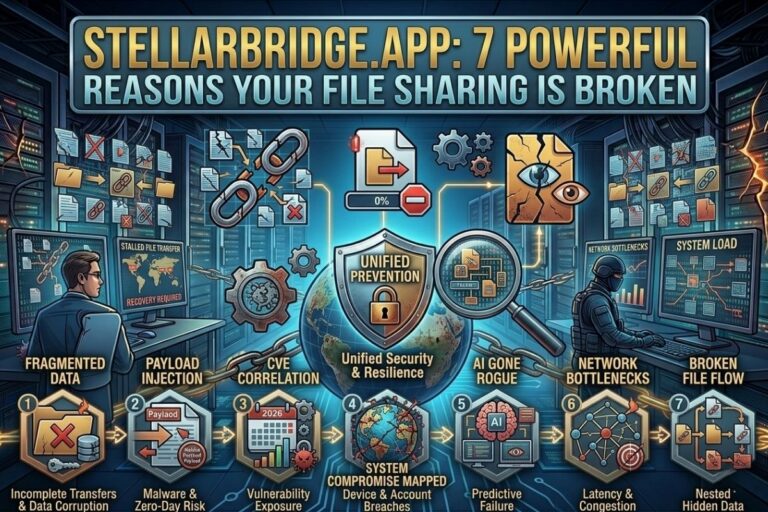
Introduction: Stellarbridge.app Is Exposing a Problem You Can’t Ignore
Stellarbridge.app isn’t just another tool—it’s a wake-up call.
Let me be direct.
Most companies think their file-sharing environment is “secure” because they’ve checked the usual boxes:
- Multi-factor authentication
- User permissions
- Cloud storage with a big-name provider
That’s not security. That’s baseline access control.
I’m a cybersecurity enthusiast, industrial control system penetration tester, and an ethical hacker. I’ve seen how environments actually get exploited—not in theory, but in practice. And what I can tell you is this:
Your file-sharing system is one of the easiest ways into your business.
That’s why platforms like Stellarbridge are forcing a shift in how we think about data control. 1. Your File Sharing Was Built for Convenience—Not Security
Let’s start here.
Tools like Google Drive, Dropbox, and SharePoint were designed to move fast and collaborate easily.
Security? That came later.
The result:
- Over-permissioned users
- Public links floating around your organization
- Sensitive files being shared externally without proper governance
According to IBM’s annual Cost of a Data Breach Report, human error and misconfigured access remain among the top causes of breaches.
That’s not a coincidence.
That’s design failure.
2. Stellarbridge.app Flips the Security Model
Here’s where Stellarbridge.app separates itself.
Instead of allowing access and then logging activity, it:
- Evaluates actions before they happen
- Enforces policy-first governance
- Denies access unless explicitly permitted
This is a zero-trust mindset applied to file systems.
Compare that to traditional tools:
| Traditional Tools | Stellarbridge.app |
|---|---|
| Allow → Monitor | Evaluate → Enforce |
| Reactive logging | Preventive control |
| User-based trust | Policy-based trust |
That’s not an upgrade.
That’s a completely different architecture.
3. AI Is Quietly Breaking Your Security Model
Here’s the part most businesses are ignoring—and it’s dangerous.
AI tools are now being integrated into:
- Document management systems
- Internal knowledge bases
- Shared drives
But those integrations often inherit broad permissions.
Meaning:
- AI can access more data than it should
- Actions may be logged under human users
- There’s no clear accountability
Organizations like National Institute of Standards and Technology (NIST) are already pushing guidance around AI risk management—and for good reason.
AI without governance is a liability.
Stellarbridge.app addresses this by treating AI as a controlled identity, not just a feature.
📌 Recommended Reading
Audio Steganography in Streaming Communities Explained4. Audit Logs Are Not Security—They’re Evidence
Let’s kill a myth.
Audit logs don’t protect you.
They help you understand what happened after something goes wrong.
That’s like installing cameras in your house but leaving the doors unlocked.
Most platforms:
- Log activity after execution
- Provide limited context
- Fail to prevent unauthorized actions
Stellarbridge.app changes this by making auditability part of enforcement, not just observation.
That’s how real security works.
5. Compliance Isn’t Optional—But Most Systems Fake It
If you’re dealing with:
- Healthcare data (HIPAA)
- Financial data
- Legal documents
You’re already under compliance pressure.
The problem?
Most tools provide checkbox compliance, not actual control.
According to Cloud Security Alliance, misconfigured cloud environments remain one of the biggest compliance risks globally.
Stellarbridge.app provides:
- Real-time enforcement
- Verifiable data access trails
- Controlled data movement
That’s the difference between passing an audit and actually being secure.
6. Ethical Hacker Perspective: Where You’re Actually Vulnerable
Let me give you the reality from an attacker’s perspective.
When I look at a target, I’m not trying to break encryption.
I’m looking for:
- Shared file links
- Misconfigured permissions
- Third-party integrations
- AI tools with excessive access
Why?
Because it’s easier.
Your file system is often the weakest link in your entire infrastructure.
And most companies don’t even monitor it properly.
That’s the gap Stellarbridge.app is addressing.
7. The Future Is Controlled Data—Not Open Access
We’re moving into a world where:
- Data is distributed
- AI is integrated everywhere
- Teams are decentralized
The old model of “just give access” doesn’t work anymore.
The future is:
- Controlled interaction
- Policy-driven access
- Continuous enforcement
That’s exactly where platforms like Stellarbridge are positioning themselves.
Stellarbridge.app and the Bigger Picture
Let’s zoom out.
This isn’t just about one platform.
This is about a shift in cybersecurity philosophy.
From:
- Reactive → Proactive
- Monitoring → Enforcement
- Trust → Verification
That shift is exactly what I’m building toward with
👉FileCorrupter.org
This site isn’t just a blog.
It’s the foundation for:
- SaaS security tools
- MSSP services
- Cybersecurity-as-a-Service (CSaaS)
And everything I publish is focused on one thing:
Exposing where businesses think they’re secure—but aren’t.
Internal Resource (Your Ecosystem)
If you’re serious about tightening your security posture, start here:
This is where I break down:
- Real-world vulnerabilities
- Security strategy that actually works
- How attackers think—and how to stop them
Final Thoughts: You’re Either Controlling Data—Or Hoping Nothing Happens
Let’s end this clean.
You have two options:
- Assume your current setup is “good enough”
- Actually understand and control how your data is accessed
Most businesses choose option one.
That’s why breaches keep happening.
Stellarbridge.app is a signal.
A signal that the industry is moving toward real control, not surface-level security.
The question is:
Are you adapting?
Or waiting until something breaks?
😄 Cyber Joke
Why did the file refuse to upload?
Because it had trust issues with the cloud! 😄