
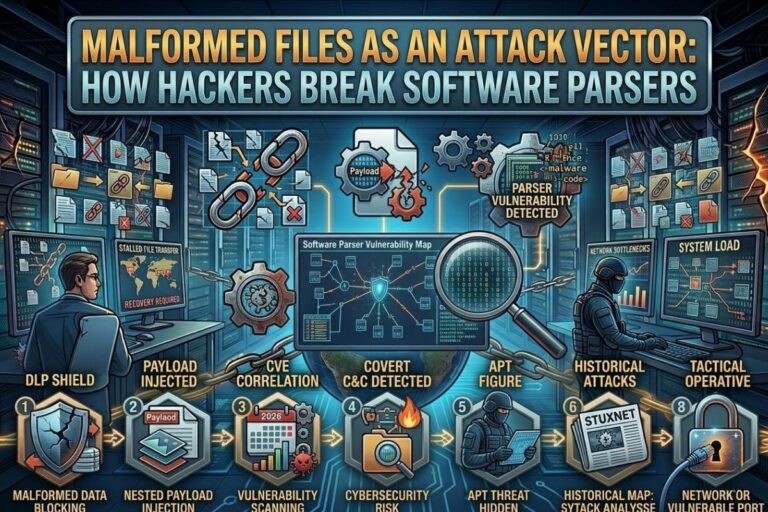
A file can look completely harmless. A PDF opens. An image loads. A document previews in a browser. But behind that simple action, software is parsing structured data. And that process is one of the most targeted areas in modern systems.
Attackers take advantage of this by creating files that break format rules. These are known as malformed file attacks. Instead of behaving like a normal file, they are designed to confuse the parser and trigger a weakness.
If you think malformed files are just harmless errors, that’s a risky assumption. Attackers actively use them in real-world campaigns to compromise systems.
Let’s take a closer look at how this works.
📌 Recommended Reading
Stellarbridge.app: 7 Powerful Reasons Your File Sharing Is BrokenHow Malformed Files Turn Into a Real Security Risk
A malformed file attack begins when a file is structured in a way the software does not expect. It may still open normally, but key parts of its format are altered to disrupt how the parser reads it.
Parsers depend on structure. A PDF has defined objects. An image has headers. A ZIP archive follows a clear layout. When those rules are broken, the parser may still attempt to process the file. That is where problems begin. The software can misread data, access incorrect memory locations, or handle input in unsafe ways. This can quickly lead to:
- System crashes that interrupt normal operations
- Memory corruption that weakens system security
- Remote code execution triggered by opening a file
This is what makes malformed files dangerous. A simple action like opening a file can become an entry point for compromise.
Common Types of Parser Exploits
Attackers use different techniques depending on the file format and the target software. Below are the most common patterns seen in real attacks.
- Buffer Overflow Attacks
A buffer overflow attack happens when a parser reads more data than it can store in memory.
For example:
- A file claims a field is small
- The actual data is much larger
- The parser copies it without proper checks
This can overwrite memory and allow execution of malicious code.
Buffer overflows are still one of the most exploited software vulnerabilities in file parsing.
- Integer Overflow and Size Confusion
In this case, the attacker manipulates numeric values like file size fields, object lengths, or array counts inside the file.
If the parser miscalculates these values, it may allocate the wrong amount of memory.
This can lead to:
- Memory corruption
- Out-of-bounds reads
- Controlled crashes
These issues are often linked to memory corruption exploits.
- Use-After-Free Vulnerabilities
A use-after-free vulnerability happens when memory is freed but still used later.
Attackers can exploit this by:
- Triggering a specific parsing sequence
- Reusing freed memory
- Injecting controlled data into that space
This technique is common in browser and document parser exploits.
- File Format Confusion Attacks
Some parsers try to support multiple formats.
Attackers exploit this by creating hybrid or ambiguous files.
For example:
- A file that looks like both a PDF and a ZIP
- A mismatched header and content type
The parser may process the file incorrectly and expose a vulnerability.
This is often called file format fuzzing when used in testing, but attackers use similar methods to find weaknesses.
- Malicious Compression and Archive Bombs
Archive formats like ZIP and RAR are often abused by attackers. They create files that look small but expand to massive sizes, or include nested layers that overload the system during extraction.
This can result in:
- Denial of service
- Resource exhaustion
- Parser crashes
These attacks are a common form of file parsing vulnerabilities and are used to overwhelm systems quickly.
How Hackers Create Malformed Files
Attackers follow a clear process to find and exploit weaknesses in file parsers. It is methodical and refined over time.
- Fuzzing
Attackers use fuzzing to send large volumes of random or slightly altered data into a parser. They watch for crashes or unusual behavior. When something breaks, that point is analyzed and shaped into a working exploit. This is a primary way to uncover parser vulnerabilities.
- Reverse Engineering
Through reverse engineering, attackers study how a parser handles file structures. They examine format rules, review code when possible, and observe how the program behaves internally. This helps them pinpoint weak areas that can be exploited.
- Exploit Development
Once a flaw is confirmed, attackers move to exploit development. They refine the input to control memory usage, guide execution flow, and deliver a payload. A simple crash is then turned into a reliable compromise.
Why Parser-Based Attacks Still Get Exploited
Even today, malformed file attacks remain highly effective. Some factors keep malformed file exploits relevant in modern threat landscapes.
Here is why:
- Many legacy parsers are still in use
- File formats are complex and hard to validate fully
- Applications trust user-provided files too early
- Secure coding practices are not always followed
- Testing often misses edge cases
How to Defend Against Malformed File Attacks
Protection requires strong handling of untrusted files.
- Strict Input Validation
Validate file structure before processing. Check headers, sizes, and consistency to reduce input validation vulnerabilities.
- Use Trusted Parsing Libraries
Avoid custom parsers when possible. Use well-maintained libraries that are regularly updated.
- Sandboxing and Isolation
Run file parsing in a restricted environment. If something fails, the impact is contained.
Final Thoughts
Malformed files are carefully designed attack tools. They take advantage of how software reads and processes data.
A single file can trigger serious vulnerabilities, including remote code execution. That is why secure parsing and proper validation are essential. Building software that safely handles untrusted input is what reduces the threat.
If you want to test how files behave when structure is altered or need a simple way to simulate corrupted inputs, you can explore tools available at filecorrupter.org It can help you better understand how file manipulation impacts parsing and system behavior in real scenarios.
😄 Cyber Joke
Why did the hacker send a corrupted file?
Because crashing software is easier than breaking into it politely! 😄