
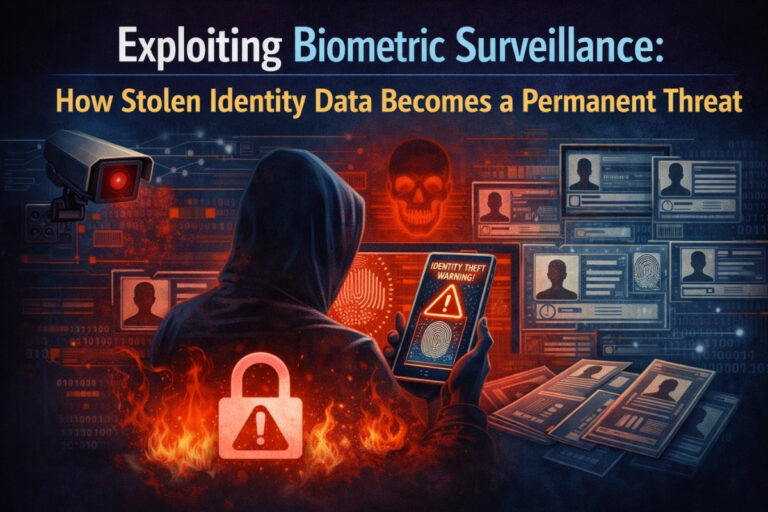
Biometric surveillance cybersecurity risks do not end when a database is breached. They begin there.
When passwords are stolen, they can be reset. When credit cards are compromised, they can be replaced. But when biometric identifiers—fingerprints, facial geometry, iris scans—are exposed, the damage is permanent. The individual carries that vulnerability for life.
This is what makes biometric surveillance fundamentally different from traditional authentication systems. The failure is not temporary. It is structural.
Biometric systems convert physical identity into digital templates. Those templates are stored, transmitted, and processed across networks just like any other data. If those systems are inadequately secured, attackers gain access not only to information—but to identity infrastructure itself.
And identity is leverage.
The Underground Value of Biometric Data
On dark web markets, stolen credentials are commodities. But biometric data is a premium asset. It offers attackers durability.
A compromised fingerprint template can be used to create spoofing artifacts. High-resolution facial data can be paired with AI-generated deepfakes to bypass facial recognition systems. Iris scan data can support synthetic identity construction for long-term fraud operations.
When biometric data is combined with breached personal information—names, addresses, social security numbers—the result is a persistent identity weapon. Fraud becomes easier. Impersonation becomes scalable.
Unlike passwords, biometric identifiers do not expire.
That permanence shifts the economics of cybercrime. Attackers are no longer looking for short-term access; they are building long-term identity portfolios.
📌 Recommended Reading
AI Bias in Biometric Systems: Risks to Identity & PrivacySpoofing and Synthetic Identity Attacks
One of the most underestimated biometric surveillance cybersecurity risks is spoofing.
Facial recognition systems can be tricked using high-quality photos, 3D masks, or AI-generated imagery. Voice recognition can be bypassed with synthetic speech models trained on short audio samples. Fingerprint readers have been defeated using silicone replicas created from latent prints.
As biometric systems become more common, adversaries refine their bypass methods.
More concerning is the rise of adversarial AI. Attackers can manipulate images in subtle ways that are invisible to humans but cause machine learning models to misclassify identities. A few pixel-level adjustments can increase misidentification probability dramatically.
This is not science fiction. It is documented research.
And when these techniques are applied at scale, biometric systems become probabilistic rather than definitive.
Civil Liberties Under Pressure
When biometric surveillance fails in private environments, the impact may involve fraud or corporate breach. When it fails in public-sector or law enforcement contexts, the consequences escalate.
Mass biometric databases create centralized targets. If compromised, they expose large populations to tracking, impersonation, or surveillance abuse.
There is also the chilling effect. When individuals know their biometric data is collected, stored, and potentially vulnerable, trust erodes. Freedom of movement and expression are influenced by perceived surveillance.
Cybersecurity failures in biometric systems do not stay confined to technical departments. They affect public confidence and institutional legitimacy.
If citizens cannot trust that their biometric data is secure, they cannot trust the systems that rely on it.
Why Traditional Security Controls Are Not Enough
Encryption and access controls are necessary but insufficient safeguards. The scale and permanence of biometric identifiers demand higher standards.
Mitigation strategies must include:
- Decentralized storage to reduce catastrophic breach impact
- Strict retention limits to minimize long-term exposure
- Continuous adversarial testing against spoofing techniques
- Independent audits of AI model robustness
- Transparent governance frameworks defining lawful use
Biometric surveillance cybersecurity risks increase as systems scale without equivalent governance maturity.
Security architecture must assume breach inevitability and design containment accordingly.
The Strategic Reality
Biometric systems promise convenience and efficiency. But they compress identity and authentication into a single immutable factor. That efficiency creates systemic fragility.
Attackers recognize that fragility.
As biometric adoption expands across banking, border security, healthcare, and consumer devices, the attack surface expands proportionally. The more society integrates biometric identity into daily operations, the more catastrophic a large-scale compromise becomes.
Cybersecurity professionals must treat biometric infrastructure as critical national-level identity systems—not as convenience upgrades.
Because once biometric data is weaponized, recovery is nearly impossible.
Q&A
Q: Why are biometric breaches more dangerous than password breaches?
Because biometric identifiers cannot be changed. Exposure creates lifelong vulnerability.
Q: Can biometric data be spoofed?
Yes. Through replicas, synthetic media, and adversarial AI techniques, attackers can bypass certain biometric systems.
Q: How does this impact civil liberties?
Large-scale biometric failures can enable mass tracking, wrongful identification, and long-term privacy erosion.
Q: Is biometric surveillance inherently insecure?
Not inherently—but without strong governance, adversarial testing, and strict data control, the risks escalate rapidly.
Final Thought
Biometric surveillance was built on the idea that identity is the strongest form of authentication. That may be true. But when identity becomes the target, strength turns into vulnerability. The real question is not whether biometric systems will fail—it is whether we are prepared for the permanence of that failure.
😄 Cyber Joke
Why are hackers excited about stolen biometric data?
Because you can change your password… but not your fingerprints! 😄