
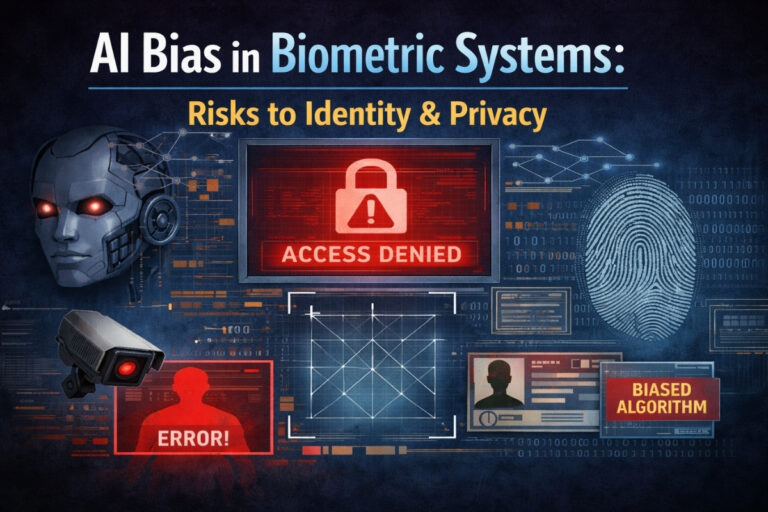
Biometric surveillance cybersecurity risks are growing faster than most organizations realize. When biometric systems fail, the consequences extend beyond technical breaches and directly threaten civil liberties, privacy, and long-term identity security.
Biometric authentication systems rely on machine learning models trained on massive datasets. These datasets determine how accurately the system recognizes faces, fingerprints, irises, or behavioral patterns. If the data is imbalanced or unrepresentative, the resulting model reflects those distortions. The system does not “see” neutrally. It sees through the statistical lens it was trained on.
Multiple independent studies have demonstrated that facial recognition systems exhibit higher error rates when identifying women, darker-skinned individuals, and elderly populations. In some cases, error rates increase dramatically compared to lighter-skinned male subjects. This is not an abstract fairness debate. It is a security flaw.
Predictable inaccuracy creates predictable attack surfaces.
If a system consistently struggles to distinguish among specific demographic groups, attackers can study those weaknesses. An adversary does not need to defeat the entire system; they only need to exploit its weakest classification patterns. Bias becomes reconnaissance material.
For example, if misidentification rates are higher within certain facial structures or lighting conditions, attackers can manipulate environmental variables or synthetic inputs to increase their probability of bypass. With the rise of AI-generated imagery, attackers can create adversarial examples tailored to known weaknesses in biometric classifiers.
This is where bias transitions from ethical issue to operational vulnerability.
False positives and false negatives both carry risk. A false negative may deny legitimate access. A false positive may grant unauthorized access. In high-security environments, even small statistical disparities compound into material exposure when scaled across thousands or millions of authentication events.
📌 Recommended Reading
When Biometric Surveillance Fails: Cybersecurity Risks to Civil LibertiesBias also intersects directly with civil liberties. In law enforcement deployments of facial recognition, misidentification can lead to wrongful stops, investigations, or arrests. In border control systems, inaccuracies can disrupt travel and create secondary screening patterns that disproportionately affect certain populations. These outcomes erode public trust in digital identity systems.
Trust, once eroded, is difficult to restore.
AI bias in biometric systems also affects corporate security environments. If employees perceive that authentication systems treat certain groups unfairly or inaccurately, internal confidence declines. Security controls rely not only on technical enforcement but also on user acceptance. Distrust weakens compliance.
Attackers understand institutional hesitation. When organizations deploy biased systems, public scrutiny increases. Litigation risk grows. Regulatory attention intensifies. This environment creates distraction and operational friction — conditions adversaries exploit.
Compounding the issue is the opacity of many biometric AI models. Deep learning systems often function as black boxes. Even developers may struggle to explain precisely why a model made a specific classification decision. Without explainability, auditing bias becomes difficult. Without auditing, mitigation becomes inconsistent.
Transparency is not a luxury in biometric systems. It is a defensive requirement.
Mitigating AI bias requires structural change. Representative training datasets must be prioritized from the beginning of model development. Continuous evaluation across demographic groups should be standard practice, not reactive damage control. Adversarial testing must simulate spoofing attempts that exploit demographic weaknesses. Independent third-party audits should validate system performance under diverse conditions.
Governance is equally critical. Clear policies defining acceptable error thresholds, redress mechanisms for misidentification, and strict usage limitations help prevent bias from escalating into systemic abuse. Data minimization strategies reduce long-term exposure. Retention policies must reflect the permanence of biometric identifiers.
Organizations often assume technological refinement will naturally reduce bias over time. Improvement is possible, but it is not automatic. Machine learning models replicate the structure of their inputs. If the data ecosystem remains skewed, the bias persists.
AI bias in biometric systems is not merely a technical artifact. It is an architectural decision point. Deploying a biased system at scale transforms statistical disparity into operational risk. In cybersecurity terms, that risk is measurable: increased attack feasibility, increased false authorization probability, and increased legal exposure.
In civil liberties terms, the stakes are higher. Biometric surveillance systems operate at the intersection of identity and power. When identification errors align with demographic patterns, institutional legitimacy is questioned. Surveillance without accuracy becomes surveillance without justice.
Security professionals must approach biometric AI with disciplined skepticism. The goal is not to abandon the technology but to treat it with adversarial rigor. Every model should be stress-tested not only for performance averages but for edge-case failures. Attackers operate in edge cases.
Bias is not random noise. It is signal — and adversaries listen carefully.
The more society integrates biometric authentication into daily life, the more consequential these weaknesses become. Access control, banking verification, airport screening, and even mobile device security increasingly rely on biometric AI. The margin for error narrows as reliance expands.
If Part 1 exposed what happens when biometric surveillance fails technically, Part 2 exposes what happens when it fails statistically.
In Part 3, we move into the operational domain: how cybercriminals actively weaponize stolen and manipulated biometric data — and why the permanence of identity makes these attacks uniquely dangerous..
😄 Cyber Joke
Why did the AI fail the facial recognition test?
Because it said, “I’m still learning to recognize my mistakes!” 😄