
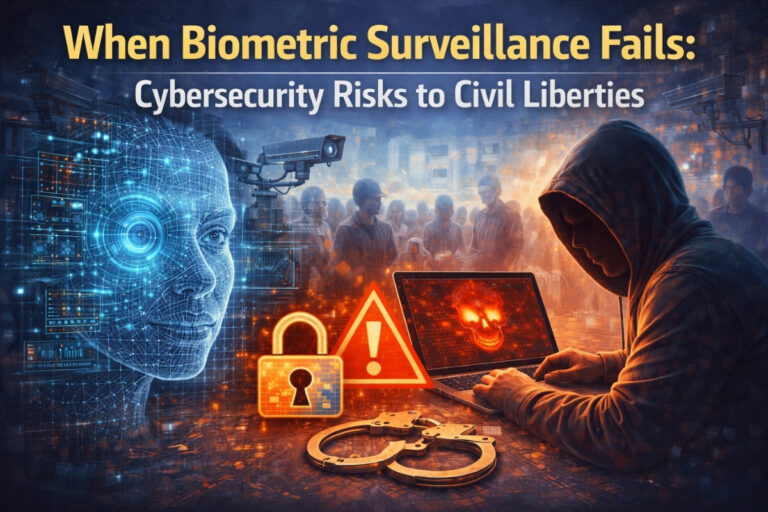
Biometric surveillance is often marketed as the future of security—frictionless authentication, seamless access control, instant identity verification. Fingerprints, facial recognition, iris scans, gait analysis. The promise is simple: your body becomes your password.
But when biometric surveillance fails, the consequences are far more severe than a locked account or a reset link. Failure in biometric systems doesn’t just create inconvenience. It creates permanent cybersecurity risk and, more critically, long-term civil liberties exposure.
Unlike passwords, biometric identifiers cannot be changed. You can rotate credentials. You cannot rotate your face.
That permanence changes everything.
Biometric surveillance systems operate at the intersection of artificial intelligence, massive data collection, cloud storage, and identity infrastructure. Each layer introduces its own attack surface. Facial recognition databases are stored in centralized repositories. Biometric templates are transmitted across networks. AI models process and classify identities in real time. Every integration point is a potential vulnerability.
📌 Recommended Reading
Inside the Mind of a Hacker Targeting Industrial Control SystemsIf a traditional authentication database is breached, organizations force a password reset. If a biometric database is breached, individuals carry that compromise for life.
Attackers understand this asymmetry.
Biometric data has become a high-value target in underground markets because it enables long-term exploitation. Stolen fingerprint templates can be used to spoof sensors. Facial recognition data can support deepfake identity construction. Iris scans can be repurposed to bypass poorly secured systems. When combined with other breached data—social security numbers, addresses, behavioral data—the result is a highly durable identity weapon.
The cybersecurity risk is structural, not incidental.
Most biometric surveillance deployments prioritize convenience and scale over adversarial resilience. Cameras are installed in public spaces. Access systems are rolled out across corporate campuses. Law enforcement integrates real-time recognition tools. Yet few organizations conduct rigorous adversarial testing against spoofing attacks, synthetic identities, or AI manipulation.
Bias compounds the vulnerability.
AI-driven biometric systems are only as good as the data used to train them. Numerous studies have demonstrated higher misidentification rates among women, people of color, and older populations. These inaccuracies are not merely ethical concerns; they create exploitable patterns. If a system consistently misclassifies certain demographics, attackers can study and weaponize those weaknesses.
Predictability is the enemy of security.
False positives also carry civil liberties implications. When biometric surveillance misidentifies an individual in a law enforcement context, the consequences may include detention, investigation, or reputational damage. Unlike password errors, biometric misidentifications intersect directly with due process and individual rights.
This is where cybersecurity risk becomes a constitutional issue.
Biometric surveillance centralizes sensitive identity markers at unprecedented scale. Historically, identity verification required physical documents or in-person confirmation. Now, large datasets of facial templates or fingerprint hashes may sit in cloud environments accessible through APIs. The larger the dataset, the more attractive the target.
And centralized targets invite sophisticated adversaries.
Nation-state actors recognize the strategic value of biometric databases. Compromising such systems offers long-term intelligence leverage. Organized cybercriminal groups see monetization opportunities through identity fraud and synthetic persona creation. Insider threats add another layer, particularly when oversight and governance are weak.
The failure mode is not hypothetical. It is inevitable in systems that scale without proportional security architecture.
Civil liberties concerns intensify when biometric surveillance extends into public spaces. Passive collection—where individuals are scanned without explicit consent—creates persistent tracking capabilities. If those systems are breached or misused, the impact extends beyond identity theft. It becomes a matter of mass surveillance exposure.
The chilling effect is real.
When individuals believe they are constantly monitored and potentially misidentified, behavioral changes follow. Freedom of assembly, freedom of expression, and privacy expectations erode. Cybersecurity failures in biometric systems do not remain confined to technical domains. They spill into societal trust.
Encryption and access controls are necessary but insufficient. True resilience requires:
Rigorous adversarial testing against spoofing and synthetic attacks.
Decentralized storage models that limit catastrophic breaches.
Strict data retention policies that minimize long-term exposure.
Transparent governance frameworks with accountability mechanisms.
Independent audits assessing bias, accuracy, and misuse potential.
Biometric surveillance cannot be treated as just another authentication upgrade. It represents a permanent binding of identity to infrastructure. When infrastructure fails—as it eventually does—the fallout is not temporary.
The core issue is this: biometric surveillance compresses identity and access into a single immutable variable. That efficiency is attractive to organizations. It is equally attractive to adversaries.
Security professionals must move beyond implementation enthusiasm and confront operational reality. Systems deployed at scale become targets at scale. The more seamless the experience for users, the more invisible the risks often become.
Biometric surveillance promises certainty. In practice, it introduces a different kind of uncertainty—one where mistakes cannot be undone and breaches cannot be reversed.
When these systems fail, the impact is not limited to compromised credentials. It reshapes the relationship between individuals and institutions. Trust, once broken in biometric systems, is exceptionally difficult to restore.
Technology may advance. Algorithms may improve. But the permanence of biometric identity means the margin for error is dangerously thin.
And in cybersecurity, thin margins rarely end wel
Q&A
Q: Can biometric data be stolen and reused?
A: Absolutely. Unlike passwords, you can’t reset your face or fingerprint. Hackers know this and plan accordingly.
Q: How does bias affect security?
A: Bias creates predictable misidentifications—attackers exploit these blind spots.
Q: Are connected systems risky?
A: Every integration is a potential chain reaction. One flaw can compromise everything.
Q: How can organizations mitigate risk?
A: Encrypt, audit, use multi-layer authentication, and enforce governance.
Final Thought
Hackers don’t care about civil liberties—they care about access, control, and chaos. Every failure in biometric surveillance chips away at trust, security, and human rights. The question isn’t if your system will fail—it’s when. And when it does, the fallout will last a lifetime.
😄 Cyber Joke
Why did the hacker love attacking industrial control systems?
Because they enjoy pushing people’s buttons! 😄