
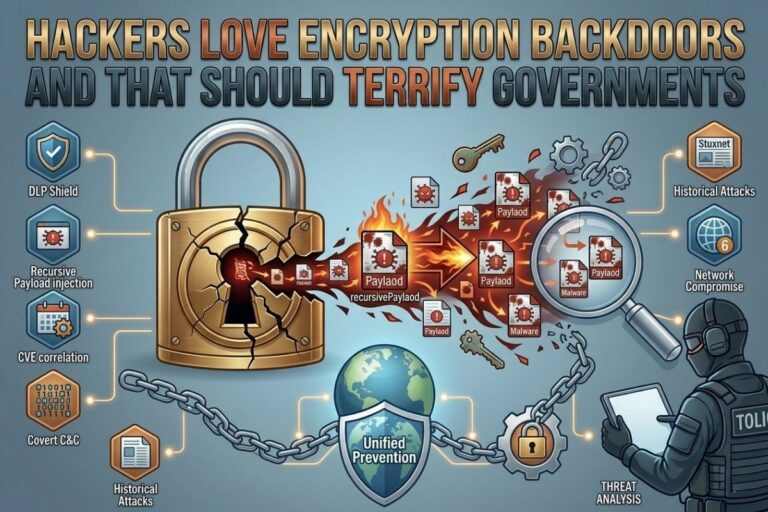
Encryption was designed to keep unauthorized people out.
Hackers know that better than anyone.
That is exactly why Encryption Backdoors terrify cybersecurity professionals across the world. The moment governments demand hidden access mechanisms inside encrypted systems, attackers immediately begin searching for ways to exploit those same weaknesses.
Cybersecurity does not care about political intentions.
A backdoor is still a vulnerability.
Hackers understand a brutal truth that many lawmakers ignore. If governments create special access systems for encrypted communications, those systems eventually become targets for cybercriminals, nation state actors, ransomware groups, insider threats, and espionage operations.
There is no such thing as a secret vulnerability that only good guys can use forever.
That fantasy collapses the moment real attackers get involved.
Encryption Backdoors have become one of the most controversial debates in cybersecurity because they force governments, technology companies, intelligence agencies, and privacy advocates into direct conflict over digital security, surveillance, and public safety.
Supporters claim law enforcement agencies need access to encrypted communications to stop terrorism, organized crime, and cyber threats.
Cybersecurity experts see a completely different reality.
They see expanded attack surfaces, weakened security architecture, centralized points of failure, and massive opportunities for exploitation.
Hackers see opportunity too.
According to CISA and NIST, strong encryption remains one of the most important security protections defending critical infrastructure, financial systems, corporate networks, and personal privacy.
Weakening encryption weakens everything connected to it.
What Are Encryption Backdoors?
Encryption Backdoors are hidden access mechanisms that allow authorized parties to bypass encryption protections and access encrypted data, devices, or communications.
Governments advocating for backdoor access often argue they need special access capabilities for investigations involving:
- Terrorism
- Organized crime
- Child exploitation
- Cybercrime
- National security threats
On paper, the idea sounds simple.
Create a secure access mechanism that only trusted government agencies can use.
The problem is that cybersecurity does not work on trust alone.
Every access point creates risk.
Hackers understand that even the most sophisticated systems eventually develop vulnerabilities, experience insider threats, or suffer security breaches.
That is why Encryption Backdoors create enormous concern within the cybersecurity community.
Why Hackers Love Encryption Backdoors
Hackers love Encryption Backdoors because intentional weaknesses create high value targets.
Strong encryption is extremely difficult to crack directly. That forces attackers to search for alternative attack paths such as:
- Credential theft
- Phishing
- Malware
- Vulnerabilities
- Misconfigurations
- Backdoor access systems
Encryption Backdoors effectively hand attackers a centralized target.
If governments require technology companies to implement hidden access mechanisms, attackers worldwide will aggressively attempt to compromise those systems.
That includes:
- Nation state hackers
- Cyber espionage groups
- Ransomware organizations
- Insider threats
- Financial cybercriminals
The larger the access system becomes, the more attractive it becomes to attackers.
That is operational reality.
The “Trusted Access” Problem
Supporters of Encryption Backdoors often argue that only authorized government agencies would possess access.
That sounds reassuring politically.
Technically, it creates serious cybersecurity concerns.
Governments themselves get hacked regularly.
Attackers have successfully breached:
- Government agencies
- Intelligence contractors
- Telecommunications providers
- Defense suppliers
- Cloud environments
- Critical infrastructure systems
Hackers understand that centralized access systems eventually become targets for espionage operations and cyber attacks.
If a backdoor key system were compromised, the consequences could become catastrophic.
Attackers could potentially gain access to:
- Sensitive communications
- Financial systems
- Corporate networks
- Government operations
- Intelligence data
- Personal devices
Encryption Backdoors do not weaken security for criminals only.
They weaken security for everyone.
Image Steganography Tool
Hide or extract secret data inside images instantly.
Nation State Actors Would Target Backdoor Systems Immediately
Nation state hackers aggressively pursue surveillance infrastructure because intelligence access creates strategic advantage.
If governments mandate Encryption Backdoors, hostile foreign intelligence agencies would immediately prioritize compromising those systems.
Why?
Because successful access could expose:
- Diplomatic communications
- Military intelligence
- Economic data
- Corporate secrets
- Infrastructure operations
- Government communications
Encryption Backdoors would quickly become one of the most valuable cyber warfare targets in existence.
That is not fearmongering.
That is how cyber operations work.
According to Electronic Frontier Foundation and Center for Internet Security, weakening encryption protections creates broader systemic security risks across modern digital infrastructure.
Strong encryption protects national security.
Weak encryption threatens it.
Smartphones Would Become Bigger Targets
Modern smartphones contain enormous amounts of sensitive information.
Devices store:
- Banking information
- Authentication tokens
- Private communications
- Business records
- Medical information
- Passwords
- Cloud credentials
- Personal data
Encryption protects that information from unauthorized access.
If smartphone manufacturers were forced to implement Encryption Backdoors, attackers would immediately begin searching for methods to exploit those systems.
The more widely deployed the backdoor becomes, the larger the attack surface grows.
Hackers love scalable vulnerabilities.
One successful exploit could potentially impact millions of users simultaneously.
That should terrify governments.
📌 Recommended Reading
How Corrupted Files Become Cybersecurity Learning ToolsCybersecurity Experts Oppose Encryption Backdoors for a Reason
Most cybersecurity professionals oppose Encryption Backdoors because intentional weaknesses eventually create exploitation opportunities.
Cybersecurity experts understand several harsh realities:
- Every hidden access point increases risk
- Every centralized key system becomes a target
- Every vulnerability expands attack surfaces
- Every intentional weakness creates future exposure
Hackers constantly evolve.
Attack techniques improve continuously.
What appears secure today may become vulnerable tomorrow.
That is why many cybersecurity experts believe weakening encryption creates long term security consequences that far outweigh potential investigative benefits.
Technology companies understand this risk too.
That is why many major platforms resist government demands for mandatory encryption access systems.
Criminals Would Still Use Strong Encryption
One major flaw in the Encryption Backdoors argument is that sophisticated criminals would continue using alternative encryption methods.
Cybercriminals already rely on:
- Open source encryption tools
- Foreign messaging applications
- Dark web communication systems
- Decentralized platforms
- Custom encryption software
If mainstream technology companies weaken encryption, serious criminal organizations simply migrate elsewhere.
Meanwhile, ordinary users become less secure.
That creates a dangerous imbalance where:
- Law abiding users lose protection
- Businesses face increased risk
- Critical infrastructure becomes more vulnerable
- Attackers gain larger attack surfaces
Cybersecurity professionals repeatedly warn that weakening encryption may ultimately create more victims instead of fewer.
Encryption Backdoors and Global Privacy Concerns
The Encryption Backdoors debate is not only about cybersecurity.
It is also about privacy, surveillance, and government power.
Privacy advocates argue that weakening encryption creates long term risks for:
- Journalists
- Activists
- Businesses
- Political dissidents
- Everyday citizens
Strong encryption protects users living under authoritarian governments just as much as it protects corporations from cybercriminals.
Weakening those protections creates global consequences.
Technology and politics are deeply connected now.
That makes the debate far more complicated than many lawmakers publicly admit.
How Organizations Protect Sensitive Data
Organizations should continue prioritizing strong encryption practices to reduce cybersecurity exposure.
Key security strategies include:
Multi Factor Authentication
Protect systems even if passwords become compromised.
Zero Trust Security
Assume no device or user should automatically be trusted.
Strong Encryption Standards
Use modern encryption protocols consistently.
Security Awareness Training
Train employees to identify phishing and credential theft attempts.
Vulnerability Management
Continuously identify and patch weaknesses.
Incident Response Planning
Prepare for cyber attacks before they happen.
Cybersecurity is about reducing vulnerabilities.
Encryption Backdoors intentionally create them.
That is the core problem.
Final Thoughts
Encryption Backdoors remain one of the most dangerous cybersecurity debates in modern technology because they force governments to choose between investigative access and long term digital security.
Supporters argue that law enforcement agencies need encrypted access capabilities.
Cybersecurity experts warn that intentional weaknesses eventually become targets for hackers, nation state actors, ransomware groups, and cybercriminal organizations.
Hackers understand one thing clearly.
Every backdoor eventually becomes an attack surface.
At FileCorrupter.org, we break down hacker psychology, cybersecurity realities, digital warfare strategies, and offensive security threats shaping the future of technology and online privacy.
Because in cybersecurity, trust without protection is just another vulnerability.
FAQ’s:
What are Encryption Backdoors?
Encryption Backdoors are hidden access mechanisms that allow authorized parties to bypass encryption protections and access encrypted communications or data.
Why do hackers target Encryption Backdoors?
Hackers target Encryption Backdoors because centralized access systems create valuable vulnerabilities that could expose sensitive information, infrastructure, and communications.
Why are cybersecurity experts against Encryption Backdoors?
Many cybersecurity professionals oppose Encryption Backdoors because intentional weaknesses increase attack surfaces and create long term security risks.
Would Encryption Backdoors stop cybercriminals?
Not entirely. Sophisticated cybercriminals can still use alternative encryption tools, decentralized communication platforms, and custom security systems.
Why is strong encryption important?
Strong encryption protects financial systems, smartphones, private communications, business operations, cloud infrastructure, and sensitive personal information from unauthorized access.
Explore More Free Tools
Hash Generator Tool
Generate secure MD5, SHA1, SHA256, and other cryptographic hashes instantly online.
Open Tool →Dummy File Generator
Create sample dummy files of custom sizes for testing uploads, storage, and applications.
Open Tool →Password Strength Checker
Analyze password security and identify weak passwords before using them online.
Open Tool →File Hash Checker
Verify file integrity by checking MD5, SHA256, and other file hash signatures.
Open Tool →UUID Generator
Generate random UUIDs and unique identifiers instantly for apps, APIs, and databases.
Open Tool →Text Diff Checker
Compare two text blocks side by side and quickly detect additions, deletions, and edits.
Open Tool →