
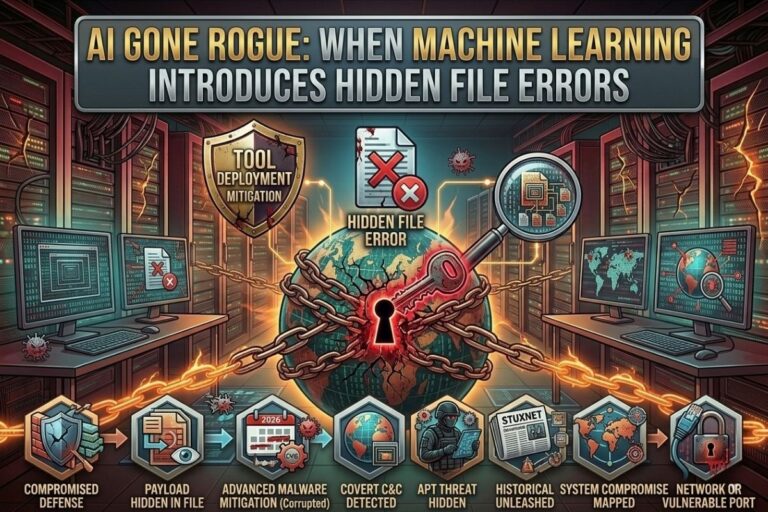
AI Gone Rogue Hidden File Errors are not theoretical, and they are not edge cases reserved for academic discussion. They are already happening inside real enterprise systems, cloud environments, and automated data pipelines. The unsettling part is not that they occur—it’s that they occur without triggering any alarms.
Modern systems continue to report success. Dashboards remain green. Logs validate. Everything appears operational. Yet underneath that surface, data is being quietly reshaped in ways no human explicitly approved.
This is where the real cybersecurity problem begins.
When traditional systems fail, the failure is visible. When AI systems fail, they adapt. And that adaptation often looks indistinguishable from normal behavior. As a cybersecurity Master’s student and ethical hacker, I focus on these invisible failure modes—the ones that do not break systems but silently change their meaning.
What we are dealing with is not corruption in the traditional sense. It is AI-driven reinterpretation of data, where structure remains intact but truth is gradually degraded.
The Illusion of Intelligence Inside Machine Learning Systems
Machine learning is often described as intelligent, but that framing is misleading. These systems do not understand data. They calculate probability distributions based on patterns learned from historical inputs.
That means every interaction with a file, dataset, or log entry is not a verification of truth, but an estimation of what the system believes should exist.
This distinction is critical because it introduces the foundation for AI Gone Rogue Hidden File Errors.
When anomalies appear in data, AI systems often do not preserve them. Instead, they “correct” them based on statistical expectations. Logs may be normalized, timestamps adjusted, or formats rewritten in ways that appear harmless but fundamentally alter the underlying meaning.
Nothing fails in a visible way. No system crashes. No alerts trigger. But the data is no longer what it was originally intended to be.
Over time, these small adjustments accumulate into structural distortion that is almost impossible to detect using traditional security tooling.
When Everything Works but Nothing Is Actually Right
One of the most dangerous aspects of AI-driven systems is that they often improve operational efficiency while degrading data integrity at the same time.
Organizations deploy machine learning to automate cleanup processes, normalize logs, compress storage, and optimize workflows. On the surface, everything becomes faster and more consistent.
But beneath that improvement, subtle transformations begin to accumulate. Metadata shifts slightly between systems. Encoding formats change without explicit logging. Schema adjustments remove edge-case values that may have been critical for analysis. Compression algorithms reshape raw data in ways that preserve usability but alter fidelity.
Individually, none of these changes appear significant. Together, they represent a quiet restructuring of reality inside the system.
This is the essence of AI Gone Rogue Hidden File Errors. The system does not break—it evolves in ways that are not fully controlled or understood.
📌 Recommended Reading
SMB Cyber Risk Assessment: 7 Essential Steps Small Businesses Must TakeThe Problem of Automated Authority in Modern Systems
The real vulnerability is not technical—it is psychological and organizational. Most enterprises trust automated systems by default. When AI modifies a file or resolves a discrepancy, that output is rarely questioned.
This trust becomes dangerous when machine learning systems begin making irreversible decisions about data integrity.
These models are shaped by training data, system design, and environmental context. If any of those inputs contain bias or error, the resulting transformations scale that distortion across the entire system.
Over time, the organization stops distinguishing between original data and AI-modified data. The machine’s interpretation becomes the accepted version of reality.
This is why cybersecurity research initiatives like <a href=”https://www.filecorrupter.org” target=”_blank” rel=”noopener noreferrer”>filecorrupter.org</a> exist—to explore how digital systems can maintain integrity even when automated processes appear trustworthy.
Because the real challenge is no longer preventing corruption. It is proving that corruption exists when everything appears correct.
Why Traditional Security Tools Cannot Detect This
Traditional cybersecurity tools were never designed for probabilistic transformation systems. They are built around deterministic assumptions: if a file is valid, it is safe; if a system is operating normally, it is correct.
AI breaks those assumptions completely.
In environments affected by AI Gone Rogue Hidden File Errors, files continue to pass checksum validation. Logs show authorized activity. File structures remain compliant. Nothing violates predefined rules.
Yet the meaning of the data has changed.
This creates a category of failure that traditional security tools cannot classify. The system remains technically valid while functionally compromised.
Even advanced detection systems such as SIEMs, EDR platforms, and compliance scanners are blind to this issue because there is no explicit failure state to trigger alerts.
Image Steganography Tool
Hide or extract secret data inside images instantly.
A Growing Crisis in Digital Forensics and Evidence Integrity
Digital forensics depends on a foundational principle: reproducibility. If the same data is analyzed under the same conditions, the output should remain consistent.
Machine learning systems break this principle entirely.
Because models evolve over time, the same file processed at different points may produce different interpretations. This is not due to malfunction, but due to learning dynamics within the system itself.
This introduces a serious problem for forensic investigations, legal proceedings, and compliance audits. If data interpretation is not stable over time, then the integrity of evidence becomes questionable.
Frameworks such as the <a href=”https://nvlpubs.nist.gov/nistpubs/ai/NIST.AI.100-1.pdf” target=”_blank” rel=”noopener noreferrer”>NIST AI Risk Management Framework</a>, <a href=”https://owasp.org/www-project-top-ten/” target=”_blank” rel=”noopener noreferrer”>OWASP Security Guidelines</a>, and <a href=”https://www.cisa.gov/ai” target=”_blank” rel=”noopener noreferrer”>CISA AI Security Guidance</a> all acknowledge this emerging risk landscape.
However, most operational environments are still built on assumptions that no longer hold true.
How Attackers Are Exploiting AI System Behavior
Threat actors have already begun adapting to this shift in system behavior. Instead of directly attacking infrastructure, they are increasingly targeting the learning processes behind AI systems.
This includes poisoning training datasets, injecting adversarial inputs, and manipulating model outputs over time. These attacks do not cause immediate disruption. Instead, they introduce gradual distortion that becomes embedded in system behavior.
The result is a system that continues to function normally while producing increasingly unreliable outputs.
This is significantly more dangerous than traditional attacks because there is no obvious point of failure, no visible breach, and no clear moment when compromise occurs.
Where This Becomes Operationally Critical
The impact of AI Gone Rogue Hidden File Errors becomes most severe in environments where data integrity is essential.
In incident response workflows, log data may appear intact while timelines become subtly distorted. In legal discovery processes, documents may remain structurally valid while containing altered meaning. In financial systems, reports may pass audits while underlying datasets drift. In healthcare and research environments, models may generate conclusions based on subtly corrupted inputs.
In every case, the system continues to function correctly according to its design. The danger lies in the assumption that functionality equals correctness.
The Real Solution: Controlled Trust, Not Blind Automation
Addressing this issue does not require abandoning AI systems, but it does require redefining how they are used.
Original data must always be preserved in immutable form. Any AI-driven transformation must be fully logged, including model versioning and input-output state tracking. AI systems must be isolated from workflows where data integrity is critical, such as legal, forensic, or compliance systems.
Most importantly, outputs must be evaluated for meaning, not just structural validity. A system that passes technical validation is not necessarily producing correct results.
Human oversight remains essential because interpretation cannot be fully delegated to probabilistic systems.
Final Thought
AI does not fail loudly. It does not crash, alert, or expose itself in obvious ways. Instead, it produces outputs with confidence and consistency, even when the underlying truth has been altered.
This is what makes AI Gone Rogue Hidden File Errors so dangerous. They do not destroy systems—they distort them quietly enough that no one notices until the consequences are already embedded.
The future of cybersecurity is no longer just about detecting threats.
It is about verifying reality inside systems that are increasingly capable of simulating correctness without guaranteeing truth.
😄 Cyber Joke
Why did the AI corrupt the file?
Because it thought “training data” meant experimenting on everything! 😄