

Your Digital Footprint Is More Permanent Than You Think
Digital Footprint.
Two words.
Most people hear them and immediately think about social media posts, browsing history, and search engines.
That definition is far too small.
Your Digital Footprint is the collection of everything you leave behind in the digital world. It includes the obvious things such as posts, photos, comments, and messages. It also includes things many people never think about. Location records. Data broker profiles. Old forum accounts. Breach databases. Archived web pages. Metadata. Purchase histories. Application records.
Most people assume the danger disappears when the moment passes.
It does not.
An embarrassing photo may fade from memory.
A deleted comment may disappear from a timeline.
An old account may become forgotten.
The internet often remembers anyway.
The internet never forgets.
It just waits.
That idea should make everyone uncomfortable.
Not because technology is evil.
Not because privacy is dead.
But because humanity has built the largest memory system in history, and most people still behave as though it has the attention span of a goldfish.
The Greatest Memory Ever Created
Human beings forget constantly.
We forget conversations.
We forget arguments.
We forget mistakes.
We forget promises.
Society has always benefited from forgetting. Time softens failures. Reputations recover. Embarrassing moments fade away.
The internet changed that equation.
For the first time in human history, ordinary people began documenting massive portions of their lives. Every photo uploaded, every comment posted, every account created, and every interaction recorded became part of an expanding digital archive.
Many people assume old information simply disappears.
In reality, information often spreads.
Copies are made.
Backups are created.
Archives are generated.
Screenshots are taken.
Third party companies collect and store records.
The result is a Digital Footprint that often grows larger over time rather than smaller.
That is the strange reality of the internet.
Information ages.
It rarely vanishes.
Deleted Does Not Mean Destroyed
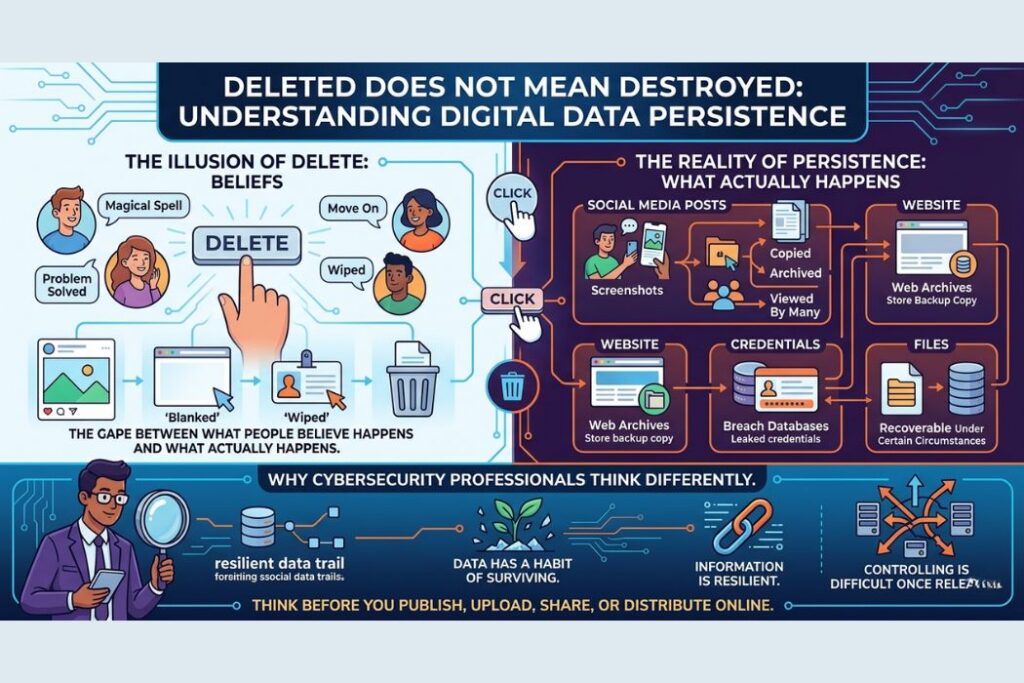
One of the most dangerous words in technology is “delete.”
People treat it like a magic spell.
Click delete.
Problem solved.
Move on.
The truth is often more complicated.
A deleted social media post may already have been viewed, copied, archived, or captured in screenshots.
A deleted website may still exist through web archives.
A deleted credential may survive inside breach databases.
A deleted file may remain recoverable under certain circumstances.
The gap between what people believe happens and what actually happens is enormous.
This is why cybersecurity professionals often approach digital information differently than the average person.
They understand that data has a habit of surviving.
Information is resilient.
Once released into the digital ecosystem, controlling it becomes increasingly difficult.
That reality should influence how people think before they publish, upload, share, or distribute information online.
Also Read: Nobody Owns Your Data. They Just Take Turns Using It
Data Breaches Never Truly End
Many people view data breaches as isolated events.
A company is breached.
News headlines appear.
Investigations begin.
Then public attention moves elsewhere.
The stolen information often does not.
A breached password can remain valuable years later.
An exposed email address can continue attracting phishing attacks long after the original incident.
Personal information can circulate through criminal ecosystems for extended periods.
The breach may disappear from public discussion.
The consequences often remain.
This is one reason cybersecurity experts repeatedly encourage strong password hygiene, multifactor authentication, and ongoing vigilance.
The risk does not always arrive immediately.
Sometimes it arrives years later.
The most dangerous data about you may not be the data that was stolen yesterday.
It may be the data you forgot existed years ago.
Your Reputation Is Part of Your Attack Surface
Cybersecurity discussions often focus on systems.
Servers.
Networks.
Applications.
Devices.
Those assets matter.
Your reputation matters too.
A Digital Footprint influences how employers, clients, universities, partners, and organizations perceive an individual.
Information that seemed harmless years ago may be interpreted differently in the future.
A comment made in anger.
A joke made without thinking.
A post created during a different stage of life.
Context changes.
Society changes.
Expectations change.
The information remains.
This is not an argument for fear.
It is an argument for awareness.
Every person should understand that reputation and cybersecurity increasingly overlap.
Attackers understand this relationship well.
Social engineering campaigns often leverage publicly available information because people willingly publish details about themselves online.
The information people reveal can become part of their vulnerability profile.
The Business of Remembering Everything
Many organizations profit from information.
Data brokers collect information.
Advertising networks collect information.
Analytics platforms collect information.
Social media companies collect information.
Entire industries exist because information has value.
That reality means forgetting is not always economically attractive.
Information generates revenue.
Information supports targeting.
Information improves profiling.
Information fuels artificial intelligence systems.
The incentives often favor retention.
This creates a challenging environment for privacy.
The issue is no longer simply what information exists.
The issue is who possesses it, how long they possess it, and how it may be used in the future.
For readers interested in cybersecurity, this topic deserves serious attention. We regularly discuss emerging threats and security trends at filecorrupter.org because understanding technology requires understanding the information ecosystem that surrounds it.
Future Technology Creates New Risks for Old Data
This may be the most important section of this article.
Many people evaluate risk using current technology.
That approach can be dangerous.
Information collected today may become more valuable tomorrow.
Artificial intelligence continues evolving.
Data analytics continue improving.
Correlation capabilities continue expanding.
Information that appears harmless in one decade may become highly revealing in another.
This is one reason privacy advocates frequently warn against excessive data collection.
The danger is not always immediate misuse.
The danger is future capability.
Old information can gain new power when technology advances.
The internet remembers.
Technology keeps learning how to remember better.
That combination should concern anyone who values privacy.
The Internet Is Building a Permanent Record of Humanity
For most of human history, information disappeared naturally.
Letters were lost.
Photographs degraded.
Records were destroyed.
Witnesses forgot.
The internet disrupted that process.
Human civilization is now building an unprecedented archive of itself.
Future generations may know more about ordinary people living today than historians know about many historical leaders.
Think about that.
Billions of people are creating digital records every day.
Photos.
Videos.
Messages.
Purchases.
Searches.
Locations.
Interactions.
Humanity has never documented itself on this scale before.
The long term implications remain unclear.
What is clear is that forgetting has become harder.
Protecting Your Digital Footprint
The goal is not paranoia.
The goal is awareness.
Think before posting.
Review privacy settings.
Use strong authentication practices.
Limit unnecessary information sharing.
Regularly search for information associated with your name.
Understand what data you willingly provide to platforms and services.
Most importantly, recognize that digital actions often have longer lifespans than emotional decisions.
A moment can last forever online.
That fact alone should encourage more thoughtful behavior.
FAQs
What is a Digital Footprint?
A Digital Footprint is the collection of information created through your online activities, including posts, searches, purchases, accounts, and interactions.
Can deleted content still exist online?
Yes. Deleted content may survive through archives, screenshots, backups, cached copies, or third party storage systems.
Why is a Digital Footprint important for cybersecurity?
Attackers frequently use publicly available information to conduct phishing campaigns, social engineering attacks, and identity related crimes.
Can old data become dangerous in the future?
Absolutely. Technological advances can increase the value and usefulness of information that appeared insignificant when originally collected.
Final Thought
People forget.
Companies forget.
Governments forget.
The internet does not.
The internet remembers the things you posted when nobody was watching.
It remembers the accounts you abandoned.
It remembers the information you assumed would disappear.
Most people believe the danger ends when the moment ends.
That belief is comforting.
It is also wrong.
The internet never forgets.
It just waits.
And one day, it reminds you what it remembers.
References
National Institute of Standards and Technology (NIST)
Electronic Frontier Foundation
Federal Trade Commission Privacy and Data Security