
There is a dangerous assumption in cybersecurity that if a file looks harmless, it is harmless. That assumption gets people compromised.
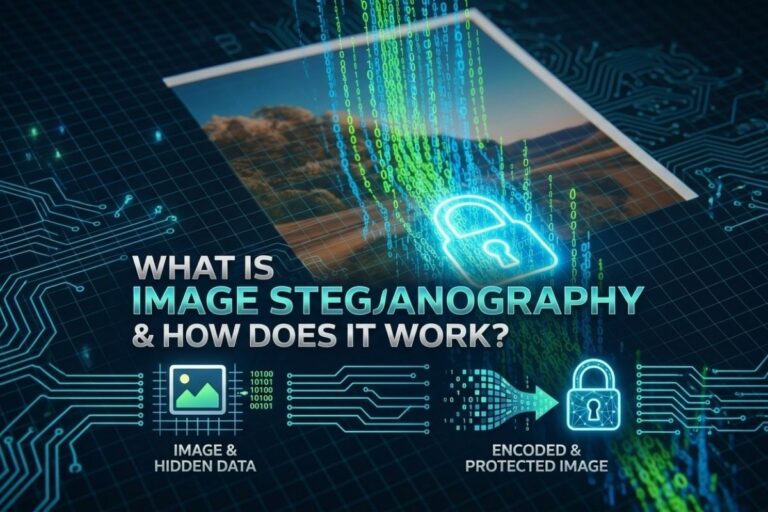
Image steganography exists to exploit that exact mindset. It allows data to be hidden inside image files in a way that is invisible to the human eye and often ignored by traditional security controls. A standard image can carry far more than pixels. It can contain instructions, fragments of data, or embedded messages that move through systems undetected.
This is not theory. This is a working technique used in real-world environments, and with the rise of steganography online tools, it is no longer limited to advanced operators. Anyone with access to a steganography encoder and a steganography decoder can manipulate images in ways most systems are not built to detect.
Understanding how this works is no longer optional.
What is Image Steganography?
Image steganography is the process used to hide message in image files without altering their visible appearance. The purpose is not to protect the content of the message, but to conceal the fact that a message exists at all. This is the critical difference between steganography and encryption. Encryption draws attention because it signals protected data, while steganography avoids attention entirely.
An image used in this process is known as a cover file. Once data is embedded, it becomes a carrier file. To anyone viewing it, nothing appears different. The image opens normally, displays correctly, and passes as legitimate. Underneath that normal appearance, however, the file has been modified to include hidden information.
This ability to conceal data in plain sight is what makes steganography effective.
How Image Steganography Works
At its core, image steganography works by manipulating the binary structure of an image. Every digital image is composed of pixels, and each pixel is represented by numerical values that define color. These values are stored in binary form, which creates an opportunity to modify the data at a level that does not noticeably impact the image itself.
The most common technique used is least significant bit manipulation. In binary values, the least significant bit is the final bit in a sequence. Changing this bit has a minimal effect on the overall value, which means the color difference is imperceptible to the human eye. By systematically modifying these bits across an image, data can be embedded without creating visible distortion.
This process operates at a level most traditional defenses never inspect, which is why it is frequently discussed in security research from organizations like OWASP.
The result is a file that looks identical to the original but contains hidden data woven into its structure. When you hide message in image files using this method, you are not adding something obvious. You are altering what is already there in a controlled and calculated way.
The Role of a Steganography Encoder and Decoder
To make this technique functional, two components are required: a steganography encoder and a steganography decoder.
A steganography encoder is responsible for embedding data into an image. It takes a clean image and a message, then integrates that message into the file by modifying specific bits. The output is a new image that appears unchanged but now contains concealed data.
A steganography decoder performs the reverse operation. It analyzes the image, identifies the modified bits, and reconstructs the hidden message. Without the decoder, the data remains inaccessible and effectively invisible. With it, you can extract hidden image data from image files that appear completely ordinary.
If you want to see this in practice, you can use your own live tool here:
https://www.filecorrupter.org
Why Steganography Matters in Cybersecurity
The value of steganography lies in its ability to bypass assumptions. Most systems are designed to detect known threats, suspicious file types, or abnormal behavior. Image files do not typically fall into those categories, which creates a gap.
Attackers exploit that gap by embedding data into images and moving them through systems that trust them by default. This can be used to transport malicious code, deliver instructions to compromised systems, or move sensitive information out of an environment without triggering alerts.
Government-backed cybersecurity guidance from CISA continues to highlight how attackers evolve beyond traditional detection models, reinforcing why techniques like steganography remain effective.
The rise of steganography online platforms has made this even more relevant. What once required technical depth is now accessible through simple interfaces, increasing both exposure and risk.
Image Steganography Tool
Hide or extract secret data inside images instantly.
Detection and Limitations
Despite its effectiveness, steganography is not perfect. It can be detected through detailed analysis of image files, particularly when examining statistical irregularities or inconsistencies in data patterns. However, this level of inspection is not standard in most environments.
Traditional security tools are not designed to analyze images at the bit level. They focus on known threats and observable behaviors, not hidden data embedded within legitimate file types. Detecting these threats requires deeper inspection models and a more advanced approach to threat detection.
Understanding this gap is critical. It highlights the difference between surface-level security and actual visibility.
Final Thoughts
Image steganography forces a shift in perspective. It challenges the idea that files can be trusted based on appearance alone. An image is no longer just an image. It is a potential carrier of hidden data that can move through systems without resistance.
To understand cybersecurity at a higher level, you have to understand techniques like this. Not just in theory, but in practice. If you can hide message in image files and later extract hidden image data from image samples, you gain insight into how easily trust can be manipulated.
Because in cybersecurity, the most effective threats are not the ones that break through defenses.
They are the ones that were never seen in the first place.
😄 Cyber Joke
Why did the hacker use steganography?
Because hiding secrets in plain sight is the best camouflage! 😄