
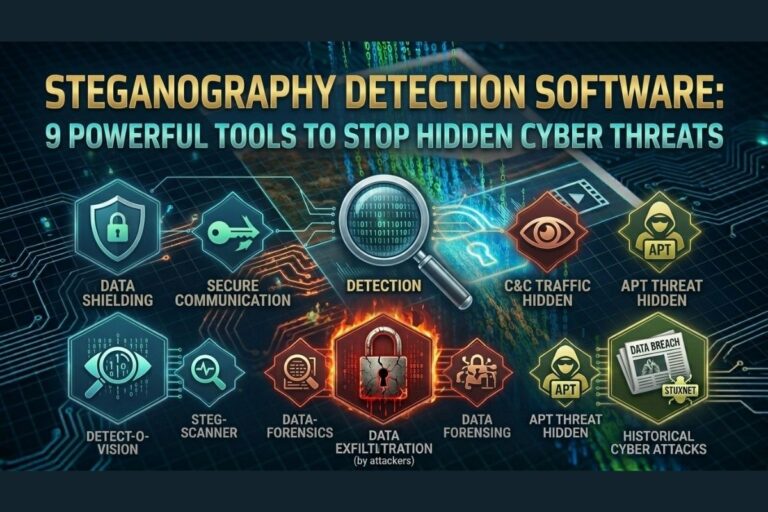
Steganography Detection Software is no longer a niche forensic capability—it is now a core requirement for modern cybersecurity defense stacks.
Attackers are no longer just encrypting malware.
They are hiding it inside normal files:
- images
- PDFs
- audio files
- network packets
- metadata structures
And most traditional security tools do not see it.
That’s the gap FileCorrupter is built to close.
👉 https://www.filecorrupter.org
If your organization is serious about MSSP-grade defense or CSaaS-level protection, this is the layer you cannot ignore.
🚨 Why Steganography Detection Software Matters in Real Cyber Attacks
Modern attackers use steganography to:
- Hide C2 (command-and-control) payloads
- Exfiltrate sensitive data silently
- Bypass antivirus and EDR systems
- Evade email security gateways
- Blend malicious traffic into normal files
According to the MITRE ATT&CK framework, data obfuscation and hidden channels are standard adversary techniques.
📌 Source: https://attack.mitre.org/
The key issue:
You cannot block what you cannot see.
That is exactly why Steganography Detection Software exists.
🧩 What Steganography Detection Software Actually Does
Steganography Detection Software analyzes digital files for hidden anomalies using:
- Statistical modeling
- Pixel-level inconsistency detection
- File entropy analysis
- Metadata structure inspection
- Machine learning classification
- Frequency domain transformation
It is designed to detect what traditional scanners miss.
🔥 1. LSB Detection Engines (Core Image Defense Layer)
Most image-based steganography uses Least Significant Bit (LSB) manipulation.
This means attackers modify pixel data in ways that are visually invisible.
Detection software responds by:
- scanning pixel randomness
- detecting noise distortion
- identifying abnormal bit distribution patterns
📌 Example tool reference: https://github.com/b3dk7/StegExpose
📊 2. File Entropy Scanning (High-Value Detection Signal)
Entropy measures randomness inside a file.
When attackers embed hidden payloads, entropy increases unnaturally.
Steganography Detection Software flags:
- compressed anomalies
- encrypted-like randomness
- inconsistent file structure entropy
This is a core MSSP triage signal.
📌 Recommended Reading
Steganography in Cybersecurity: Uses, Risks & Examples🧠 3. AI-Based Steganography Detection Models
Modern CSaaS systems use machine learning to detect:
- manipulated image datasets
- altered audio waveforms
- statistical deviations from baseline files
This is where FileCorrupter-style platforms evolve into intelligent detection systems instead of static scanners.
AI models improve detection over time based on:
- new attack samples
- adversarial payload evolution
- real-time SOC feedback loops
📂 4. Metadata Exploitation Detection
Attackers often hide payloads inside:
- EXIF data (images)
- ID3 tags (audio)
- PDF object streams
- file headers
Steganography Detection Software inspects:
- metadata inflation
- structure inconsistencies
- encoding mismatches
This is a high-success attack vector for defenders because attackers often overlook it.
Image Steganography Tool
Hide or extract secret data inside images instantly.
🌐 5. Network Steganography Detection Layer
Not all steganography lives in files.
Advanced attackers use:
- DNS tunneling
- HTTP header encoding
- packet timing manipulation
- ICMP payload hiding
Detection requires:
- deep packet inspection (DPI)
- traffic baseline modeling
- anomaly detection systems
📌 OWASP reference: https://owasp.org/
🧪 6. Frequency Domain Analysis (Advanced Forensics)
This technique transforms files into mathematical representations:
- DCT (images)
- FFT (audio)
Hidden payloads become visible through:
- frequency distortion
- pattern irregularities
- signal noise inconsistencies
This is advanced SOC / forensic tier detection.
🛡️ 7. MSSP Integration Layer (Where Real Value Exists)
Steganography Detection Software becomes powerful when integrated into:
SOC Stack:
- SIEM ingestion pipelines
- threat intelligence platforms
- alert correlation engines
Security Stack:
- email security gateways
- file upload inspection systems
- endpoint sandboxing tools
Response Stack:
- auto-quarantine
- workflow escalation
- incident response automation
⚙️ 8. Real Defensive Architecture (CSaaS Model)
A production-grade MSSP architecture looks like this:
Layer 1: Intake
- web uploads
- email attachments
- API ingestion
Layer 2: Normalization
- hashing
- file parsing
- metadata extraction
Layer 3: Detection Engine
- entropy analysis
- LSB detection
- ML classification
Layer 4: Correlation
- SIEM integration
- MITRE mapping
- threat intelligence feeds
Layer 5: Response
- quarantine
- alerting
- incident automation
This is exactly the type of system FileCorrupter is positioned to evolve into.
💰 Why This Matters for MSSPs & SaaS Security Buyers
Buyers don’t care about “steganography.”
They care about:
- preventing breaches
- reducing incident response time
- improving detection coverage
- closing invisible attack gaps
Steganography Detection Software becomes valuable because it solves:
“We didn’t even know this attack was happening.”
That’s where budgets open.
🚀 Where FileCorrupter Fits
FileCorrupter is positioned at the intersection of:
- file integrity security
- hidden payload detection
- cyber forensic automation
- CSaaS-based defense intelligence
👉 https://www.filecorrupter.org
The long-term vision:
Turn hidden file manipulation into a detectable, automatable security layer.
🔗 External Authority Sources
- MITRE ATT&CK: https://attack.mitre.org/
- NIST Cybersecurity Framework: https://www.nist.gov/cyberframework
- OWASP Top 10: https://owasp.org/
- StegExpose Tool: https://github.com/b3dk7/StegExpose
- SANS Institute: https://www.sans.org/
😄 Cyber Joke
Why did the security analyst distrust image files?
Because they might be hiding more than just pixels! 😄