
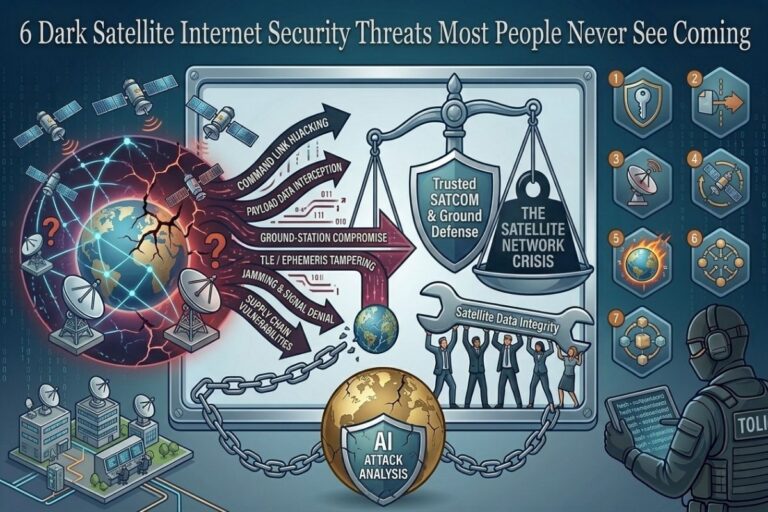
Satellite internet is changing the world faster than most people realize.
Remote regions now have access to high speed connectivity. Maritime operations depend on satellite communications. Disaster zones increasingly rely on orbital internet infrastructure when traditional networks fail. Military operations, airlines, businesses, emergency response teams, and millions of civilians now depend on satellite powered connectivity every single day.
That growth creates enormous opportunity.
It also creates enormous vulnerability.
The dark side of satellite internet security is that most people assume space based communication systems are naturally secure simply because they operate far above Earth. That assumption is dangerously wrong.
Hackers do not need to physically touch infrastructure to compromise it. Sometimes all they need is access to weak authentication systems, vulnerable firmware, poorly secured communication links, or compromised ground stations.
And as satellite internet adoption accelerates worldwide, attackers are paying very close attention.
At filecorrupter.org, we focus on cybersecurity threats with real-world consequences. Satellite internet security belongs in that conversation because modern civilization is rapidly becoming dependent on infrastructure operating silently in orbit above our heads.
The terrifying part is this:
Most users have no idea how exposed these systems may actually become over the next decade.
Satellite Internet Is Expanding Faster Than Cybersecurity
Commercial satellite internet systems are growing rapidly across the globe.
Private companies are racing to deploy satellite constellations capable of delivering broadband access to remote communities, transportation systems, military operations, and commercial industries. According to CISA guidance on space systems critical infrastructure, space based infrastructure now plays a major role in economic stability, communications, and national security.
That growth changes the cybersecurity landscape completely.
More satellites.
More user terminals.
More communication endpoints.
More connected infrastructure.
More attack surfaces.
Cybercriminals always follow dependency.
The more society depends on a technology, the more attractive it becomes as a target.
Satellite internet is rapidly becoming one of the most valuable infrastructure targets on Earth.
Hackers Could Target User Terminals Directly
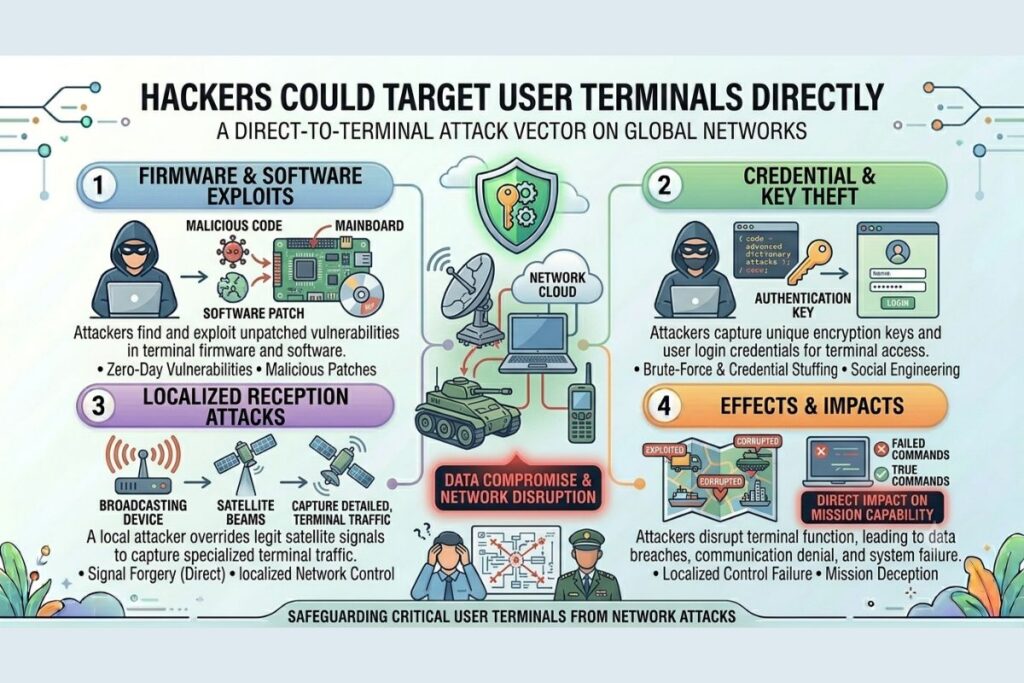
Most people imagine satellite cyberattacks involving highly advanced attacks against systems orbiting Earth.
In reality, attackers often focus on weaker entry points closer to civilians.
User terminals.
Routers.
Home systems.
Business communication hardware.
Portable satellite equipment.
These devices may become highly attractive attack vectors for cybercriminals seeking access into broader satellite communication ecosystems.
Potential attack methods include:
- malware infections
- firmware exploitation
- credential theft
- weak authentication abuse
- supply chain compromises
- phishing attacks against administrators
Attackers understand that compromising the edge of a network can sometimes create pathways deeper into the infrastructure itself.
The danger increases dramatically as millions of new satellite internet users connect devices globally.
Every connected endpoint becomes another potential vulnerability.
Satellite Internet Could Become a Prime Target During Cyber Warfare
Modern warfare increasingly involves infrastructure disruption rather than direct physical confrontation.
Satellite internet systems now support:
- military communication
- emergency response operations
- logistics coordination
- battlefield intelligence
- remote infrastructure management
- civilian communication systems
That makes commercial satellite internet providers strategically valuable targets during geopolitical conflict.
According to NASA cybersecurity initiatives, protecting space based communication infrastructure has become increasingly important as cyber threats targeting critical systems continue evolving globally.
Imagine the consequences of widespread satellite internet disruption during:
- military escalation
- natural disasters
- cyber warfare campaigns
- emergency response situations
- infrastructure crises
The effects could spread rapidly across communication networks, transportation systems, and operational coordination platforms simultaneously.
The battlefield is no longer limited to physical territory.
It now extends into orbital infrastructure.
Also Read: 5 Terrifying GPS Spoofing Attacks That Could Cripple Entire Cities
Communication Interception Is a Growing Concern
Satellite communication systems transmit enormous amounts of sensitive information daily.
Businesses.
Governments.
Military organizations.
Healthcare systems.
Transportation operators.
Remote infrastructure networks.
All depend on secure communication channels.
Weak encryption, insecure transmission protocols, or compromised infrastructure could potentially expose sensitive communications to interception.
This creates major concerns involving:
- espionage
- intelligence gathering
- corporate surveillance
- military operations
- infrastructure monitoring
- sensitive operational data
According to European Space Agency cybersecurity research, cybersecurity resilience for space communication systems is becoming increasingly important as reliance on satellite infrastructure grows worldwide.
The risk is no longer theoretical.
The commercial expansion of satellite internet is happening at extraordinary speed, and cybersecurity protections must evolve just as rapidly.
Emergency Infrastructure Could Become Vulnerable
One of the most overlooked risks involving satellite internet security is emergency dependency.
During major disasters, traditional communication infrastructure may fail entirely. Hurricanes, wildfires, earthquakes, terrorist attacks, and infrastructure failures often damage terrestrial communication systems.
Satellite internet may become the primary communication lifeline during those moments.
That creates enormous responsibility.
A successful cyberattack against satellite communication systems during a major emergency could:
- disrupt rescue coordination
- isolate affected communities
- interfere with emergency communication
- slow medical response operations
- impact disaster recovery logistics
This is where cybersecurity becomes deeply human rather than purely technical.
Infrastructure cybersecurity now directly intersects with public safety.
Cyberattacks against communication systems can create consequences far beyond stolen data or financial loss.
Lives may depend on these networks functioning correctly.
The Supply Chain Problem Is Growing
Satellite internet ecosystems involve highly complex supply chains.
Hardware manufacturers.
Software providers.
Cloud infrastructure.
Third party vendors.
Communication providers.
Firmware developers.
Ground station operators.
Every additional layer introduces potential cybersecurity risk.
Attackers increasingly target supply chains because compromising one trusted vendor can create access into much larger infrastructure ecosystems. According to National Institute of Standards and Technology cybersecurity framework, supply chain security has become one of the most important challenges facing critical infrastructure protection today.
Satellite internet infrastructure depends heavily on interconnected vendors and technologies.
That complexity creates opportunity for sophisticated attackers.
The larger the ecosystem grows, the harder it becomes to secure every component consistently.
Most Consumers Assume Satellite Internet Is Automatically Safe
This may become one of the biggest long term cybersecurity problems.
Consumers often associate advanced technology with advanced security. Satellite internet sounds futuristic, which creates psychological trust automatically.
That trust can become dangerous.
Most users never think about:
- firmware vulnerabilities
- communication encryption
- authentication security
- infrastructure resilience
- cyber warfare targeting
- supply chain threats
- signal interception risks
Attackers depend on that lack of awareness.
The most dangerous cyber threats are often the ones operating quietly beneath systems people trust completely.
Satellite internet infrastructure may eventually become as essential as electricity or traditional telecommunications.
And that level of dependency always attracts attackers.
The Future Of Connectivity Also Brings New Risks
The expansion of satellite internet represents incredible technological progress.
Global connectivity.
Remote communication.
Disaster resilience.
Expanded infrastructure access.
Military coordination.
Commercial innovation.
All of these developments carry enormous benefits.
But every technological advancement also expands the cyber battlefield.
That is the reality modern society must confront.
The future internet will not exist solely through cables buried underground or cellular towers standing above cities. Increasingly, connectivity will depend on infrastructure orbiting hundreds of miles above Earth.
And attackers are already studying how to exploit it.
Frequently Asked Questions
What is satellite internet security?
Satellite internet security involves protecting satellite communication systems, user terminals, ground stations, and network infrastructure from cyberattacks, unauthorized access, and operational disruption.
Can satellite internet be hacked?
Yes. Attackers may target user terminals, communication links, software systems, authentication mechanisms, firmware, or supporting infrastructure connected to satellite internet services.
Why is satellite internet important to cybersecurity?
Satellite internet supports communication infrastructure, emergency response operations, military coordination, remote connectivity, and critical systems worldwide, making it an attractive target for cybercriminals and nation-state actors.
What are the biggest satellite internet cybersecurity risks?
Major risks include communication interception, malware attacks, firmware vulnerabilities, supply chain compromises, infrastructure disruption, weak authentication systems, and cyber warfare targeting.
Final Thought
Most people view satellite internet as the future of connectivity.
They are right.
But the future also comes with new attack surfaces, new infrastructure dependencies, and new cybersecurity risks most civilians still fail to recognize.
The systems operating silently above Earth are becoming deeply integrated into communication networks, emergency response coordination, military operations, transportation infrastructure, and global commerce.
That dependency creates opportunity for attackers.
And cybercriminals always follow opportunity.
The next generation of cyber warfare may not target only computers sitting inside offices or data centers. It may target the orbital communication systems modern civilization increasingly depends on every single day.
Satellite internet security is no longer a niche cybersecurity issue.
It is becoming one of the most important infrastructure security battles of the modern era.
Explore More Free Tools
Hash Generator Tool
Generate secure MD5, SHA1, SHA256, and other cryptographic hashes instantly online.
Open Tool →Dummy File Generator
Create sample dummy files of custom sizes for testing uploads, storage, and applications.
Open Tool →Password Strength Checker
Analyze password security and identify weak passwords before using them online.
Open Tool →File Hash Checker
Verify file integrity by checking MD5, SHA256, and other file hash signatures.
Open Tool →UUID Generator
Generate random UUIDs and unique identifiers instantly for apps, APIs, and databases.
Open Tool →Text Diff Checker
Compare two text blocks side by side and quickly detect additions, deletions, and edits.
Open Tool →