
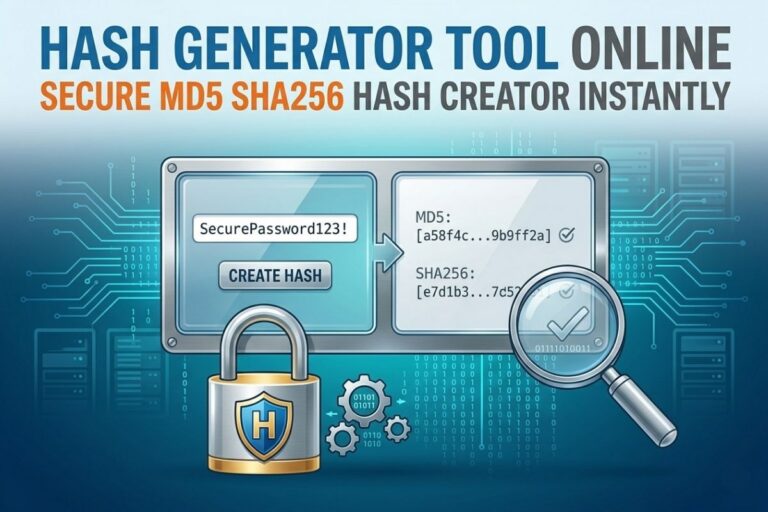
Cybersecurity Grade Hashing for Developers, Analysts, and Ethical Hackers
Welcome to a precision built cryptographic utility designed for speed, accuracy, and real world security workflows.
The Hash Generator Tool gives you the ability to instantly convert any input text into cryptographic hash outputs used across cybersecurity, software development, digital forensics, and data integrity validation.
This is not a gimmick tool. This is a functional security utility built for professionals who understand what hashing actually represents in modern systems.
Whether you are validating data, testing password logic, analyzing security behavior, or building applications that depend on deterministic outputs, hashing is a foundational operation. This tool delivers it instantly.
No friction. No unnecessary steps. Just direct cryptographic transformation.
Hash Generator Tool
Generate secure hashes instantly using MD5, SHA1, SHA256, SHA512, and other cryptographic algorithms. Perfect for developers, security testing, password verification, checksum validation, and data integrity checks.
Open Hash Generator →- ✔ Generate MD5 & SHA Hashes
- ✔ Fast Cryptographic Encoding
- ✔ Secure Browser-Based Tool
- ✔ Useful for Developers & Testing
- ✔ Free & No Registration Needed
🧠 What Is a Hash Generator
A hash generator is a cryptographic utility that converts input data into a fixed length string of characters that represents the original data.
This output is called a hash value.
A hash function is one way, meaning:
You can generate a hash from input
But you cannot reverse the hash back into the original input
That is what makes hashing fundamental in cybersecurity systems.
Common hash algorithms include:
MD5
SHA1
SHA256
SHA512
Each produces a unique output pattern based on the same input, but with different levels of security strength.
⚙️ How Hashing Works in Simple Terms
When you input text into a hashing algorithm, the system performs a mathematical transformation on that data.
For example:
Input:
admin123
Output using SHA256:
A long fixed length alphanumeric string unique to that input
Even a small change in input completely changes the output.
Example:
admin123
admin124
These produce completely different hashes.
This behavior is called the avalanche effect in cryptography. A single character change completely alters the output.
🔐 Why Hashing Matters in Cybersecurity
Hashing is one of the core pillars of modern security systems.
It is used to protect, verify, and validate data without exposing the original content.
Here is where it matters in real environments:
😄 Cyber Joke
Why did the hacker love hash generators?
Because turning passwords into random gibberish is their kind of magic trick! 😄
Password Storage
Systems do not store passwords directly. They store hashed versions. When you log in, your input is hashed and compared to the stored hash.
If the hashes match, authentication succeeds.
If not, access is denied.
Data Integrity Verification
Hashing is used to confirm that files or messages have not been altered.
If even one byte changes, the hash changes completely.
This is critical in:
Software downloads
Forensic investigations
Secure communications
Cloud storage validation
Digital Signatures
Hashing is used in combination with encryption to verify authenticity and prevent tampering.
Cybersecurity Analysis
Ethical hackers and security analysts use hashing to:
Identify patterns
Compare datasets
Validate leaked credentials
Test password strength systems
🧪 Supported Hash Algorithms in This Tool
This Hash Generator Tool supports multiple industry standard cryptographic functions:
MD5
Older algorithm
Fast but not secure for sensitive data
Still used for checksums and legacy systems
SHA1
Improved over MD5 but considered weak by modern standards
Used in older systems and compatibility layers
SHA256
Current industry standard for secure hashing
Used in blockchain, security systems, and authentication protocols
SHA512
Stronger variant of SHA256
Used in high security environments requiring extended collision resistance.
🛠️ How to Use the Hash Generator Tool
This tool is designed for speed and simplicity.
Step 1
Enter your input text into the field
Step 2
Select your hashing algorithm such as MD5 SHA256 or SHA512
Step 3
Click generate
Step 4
Copy your hash output instantly
There are no extra steps, no unnecessary authentication, and no delays.
It is built for rapid workflow integration.
🧩 Real World Use Cases
This tool is not theoretical. It is built for real operational environments.
Ethical Hacking
Security professionals use hash generation to:
Test password strength systems
Simulate attack scenarios
Compare hashed credential leaks
Analyze system vulnerabilities
Software Development
Developers use hashing for:
Data validation
Caching systems
Unique identifier generation
API request verification
Cyber Forensics
Investigators use hashing to:
Confirm file integrity
Detect tampering
Track digital evidence changes
Validate chain of custody
DevSecOps Pipelines
Hashing ensures consistency in:
Deployment verification
Container integrity
Configuration validation
Automated security checks
Database Integrity
Hashes are used to verify that records have not been altered unexpectedly.
Also Read : Password Strength Checker: 7 Powerful Ways to Create Secure Passwords
🧠 Important Security Insight
Not all hash functions are equally secure.
MD5 and SHA1 are considered weak for security sensitive operations due to collision vulnerabilities.
SHA256 and SHA512 are recommended for modern systems.
If you are building or testing security systems, always choose SHA256 or higher unless you are working with legacy compatibility requirements.
⚡ Why This Tool Exists
Most online hash generators are cluttered, slow, or filled with unnecessary distractions.
This tool is designed with a different mindset.
It is built for:
Speed
Accuracy
Security awareness
Developer efficiency
Ethical hacking workflows
No ads interfering with usability
No unnecessary features slowing execution
No data retention of your input
Just a direct cryptographic utility.
🧱 Technical Foundation of Hash Functions
A cryptographic hash function follows strict mathematical properties:
Deterministic output
Same input always produces same hash
Fixed length output
Regardless of input size
Pre image resistance
Cannot reverse hash back into original input
Collision resistance
Two different inputs should not produce same output
Avalanche effect
Small input change produces completely different output
These properties are what make hashing reliable for security systems.
🔍 Example Output Behavior
Input:
password
MD5 Output:
098f6bcd4621d373cade4e832627b4f6
SHA256 Output:
5e884898da28047151d0e56f8dc6292773603d0d6aabbdd62a11ef721d1542d8
Even though the input is identical, the outputs differ dramatically based on algorithm strength.
🧪 Developer Integration Use
If you are building applications, you can use hashing for:
User authentication systems
Data verification layers
Token generation
Security fingerprinting
API request validation
Hashing should always be treated as a foundational security primitive, not an optional feature.
🧠 Ethical Hacker Perspective
From a cybersecurity standpoint, hashing is often misunderstood.
It is not encryption.
It does not protect confidentiality on its own.
Instead, it ensures integrity and consistency.
Attackers often target weak implementations, not the algorithm itself.
Common mistakes include:
Using MD5 for password storage
Storing unhashed credentials
Reusing predictable salts
Failing to validate hash algorithms during migration
Proper hashing strategy is a defensive requirement, not a feature.
❓ Frequently Asked Questions
What is a hash generator used for
It is used to convert input data into a fixed cryptographic output for security, validation, and verification purposes.
Can a hash be reversed
No. Cryptographic hashes are one way functions and cannot be reversed into original input.
Which hash algorithm is the most secure
SHA256 and SHA512 are currently considered secure for modern applications.
Is MD5 still safe
No. MD5 is vulnerable to collision attacks and should not be used for security sensitive data.
Can two inputs produce the same hash
In theory yes, but secure algorithms like SHA256 make this extremely unlikely in practical systems.
🔥 Final Takeaway
Hashing is not optional in modern cybersecurity systems.
It is a foundational mechanism that supports authentication, integrity validation, digital trust, and secure software design.
This Hash Generator Tool is built to give you immediate access to that capability without overhead, friction, or unnecessary complexity.
If you are building systems, testing security models, or working in ethical hacking environments, hashing is one of the first primitives you must fully understand and correctly implement.
Explore More Free Tools
Hash Generator Tool
Generate secure MD5, SHA1, SHA256, and other cryptographic hashes instantly online.
Open Tool →Dummy File Generator
Create sample dummy files of custom sizes for testing uploads, storage, and applications.
Open Tool →Password Strength Checker
Analyze password security and identify weak passwords before using them online.
Open Tool →File Hash Checker
Verify file integrity by checking MD5, SHA256, and other file hash signatures.
Open Tool →UUID Generator
Generate random UUIDs and unique identifiers instantly for apps, APIs, and databases.
Open Tool →Text Diff Checker
Compare two text blocks side by side and quickly detect additions, deletions, and edits.
Open Tool →