
Most developers spend countless hours building features, fixing bugs, optimizing performance, and preparing applications for deployment.
Then launch day arrives.
Everything appears ready.
Until a user uploads a file the development team never tested.
Suddenly, uploads fail. Performance drops. Storage behaves unexpectedly. Error messages appear where none existed before. The application that looked flawless in staging begins showing cracks in production.
This scenario happens more often than many teams would like to admit.
The problem is rarely the feature itself.
The problem is inadequate testing.
That is why every serious development team should use a dummy file generator for developers before launch day.
Dummy files help teams simulate real world conditions, uncover hidden weaknesses, and validate system behavior before customers discover problems first.
The best developers do not simply test whether software works.
They test whether software survives.
Use Our Tool: Dummy File Generator
Why Developers Need Better Testing Data
Testing environments often suffer from a common problem.
They are too clean.
Developers create ideal conditions with perfectly formatted files, predictable user behavior, and controlled environments. Unfortunately, production environments are rarely that cooperative.
Real users upload large files.
Real users upload unexpected formats.
Real users make mistakes.
Applications must be prepared for all of it.
Without realistic test data, teams are essentially guessing how software will behave under real world conditions.
A dummy file generator provides a practical solution by creating files specifically designed to evaluate system performance, storage capacity, upload workflows, and application stability.
Instead of hoping everything works, developers can verify it.
That difference is significant.
What Is A Dummy File Generator?
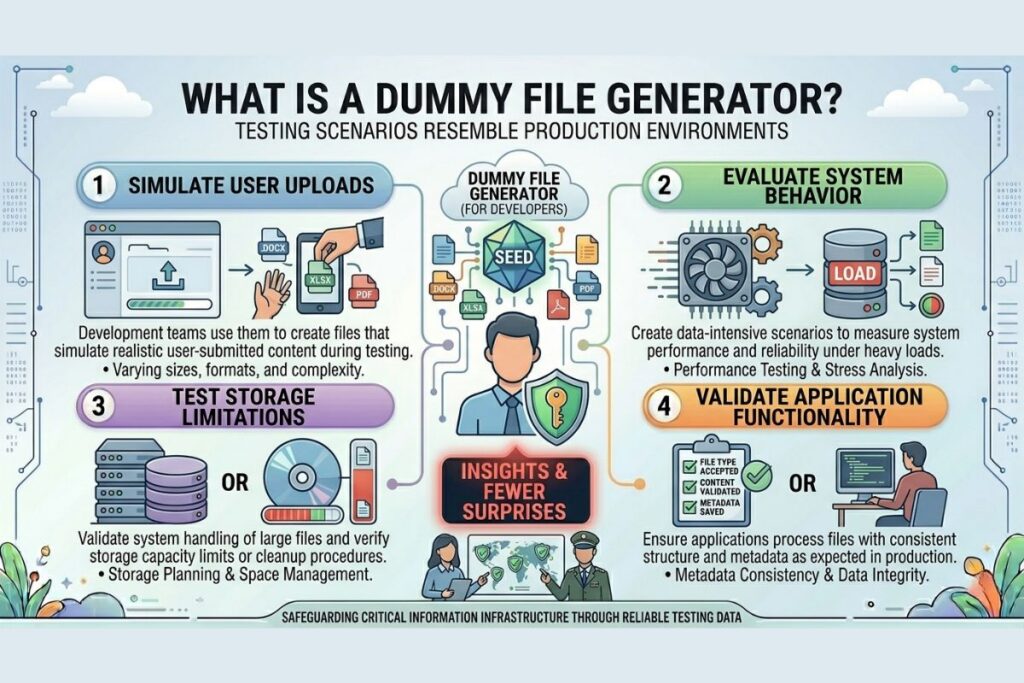
A dummy file generator is a tool that creates files for testing purposes.
These files can vary in size, format, structure, and complexity depending on testing requirements.
Development teams use them to simulate user uploads, evaluate system behavior, test storage limitations, and validate application functionality.
A dummy file generator for developers allows teams to create testing scenarios that closely resemble production environments.
This provides valuable insights before software reaches customers.
Rather than relying on random files gathered from various sources, developers can generate consistent test data on demand.
The result is more reliable testing and fewer surprises after deployment.
Dummy Files Reveal Hidden Problems
One reason dummy files are so valuable is their ability to expose weaknesses that traditional testing often misses.
Applications may perform perfectly with small files but struggle when processing larger uploads.
Storage systems may behave normally until they reach capacity thresholds.
Upload validation may fail under unexpected conditions.
These issues often remain hidden because developers never encounter them during standard testing.
Dummy files help eliminate these blind spots.
They allow teams to intentionally create scenarios that push systems beyond normal operating conditions.
The goal is not to break software.
The goal is to understand how software behaves when challenged.
That understanding creates stronger applications.
Also Read: Stress Testing Upload Systems With Corrupt Files
Performance Testing Becomes More Accurate
Performance testing without realistic data is often misleading.
An application may appear fast when processing small test files.
The experience changes dramatically when users begin uploading large documents, videos, archives, or datasets.
A dummy file generator helps developers evaluate:
- Upload speed
- Storage performance
- Processing efficiency
- Resource utilization
- Application responsiveness
- Network impact
By generating files of various sizes, teams gain a clearer picture of how systems perform under realistic workloads.
This allows performance issues to be identified long before customers encounter them.
Launch day should not be the first large scale performance test.
Upload Systems Need Real Stress Testing
File uploads are among the most common features in modern applications.
They are also one of the most frequently overlooked areas during testing.
Developers often validate whether an upload succeeds.
They rarely test how the system behaves under significant load.
A dummy file generator for developers makes stress testing practical.
Teams can simulate hundreds or thousands of uploads without relying on real customer data.
This reveals weaknesses involving:
- Upload limitations
- Processing delays
- Timeout errors
- Storage bottlenecks
- Validation failures
- Scalability concerns
The sooner these issues are discovered, the less expensive they become to fix.
Better Storage Planning
Storage requirements are often underestimated.
Applications may perform well during development while using only a small amount of data.
Production environments tell a different story.
As uploads increase, storage systems experience growing demands.
Without proper testing, organizations may discover capacity limitations only after users begin experiencing problems.
Dummy files allow teams to model storage growth and evaluate long term scalability.
Developers can observe how applications behave as storage consumption increases and determine whether infrastructure plans are realistic.
Good testing prevents expensive surprises.
Why DevOps Teams Love Dummy Files
Development teams are not the only groups that benefit from realistic testing data.
DevOps professionals rely on dummy files when validating deployment environments, infrastructure configurations, and automation workflows.
Large datasets provide opportunities to test backup systems, monitoring solutions, storage replication, and disaster recovery procedures.
Dummy files also allow teams to evaluate cloud storage costs and resource utilization before deployment.
This helps organizations make informed infrastructure decisions rather than relying on assumptions.
When testing becomes more realistic, operational confidence increases.
Security Testing Benefits
Many developers associate dummy files with performance testing.
The security advantages are equally important.
Applications accepting uploaded content must process untrusted data safely.
Testing upload workflows with various file types helps identify weaknesses in validation controls and processing logic.
According to guidance from the official Open Web Application Security Project, secure file handling remains an important component of application security.
Learn more at https://owasp.org.
A well designed testing strategy examines not only functionality but also resilience against unexpected inputs.
Strong security begins with strong testing.
Why Manual Testing Is Not Enough
Some teams attempt to gather test files manually.
This approach creates several challenges.
Finding files of specific sizes takes time.
Organizing test datasets becomes difficult.
Consistency suffers across projects.
Reproducing testing conditions becomes complicated.
A dedicated dummy file generator for developers eliminates these problems.
Files can be generated on demand.
Testing becomes repeatable.
Workflows become more efficient.
Developers spend less time searching for data and more time improving software.
That efficiency becomes increasingly valuable as projects grow.
Why FileCorrupter.org Fits The Workflow
Modern development teams need practical testing tools.
They need solutions that save time while improving software quality.
FileCorrupter.org helps developers generate testing resources that support upload validation, storage testing, performance analysis, and application reliability assessments.
Instead of relying on random files scattered across different environments, teams can quickly create the testing assets they need.
The result is better preparation before launch day and greater confidence after deployment.
Reliable software starts with realistic testing.
The Difference Between Good And Great Developers
Good developers verify functionality.
Great developers verify reliability.
Good developers focus on whether a feature works.
Great developers focus on whether it continues working when conditions change.
That mindset separates stable applications from unstable ones.
The most successful teams understand that software quality is determined long before customers interact with a product.
It is determined during testing.
The more realistic the testing process becomes, the fewer surprises occur after launch.
That is exactly why dummy file generators have become valuable tools for modern development teams.
Frequently Asked Questions
What is a dummy file generator for developers?
A dummy file generator for developers is a tool that creates files of various sizes and formats for testing application performance, storage systems, upload workflows, and infrastructure.
Why should developers use dummy files before launch?
Dummy files help identify performance bottlenecks, storage limitations, upload failures, scalability concerns, and reliability issues before software reaches production.
Can dummy files improve performance testing?
Yes. Dummy files allow teams to simulate realistic workloads and evaluate how applications behave under conditions that closely resemble production environments.
Are dummy file generators useful for DevOps teams?
Absolutely. DevOps teams use dummy files to test storage systems, backup processes, deployment workflows, monitoring solutions, and infrastructure scalability.
Final Thought
Launch day should never be the moment developers discover how their software behaves under real world conditions.
That discovery should happen long before deployment.
A dummy file generator for developers provides a simple but powerful way to improve testing quality, strengthen application reliability, and uncover hidden weaknesses before users find them.
The teams that invest in realistic testing consistently build stronger software.
They experience fewer surprises.
They resolve fewer emergencies.
And they earn greater trust from users.
The next time a project appears ready for deployment, ask one question:
Have we tested it with realistic data?
The bug that crashes production is often hiding inside a file nobody thought to create.
Explore More Free Tools
Hash Generator Tool
Generate secure MD5, SHA1, SHA256, and other cryptographic hashes instantly online.
Open Tool →Dummy File Generator
Create sample dummy files of custom sizes for testing uploads, storage, and applications.
Open Tool →Password Strength Checker
Analyze password security and identify weak passwords before using them online.
Open Tool →File Hash Checker
Verify file integrity by checking MD5, SHA256, and other file hash signatures.
Open Tool →UUID Generator
Generate random UUIDs and unique identifiers instantly for apps, APIs, and databases.
Open Tool →Text Diff Checker
Compare two text blocks side by side and quickly detect additions, deletions, and edits.
Open Tool →