
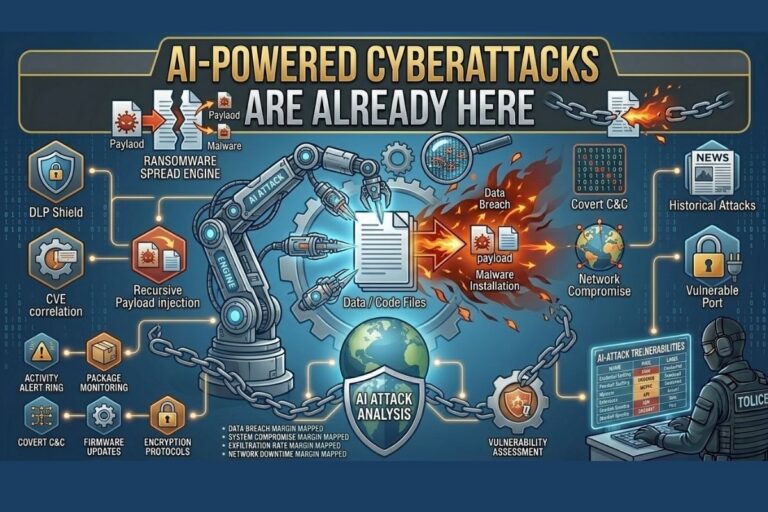
The cybersecurity battlefield has changed.
For years, cybercriminals relied on the same playbook. They sent phishing emails riddled with spelling mistakes. They launched malware campaigns that were often easy to detect. They spent hours researching targets before attempting social engineering attacks.
Those days are disappearing.
AI-powered cyberattacks are already here, and they are transforming cybercrime faster than most people realize. Artificial intelligence is giving criminals new capabilities that allow them to automate attacks, improve deception, scale operations, and increase success rates.
As an ethical hacker, I spend a lot of time studying how attackers think. One thing has always remained true. Hackers love efficiency. Anything that allows them to attack more people in less time becomes valuable.
Artificial intelligence is the ultimate efficiency tool.
The scary part is not that AI is becoming smarter. The scary part is that criminals are becoming more effective because of it.
Individuals, businesses, healthcare organizations, and government agencies are all feeling the impact.
The future of cybercrime is no longer coming.
It has arrived.
What Are AI-Powered Cyberattacks?
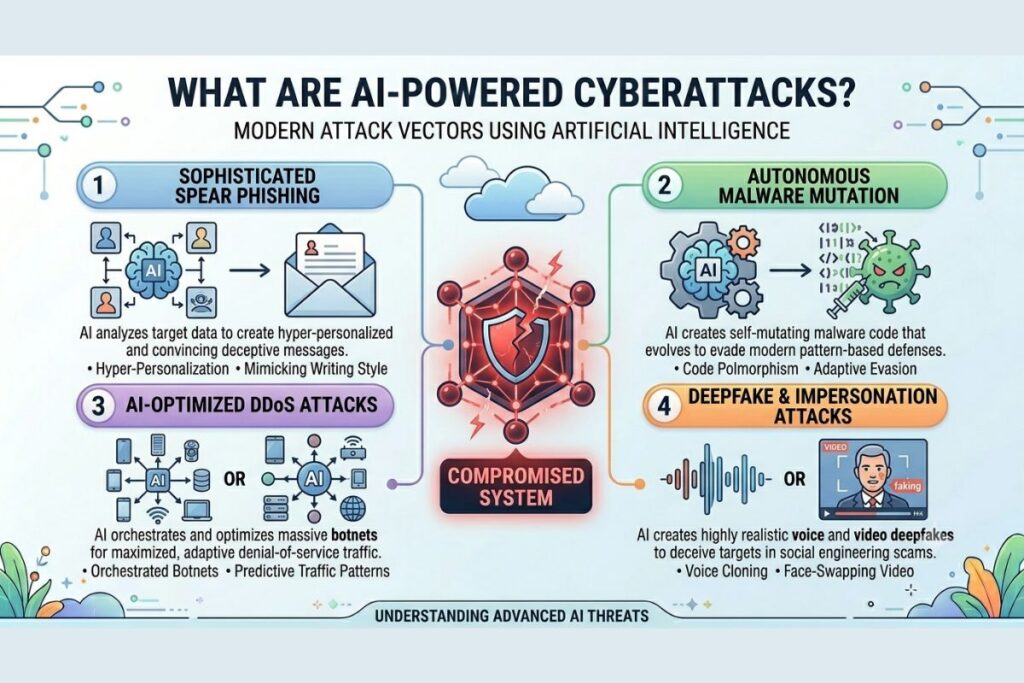
AI-powered cyberattacks involve the use of artificial intelligence technologies to enhance malicious activities. Rather than manually performing every stage of an attack, cybercriminals can use AI to automate tasks that once required significant time and skill.
Artificial intelligence can generate phishing emails, analyze target information, identify vulnerabilities, create convincing social engineering messages, and assist with malware development.
Think of AI as a force multiplier.
A criminal who previously targeted ten people might now target ten thousand.
A scammer who once needed hours to craft a convincing email can now generate hundreds in minutes.
This shift fundamentally changes the economics of cybercrime.
More automation means more attacks.
More attacks mean more victims.
Also Read: Smart Doorbells: Convenience or Cybersecurity Nightmare?
Why AI-Powered Cyberattacks Are More Dangerous
One of the biggest myths in cybersecurity is that technology is always the primary target.
In reality, people are often the target.
Hackers understand psychology. They understand urgency. They understand trust.
Artificial intelligence helps them exploit those weaknesses more effectively than ever before.
Traditional phishing emails often contained obvious red flags. Poor grammar, strange wording, and suspicious formatting frequently exposed scams before victims clicked.
AI changes that equation.
Modern AI systems can generate polished, professional communications that appear completely legitimate.
Imagine receiving an email from what appears to be your bank. The message contains perfect grammar, references your industry, and creates a sense of urgency.
Most people would struggle to recognize the deception.
That is exactly why AI-powered cyberattacks are becoming so successful.
The attacks no longer look suspicious.
They look authentic.
How Hackers Use AI-Powered Cyberattacks
Cybercriminals are constantly looking for ways to increase efficiency. Artificial intelligence provides numerous opportunities to do exactly that.
AI-Powered Phishing Campaigns
Phishing remains one of the most effective attack methods because it targets human behavior.
Artificial intelligence allows criminals to create highly personalized messages based on publicly available information.
Social media accounts, business websites, online forums, professional networking profiles, and previous data breaches provide attackers with valuable intelligence.
AI can process that information and generate customized messages that feel personal and trustworthy.
The result is a phishing campaign that appears far more convincing than traditional scams.
AI-Assisted Social Engineering
Social engineering attacks rely on manipulation.
Artificial intelligence makes manipulation easier.
Attackers can generate scripts, responses, and conversations designed to exploit human emotions.
Fear.
Trust.
Urgency.
Curiosity.
These emotions have always been powerful tools for cybercriminals.
Artificial intelligence simply helps them weaponize those emotions more effectively.
AI-Driven Reconnaissance
Before launching an attack, hackers gather intelligence.
Artificial intelligence can automate this process.
AI systems can analyze enormous amounts of publicly available information and identify valuable targets, weak security practices, and organizational structures.
Instead of spending days researching a company, attackers can use AI to accelerate the process dramatically.
That means attacks can occur faster and more frequently.
AI-Powered Cyberattacks and Deepfake Technology
One of the most disturbing developments in cybersecurity involves deepfakes.
Deepfake technology uses artificial intelligence to create realistic audio, video, and images that mimic real people.
Imagine receiving a phone call from your CEO.
The voice sounds perfect.
The tone sounds authentic.
The request seems legitimate.
Except it is not your CEO.
It is an attacker using AI-generated voice cloning.
Deepfake fraud is becoming increasingly sophisticated, and organizations that rely solely on voice verification are exposing themselves to significant risk.
The same technology can create fake video messages, fake interviews, and fake evidence designed to manipulate victims.
This is why trust alone can no longer be considered a security control.
Verification must become part of every critical business process.
AI Malware Is Becoming Smarter
Cybercriminals are also using artificial intelligence to improve malware.
Contrary to popular belief, AI is not independently creating advanced cyber weapons without human involvement.
However, it is helping attackers modify malicious code, identify weaknesses in security products, and automate portions of the development process.
The result is malware that evolves more quickly and becomes increasingly difficult to detect.
Security teams are facing a new challenge.
Attackers can now iterate and improve malicious tools at unprecedented speed.
That speed creates significant advantages for criminals.
Healthcare Is a Prime Target
Healthcare organizations have become one of the most attractive targets for cybercriminals.
Hospitals store sensitive patient information, manage critical infrastructure, and often cannot tolerate downtime.
AI-powered cyberattacks increase the risk.
A successful phishing campaign against a healthcare provider could lead to ransomware infections, stolen patient records, or operational disruptions.
The consequences extend far beyond financial losses.
In some cases, patient care can be affected.
That is why healthcare cybersecurity remains one of the most important topics covered at filecorrupter.org.
Cybersecurity failures in healthcare are not simply business problems.
They can become human problems.
Small Businesses Are Increasingly Vulnerable
Many small business owners assume hackers only care about large corporations.
That assumption is dangerous.
Attackers often prefer easier targets.
Small businesses frequently lack dedicated cybersecurity teams, advanced monitoring capabilities, and mature security programs.
Artificial intelligence allows cybercriminals to identify vulnerable organizations more efficiently.
A small accounting firm.
A local law office.
A healthcare clinic.
A real estate company.
All of them can become targets.
Cybercriminals do not always attack the biggest organizations.
They attack the easiest ones.
Shadow AI Creates Internal Risks
External threats are not the only concern.
Organizations must also address internal risks associated with artificial intelligence.
Employees increasingly use AI tools to improve productivity.
Unfortunately, many do so without understanding the security implications.
Sensitive business documents, proprietary information, source code, financial records, and customer data may be uploaded into AI systems without proper authorization.
This phenomenon is commonly known as Shadow AI.
Without clear governance policies, organizations may unintentionally expose valuable information.
Security leaders must establish rules regarding AI usage before these risks become major incidents.
Defending Against AI-Powered Cyberattacks
Fortunately, there are practical ways to reduce risk.
Organizations should implement multi-factor authentication across critical systems.
Employees should receive ongoing cybersecurity awareness training.
Software and operating systems should be patched regularly.
Sensitive requests should always be verified through secondary communication channels.
Strong password policies should be enforced.
Security monitoring should be improved.
Incident response plans should be developed and tested.
Businesses should also leverage trusted cybersecurity resources.
The Cybersecurity and Infrastructure Security Agency provides valuable guidance:
The National Institute of Standards and Technology offers security frameworks and best practices:
https://www.nist.gov/cyberframework
Microsoft Security regularly publishes insights regarding emerging cyber threats:
https://www.microsoft.com/security
The goal is not perfection.
The goal is resilience.
Why Understanding Attackers Matters
One advantage ethical hackers possess is perspective.
We study attacker behavior.
We examine techniques.
We identify weaknesses before criminals exploit them.
That mindset helps organizations understand how threats evolve.
The best defenders think like attackers.
They ask difficult questions.
They challenge assumptions.
They recognize that cybersecurity is not a technology problem alone.
It is a people problem, a process problem, and a mindset problem.
Artificial intelligence simply magnifies those existing challenges.
The Future of Cybercrime Has Arrived
Artificial intelligence will continue transforming cybercrime.
Attackers will become faster.
Scams will become more convincing.
Deepfakes will become more realistic.
Automation will continue expanding.
Organizations that ignore these trends will struggle to defend themselves.
Those that adapt will be better positioned to withstand future threats.
At filecorrupter.org, the mission remains simple.
Expose threats.
Educate readers.
Strengthen defenses.
And help people understand how cybercriminals really operate.
Because the best defense begins with awareness.
FAQs
What are AI-powered cyberattacks?
AI-powered cyberattacks use artificial intelligence technologies to enhance phishing, malware, reconnaissance, social engineering, and other malicious activities.
Why are AI-powered cyberattacks increasing?
Cybercriminals use artificial intelligence because it increases efficiency, improves personalization, automates tasks, and helps scale attacks more effectively.
Can AI create malware?
AI can assist with malware development and modification, but human attackers still direct most malicious operations.
How can businesses defend against AI-powered cyberattacks?
Businesses should implement multi-factor authentication, employee training, security monitoring, regular patching, incident response planning, and strong AI governance policies.
Final Thought
AI-powered cyberattacks are not tomorrow’s problem.
They are today’s reality.
Artificial intelligence is giving cybercriminals new capabilities that increase the scale, sophistication, and effectiveness of attacks. Whether it is phishing, deepfakes, malware, or social engineering, attackers are finding ways to use AI to their advantage.
The organizations and individuals who succeed in this environment will not be the ones with the most expensive technology.
They will be the ones who stay informed, remain vigilant, and continuously adapt.
Cybersecurity has always been an arms race.
Artificial intelligence has simply accelerated it.
Explore More Free Tools
Hash Generator Tool
Generate secure MD5, SHA1, SHA256, and other cryptographic hashes instantly online.
Open Tool →Dummy File Generator
Create sample dummy files of custom sizes for testing uploads, storage, and applications.
Open Tool →Password Strength Checker
Analyze password security and identify weak passwords before using them online.
Open Tool →File Hash Checker
Verify file integrity by checking MD5, SHA256, and other file hash signatures.
Open Tool →UUID Generator
Generate random UUIDs and unique identifiers instantly for apps, APIs, and databases.
Open Tool →Text Diff Checker
Compare two text blocks side by side and quickly detect additions, deletions, and edits.
Open Tool →