
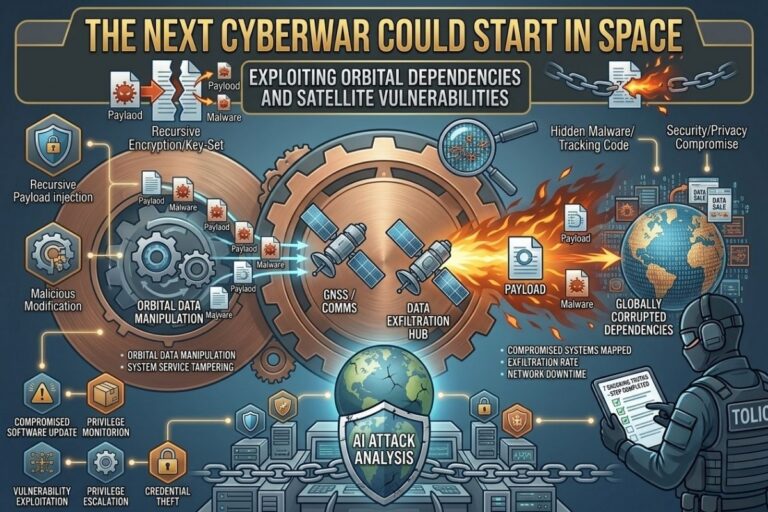
Most people still imagine the next major war beginning with missiles, fighter jets, naval fleets, or troops crossing borders.
That assumption may be one of the most dangerous misconceptions of the modern era.
The next cyberwar could start in space.
Not because satellites are futuristic technology. Not because governments are obsessed with science fiction. And not because space has suddenly become a military playground.
The next cyberwar could start in space because modern civilization depends on orbital infrastructure more than most people realize.
Every day, satellites quietly support GPS navigation, military communications, emergency response systems, weather forecasting, financial synchronization, transportation networks, intelligence gathering, internet connectivity, and critical infrastructure operations around the world.
That dependency creates vulnerability.
And vulnerability attracts attackers.
Space cyber warfare is rapidly emerging as one of the most important cybersecurity threats facing governments, businesses, military organizations, and civilians alike.
At filecorrupter.org, we focus on cybersecurity threats with real-world consequences. Space cyber warfare represents exactly that kind of threat because successful attacks against orbital infrastructure could create disruptions across multiple sectors simultaneously without a single shot being fired.
The battlefield is changing.
And most people have not noticed.
Space Cyber Warfare Is No Longer Science Fiction
For decades, space was viewed primarily as a domain for exploration, scientific discovery, and technological innovation.
Today, it is something else entirely.
It is infrastructure.
According to CISA Space Systems Critical Infrastructure guidance, satellite systems play a direct role in national security, public safety, communications, transportation, and economic stability.
That means attacks against orbital infrastructure no longer affect only governments or aerospace organizations.
They affect everyone.
Space cyber warfare has become a realistic threat because modern societies have built enormous dependencies on systems operating hundreds of miles above Earth.
The more dependent civilization becomes on satellites, the more valuable those systems become as targets.
Cybercriminals understand that.
Nation-state attackers understand that.
Military planners understand that.
The question is whether the public understands it.
Space Cyber Warfare Could Disrupt Military Communications
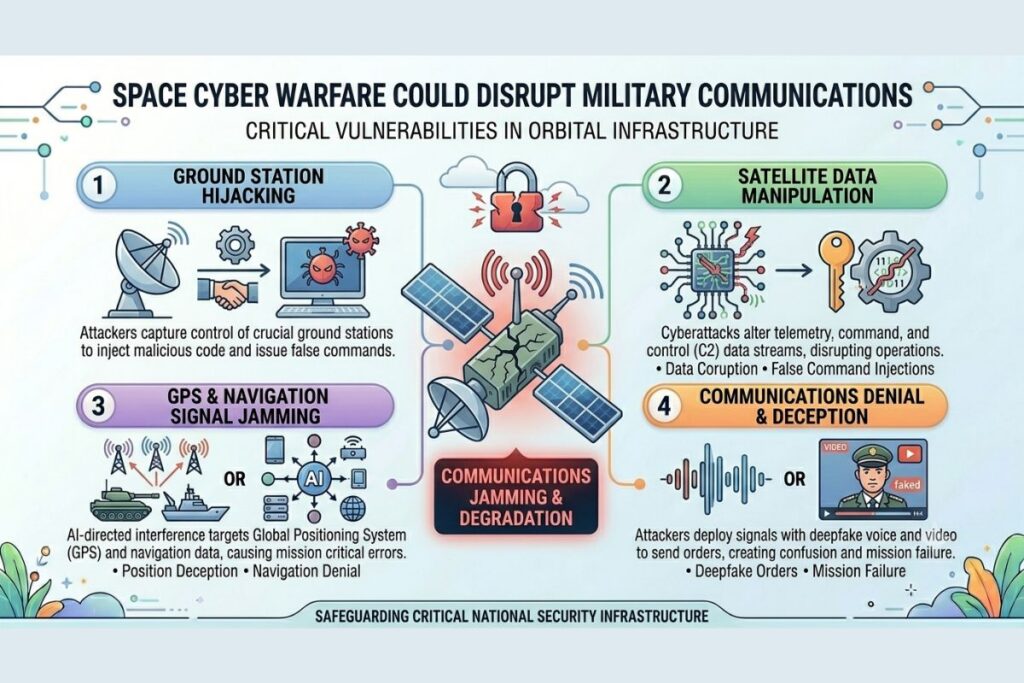
Military operations depend heavily on satellite infrastructure.
Modern armed forces use satellites to:
- coordinate operations
- communicate globally
- gather intelligence
- monitor adversaries
- support drone operations
- synchronize battlefield movement
Without satellite communications, military effectiveness drops dramatically.
That reality makes military satellite systems attractive targets during geopolitical conflict.
A successful space cyber warfare campaign targeting communication systems could potentially:
- isolate military units
- delay operational responses
- weaken intelligence sharing
- disrupt command structures
- create confusion during critical missions
According to NASA Cybersecurity initiatives, protecting space systems from cyber threats has become increasingly important as dependence on orbital infrastructure continues growing.
The battlefield is no longer confined to land, sea, and air.
It now extends into orbit.
Space Cyber Warfare Could Weaponize GPS Systems
Most people use GPS every day without thinking about it.
Drivers rely on navigation apps.
Airlines depend on positioning systems.
Shipping companies use GPS for logistics.
Emergency responders rely on location accuracy.
Financial institutions depend on timing synchronization.
That level of dependency creates opportunity.
One of the most dangerous forms of space cyber warfare involves GPS spoofing.
GPS spoofing occurs when attackers transmit false navigation signals that trick systems into calculating incorrect locations or timing information.
The terrifying part is that victims often do not realize they are being manipulated.
The systems appear functional.
The information appears legitimate.
The trust remains intact until the consequences become impossible to ignore.
A successful GPS manipulation campaign could affect:
- aircraft navigation
- cargo transportation
- emergency services
- military coordination
- financial transactions
- public infrastructure
This is why satellite cybersecurity has become a national security issue rather than simply a technical concern.
Space Cyber Warfare Threatens Critical Infrastructure
Modern infrastructure is interconnected.
Power grids communicate digitally.
Transportation systems rely on synchronized timing.
Emergency response networks depend on reliable communication.
Financial institutions require accurate data transmission.
Many of these systems depend directly or indirectly on satellite infrastructure.
That means space cyber warfare could create cascading failures across multiple industries.
Imagine a coordinated attack targeting:
- communication satellites
- GPS systems
- emergency response infrastructure
- transportation networks
The disruption would spread rapidly.
Attackers increasingly recognize that targeting infrastructure can create greater impact than targeting individual organizations.
That is why space cyber warfare deserves serious attention.
It is not just about satellites.
It is about everything connected to them.
Commercial Satellites Have Become Strategic Targets
Governments are not the only organizations operating satellites anymore.
Private companies now launch and manage satellites supporting:
- internet services
- communications
- logistics
- navigation
- defense partnerships
- remote connectivity
This creates a new cybersecurity challenge.
Commercial organizations now control infrastructure with enormous strategic value.
According to European Space Agency cybersecurity research, protecting space systems against cyber threats is becoming increasingly important as commercial and government reliance on orbital infrastructure expands.
Commercial satellites may become attractive targets because they support both civilian and military operations.
That overlap creates risk.
And attackers know it.
Also Read: AI-Powered Cyberattacks Are Already Here
Space Cyber Warfare Could Exploit Ground Stations
When people imagine satellite hacking, they often picture attackers targeting spacecraft directly.
In reality, ground stations frequently represent a more practical target.
Ground stations manage:
- communication systems
- satellite telemetry
- software updates
- operational commands
- authentication systems
Compromising a ground station may provide indirect access to broader satellite infrastructure.
Potential attack methods include:
- phishing campaigns
- credential theft
- ransomware attacks
- malware infections
- insider threats
- software vulnerabilities
Cybercriminals rarely choose the hardest path.
They look for the weakest link.
Ground infrastructure often provides exactly that opportunity.
Space Cyber Warfare Creates Psychological Chaos
One of the most overlooked aspects of space cyber warfare is psychological impact.
Traditional warfare produces visible destruction.
Cyber warfare often produces confusion.
Communication systems appear operational but behave unpredictably.
Navigation systems continue functioning but provide false information.
Infrastructure remains online while producing unreliable results.
This creates uncertainty.
And uncertainty weakens decision-making.
Attackers increasingly recognize that psychological disruption can be just as effective as physical disruption.
Space cyber warfare amplifies this effect because orbital systems operate far beyond public visibility.
Most civilians would never recognize an attack until its consequences become widespread.
Why Space Cyber Warfare Will Continue Growing
The future points in one direction.
More satellites.
More connected infrastructure.
More commercial space operations.
More dependence on orbital systems.
That means the attack surface will continue expanding.
Space cyber warfare will likely grow because:
- satellite dependence is increasing
- commercial space activity is expanding
- military reliance on orbital systems continues growing
- infrastructure connectivity is accelerating
- cybercriminals follow opportunity
The more important these systems become, the more attractive they become as targets.
That is the reality governments and cybersecurity professionals must prepare for.
Frequently Asked Questions
What is space cyber warfare?
Space cyber warfare involves cyberattacks targeting satellites, communication systems, GPS infrastructure, ground stations, and orbital technologies that support military, civilian, and commercial operations.
Why is space cyber warfare important?
Space cyber warfare threatens critical infrastructure that supports communication, transportation, emergency response, financial systems, and national security operations.
Can hackers target satellites?
Attackers may target satellites directly or compromise supporting infrastructure such as ground stations, communication networks, authentication systems, and operational software.
Why are satellites valuable cyber targets?
Satellites support GPS navigation, military communications, internet connectivity, intelligence gathering, emergency response coordination, and economic infrastructure worldwide.
Final Thought
Most people still imagine the next major conflict beginning with conventional weapons.
That mindset belongs to another era.
Modern civilization depends heavily on infrastructure operating silently above Earth every second of every day. Communication networks, military operations, transportation systems, financial institutions, emergency responders, and commercial enterprises all rely on satellites functioning continuously without disruption.
That dependency creates vulnerability.
And attackers understand exactly how valuable that vulnerability has become.
The next cyberwar may not begin inside a corporate network.
It may not begin inside a government agency.
It may not even begin on Earth.
The next cyberwar could start in space.
Explore More Free Tools
Hash Generator Tool
Generate secure MD5, SHA1, SHA256, and other cryptographic hashes instantly online.
Open Tool →Dummy File Generator
Create sample dummy files of custom sizes for testing uploads, storage, and applications.
Open Tool →Password Strength Checker
Analyze password security and identify weak passwords before using them online.
Open Tool →File Hash Checker
Verify file integrity by checking MD5, SHA256, and other file hash signatures.
Open Tool →UUID Generator
Generate random UUIDs and unique identifiers instantly for apps, APIs, and databases.
Open Tool →Text Diff Checker
Compare two text blocks side by side and quickly detect additions, deletions, and edits.
Open Tool →