
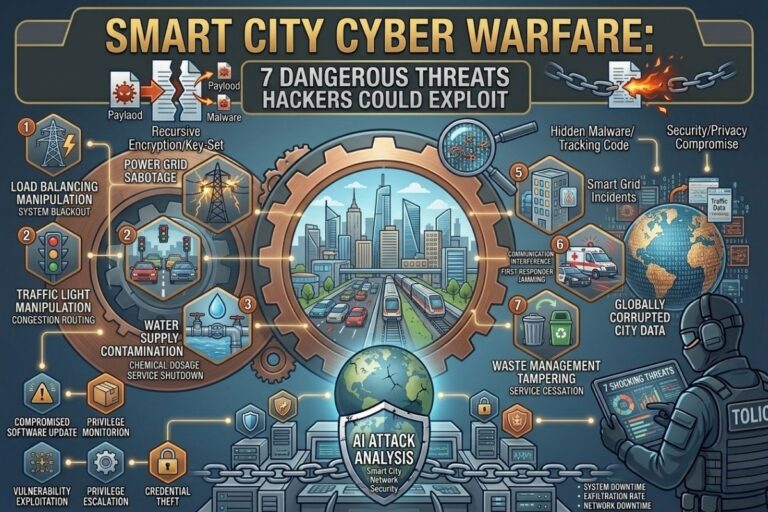
The smarter cities become, the more dangerous they may become when hackers target the systems controlling them.
Modern cities are evolving into massive interconnected digital ecosystems powered by artificial intelligence, IoT devices, automated infrastructure, surveillance networks, cloud systems, traffic management platforms, and real-time communication technology. These systems promise efficiency, convenience, automation, and enhanced public safety.
They also create one of the largest cyberattack surfaces modern civilization has ever built.
Smart city cyber warfare is rapidly becoming one of the most dangerous infrastructure cybersecurity concerns in the world because modern urban environments increasingly depend on connected systems functioning continuously without disruption.
That dependency creates vulnerability.
And attackers are paying attention.
At filecorrupter.org, we focus on cybersecurity threats with real-world consequences. Smart city cyberwarfare belongs at the center of that conversation because cyberattacks targeting urban infrastructure could disrupt transportation systems, emergency communication, healthcare operations, public utilities, financial infrastructure, and civilian safety simultaneously.
This is no longer science fiction.
This is the future battlefield of cyber warfare.
Smart City Cyber warfare Could Disrupt Entire Transportation Networks
Modern cities increasingly depend on connected transportation systems.
Traffic signals.
Public transportation.
Rail systems.
Airport infrastructure.
Autonomous vehicle coordination.
Smart traffic monitoring.
Many of these systems rely on centralized digital infrastructure operating continuously behind the scenes.
That creates opportunity for attackers.
According to CISA critical infrastructure guidance, transportation systems now represent major cybersecurity targets because modern infrastructure relies heavily on interconnected digital systems.
A successful smart city cyber warfare attack targeting transportation infrastructure could potentially:
- disrupt traffic systems
- create citywide gridlock
- interfere with emergency vehicle routing
- delay evacuation efforts
- disrupt airport coordination
- interrupt public transportation operations
The terrifying part is this:
Modern cities are becoming increasingly dependent on automation controlling systems most civilians never even think about.
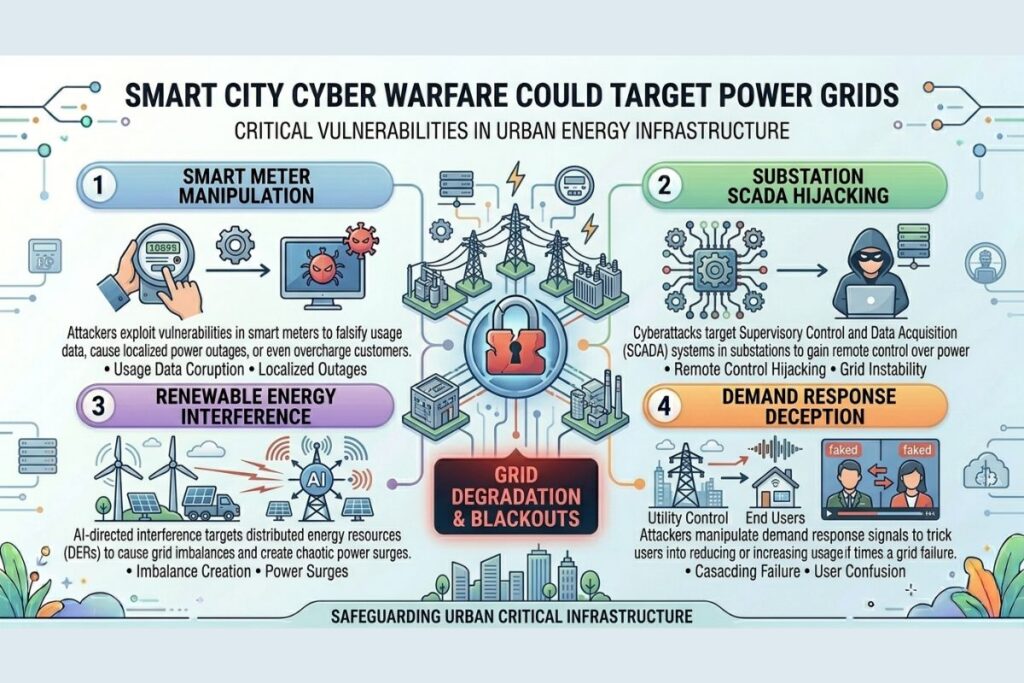
Smart City Cyber warfare Could Target Power Grids
Electricity powers modern civilization.
Without power, smart cities become extremely vulnerable.
Modern energy infrastructure increasingly relies on:
- automated monitoring systems
- smart grids
- cloud connectivity
- digital utility management
- AI optimization systems
- remote operational control
This creates another massive cyberattack surface.
Smart city cyber-warfare attacks targeting power infrastructure could potentially:
- trigger blackouts
- disrupt emergency systems
- interfere with communication networks
- weaken transportation infrastructure
- impact healthcare operations
- create widespread operational confusion
According to Department of Energy cybersecurity initiatives, energy infrastructure cybersecurity is becoming increasingly critical as digital utility systems continue expanding nationwide.
Attackers understand that infrastructure disruption creates fear, uncertainty, and psychological instability.
That makes power systems extremely attractive targets.
Surveillance Systems Could Become Dangerous Weapons
Smart cities increasingly depend on surveillance technology.
Cameras.
Facial recognition systems.
AI monitoring platforms.
License plate readers.
Sensor networks.
Behavioral analytics systems.
These technologies are often promoted as tools for public safety and operational efficiency.
But what happens if attackers gain access to them?
Smart city cyber warfare involving surveillance systems could potentially allow attackers to:
- monitor civilians
- manipulate public information
- interfere with law enforcement coordination
- track movement patterns
- disrupt security operations
- compromise privacy at massive scale
According to National Institute of Standards and Technology cybersecurity framework, interconnected infrastructure systems require increasingly advanced cybersecurity protections as digital dependency grows worldwide.
The darker reality is this:
The same systems designed to make cities safer may eventually become tools attackers exploit against the public itself.
Emergency Infrastructure Could Collapse During Crisis
One of the most dangerous aspects of smart city cyber warfare involves emergency infrastructure dependency.
Modern emergency response systems increasingly rely on:
- cloud communication platforms
- GPS coordination
- AI dispatch systems
- digital routing systems
- smart surveillance infrastructure
- connected medical communication
Now imagine attackers disrupting those systems during:
- hurricanes
- terrorist attacks
- wildfires
- earthquakes
- infrastructure failures
- civil emergencies
The consequences could become catastrophic.
Potential impacts include:
- delayed emergency response
- disrupted evacuation efforts
- failed communication systems
- isolated communities
- weakened medical coordination
- slower disaster response operations
Cybersecurity is no longer just about protecting information.
Infrastructure cybersecurity now directly affects public safety and human survival.
That changes everything.
Smart City Cyber warfare Could Exploit IoT Devices
Smart cities depend heavily on IoT technology.
Connected sensors now manage:
- traffic systems
- environmental monitoring
- utility infrastructure
- surveillance systems
- transportation coordination
- public communication systems
Every connected device creates another potential vulnerability.
And many IoT systems historically suffer from:
- weak authentication
- outdated firmware
- poor security standards
- inconsistent updates
- vulnerable communication protocols
Attackers actively search for these weaknesses.
The more connected cities become, the larger the attack surface grows.
Cyber criminals follow dependency.
And smart cities are becoming deeply dependent on interconnected digital infrastructure.
Also Read: The Next Cyberwar Could Start in Space
Healthcare Infrastructure Inside Smart Cities Could Be Vulnerable
Modern healthcare systems increasingly integrate with smart city infrastructure.
Hospitals now rely on:
- cloud communication systems
- connected emergency dispatch
- digital medical infrastructure
- smart utility systems
- automated monitoring technology
- AI operational systems
This creates serious cybersecurity concerns.
A smart city cyber warfare attack disrupting healthcare infrastructure could potentially:
- delay emergency care
- interfere with medical communication
- disrupt hospital operations
- weaken ambulance coordination
- impact patient monitoring systems
At filecorrupter.org, we have already discussed how healthcare cybersecurity failures can directly affect human lives. Smart city infrastructure expands those risks even further because healthcare systems increasingly depend on broader digital ecosystems operating around them.
The smarter infrastructure becomes, the more interconnected the risks become as well.
Artificial Intelligence Is Expanding The Cyber Battlefield
Artificial intelligence is rapidly becoming part of smart city operations.
AI systems increasingly manage:
- traffic optimization
- surveillance analytics
- infrastructure monitoring
- emergency dispatch
- utility efficiency
- predictive maintenance systems
This creates another major cybersecurity concern.
Attackers may eventually target:
- AI decision systems
- machine learning infrastructure
- automated operational controls
- predictive analytics platforms
The danger is not just infrastructure failure.
The danger is manipulated automation.
The future cyber battlefield may involve attackers manipulating systems trusted to make decisions automatically on behalf of entire cities.
That is a terrifying evolution in cyber warfare.
Most Civilians Would Never See The Attack Coming
This may be the most dangerous part of smart city cyber warfare.
Most civilians trust connected infrastructure completely because it operates silently in the background of everyday life.
Traffic systems work.
Utilities function normally.
Emergency services respond quickly.
Communication systems stay connected.
Until suddenly they do not.
Modern cyber warfare increasingly focuses on invisible infrastructure manipulation rather than obvious destruction. Attackers understand that confusion and uncertainty often create more disruption than direct attacks alone.
Smart city cyber warfare represents exactly that kind of threat.
Invisible.
Psychological.
Infrastructure focused.
Massively scalable.
And modern cities are becoming more vulnerable every single year.
Frequently Asked Questions
What is smart city cyber warfare?
Smart city cyber warfare involves cyberattacks targeting connected urban infrastructure such as transportation systems, surveillance networks, power grids, emergency communication systems, and IoT devices.
Why are smart cities vulnerable to cyberattacks?
Smart cities rely heavily on interconnected digital systems, AI infrastructure, cloud communication, and IoT devices, which create large cyberattack surfaces for hackers and nation-state attackers.
What infrastructure could hackers target in smart cities?
Attackers may target transportation systems, emergency communication networks, surveillance systems, healthcare infrastructure, smart grids, utility systems, and AI operational platforms.
Why is smart city cybersecurity important?
Smart city cybersecurity protects critical infrastructure supporting public safety, healthcare operations, transportation systems, emergency response coordination, and daily urban operations.
Final Thought
Modern cities are becoming smarter, faster, more connected, and more automated every single year.
That progress creates incredible technological potential.
It also creates enormous cybersecurity risk.
The future cyber battlefield may not begin inside military compounds or government facilities. Increasingly, it may begin inside the digital infrastructure quietly controlling transportation systems, communication networks, emergency operations, utilities, and public services inside modern cities.
That dependency creates vulnerability.
And attackers understand exactly how valuable that vulnerability has become.
The smarter cities become, the more dangerous they may become when hackers target the systems controlling them.
Explore More Free Tools
Hash Generator Tool
Generate secure MD5, SHA1, SHA256, and other cryptographic hashes instantly online.
Open Tool →Dummy File Generator
Create sample dummy files of custom sizes for testing uploads, storage, and applications.
Open Tool →Password Strength Checker
Analyze password security and identify weak passwords before using them online.
Open Tool →File Hash Checker
Verify file integrity by checking MD5, SHA256, and other file hash signatures.
Open Tool →UUID Generator
Generate random UUIDs and unique identifiers instantly for apps, APIs, and databases.
Open Tool →Text Diff Checker
Compare two text blocks side by side and quickly detect additions, deletions, and edits.
Open Tool →