
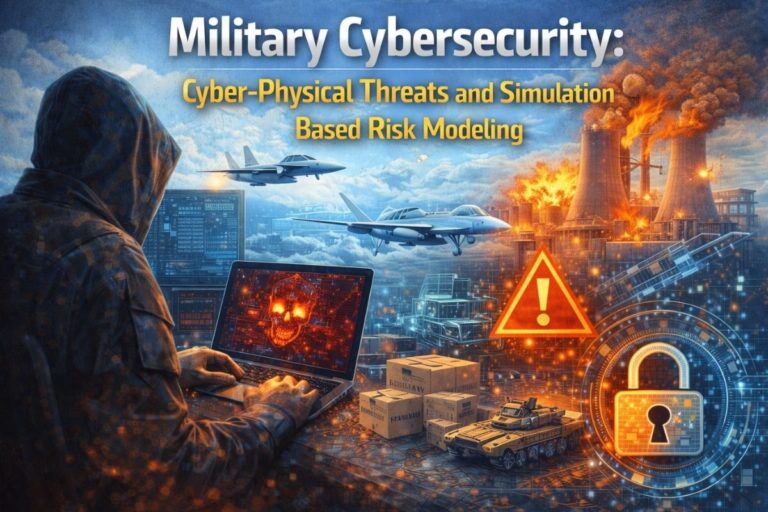
Military cybersecurity is not just about defending networks—it’s about protecting the convergence of digital and physical systems under high-stakes operational conditions. Fighter jets, missile control systems, and mission-critical OT networks are cyber-physical assets, where a single compromise can impact mission success, personnel safety, and national security.
Simulation-based risk modeling is the executive’s lens for understanding threats. By combining adversarial thinking, operational analysis, and technology assessment, leaders can anticipate vulnerabilities, prioritize defenses, and plan resilient responses.
This article examines cyber-physical threats to military systems and explores how simulation-driven modeling informs strategic decision-making.
Understanding Cyber-Physical Threats
Cyber-physical threats occur where digital compromise intersects with physical consequences. In military OT, these include:
- Flight control disruption via avionics or navigation system compromise
- Weapons systems manipulation through embedded software vulnerabilities
- Sensor or radar data interference impacting situational awareness
- Mission planning errors introduced via compromised logistics software
Unlike traditional IT attacks, the consequences are immediate and tangible. Understanding the attack surface requires mapping IT-OT interactions, human workflows, and operational dependencies.
Military cybersecurity executives must adopt a holistic view, recognizing that cyber attacks may manifest physically and operationally.
📌 Recommended Reading
Military Cybersecurity: Supply Chain Attack RisksSimulation-Based Risk Modeling
Simulation-based risk modeling is the process of virtually testing adversarial scenarios before they occur in real life. For military OT, this involves:
- Digital Twin Modeling: Creating virtual replicas of aircraft, weapons systems, or ground networks to simulate attack impact.
- Scenario Simulation: Testing APT attacks, supply chain compromises, or sensor manipulation in a controlled environment.
- Impact Analysis: Evaluating operational consequences, mission disruption, and cascading failures.
- Mitigation Testing: Validating segmentation, redundancy, and response protocols in realistic scenarios.
By simulating cyber-physical attacks, executives can identify hidden dependencies and weak points before adversaries exploit them.
Adversarial Thinking in Simulation
Hackers approach cyber-physical attacks methodically:
- Reconnaissance: Mapping networked OT assets, endpoints, and data flows.
- Targeting Leverage Points: Identifying critical systems whose compromise yields operational advantage.
- Persistence Planning: Ensuring long-term access while minimizing detection.
- Impact Maximization: Manipulating physical outcomes without exposing themselves.
Simulation allows executives to mirror this mindset, exposing vulnerabilities that traditional risk assessments may miss.
Common Cyber-Physical Threats in Military OT
- Sensor Spoofing: Attackers feed false data to radar, GPS, or other sensors, potentially affecting aircraft navigation or targeting.
- Firmware and Embedded System Attacks: Compromised updates or malicious code within avionics can subtly alter operational behavior.
- Autonomous System Manipulation: Drones, UAVs, and robotic maintenance tools may be manipulated via networked commands.
- Networked Mission Planning Attacks: Cyber intrusions into planning software can alter mission parameters or operational readiness.
Each threat demonstrates the importance of viewing OT as a system of interdependent cyber-physical assets, not isolated devices.
Case Study: Lessons from Simulation and Industrial OT
While military cyber-physical incidents are rarely publicized, industrial OT examples illustrate transferable lessons:
- SCADA and ICS Malware: Targeted attacks on industrial OT highlight the consequences of data manipulation and automated system disruption.
- Red Team Exercises: Simulation-based penetration testing reveals hidden dependencies and operational gaps in OT networks.
- Supply Chain and Vendor Risks: Compromised firmware or update channels can introduce systemic vulnerabilities.
Executives can leverage these lessons for military OT, applying simulation to proactively mitigate risk.
Executive-Level Threat Modeling
A structured approach ensures operational insight and mitigation:
- System Mapping: Identify every cyber-physical asset, from avionics to sensors to planning software.
- Criticality Assessment: Determine which systems would create the greatest operational impact if compromised.
- Scenario-Based Simulation: Model attacks ranging from sensor spoofing to mission planning interference.
- Risk Prioritization: Allocate resources based on simulated impact and probability.
- Resilience Planning: Integrate redundancy, detection, and response capabilities into operational workflows.
This approach enables executives to make informed decisions and anticipate adversary strategies.
Emerging Technologies and Threats
As military systems adopt new technologies, cyber-physical risks evolve:
- AI-Assisted Systems: Vulnerable to data poisoning and model manipulation.
- Autonomous UAVs and Drones: Networked control increases attack surface.
- Advanced Sensor Networks: Greater interconnectivity creates new pathways for cyber-physical manipulation.
- Integrated Logistics Systems: Connecting maintenance, planning, and operational networks expands the opportunity for systemic exploitation.
Executives must evaluate both current risk and future threat landscapes, adapting defenses proactively.
Mitigation Strategies
- Segmentation and Redundancy: Isolate critical OT systems and ensure backup operational capabilities.
- Simulation-Driven Defense Testing: Continuously test responses to cyber-physical attack scenarios.
- Endpoint Hardening: Secure maintenance tools, diagnostic devices, and communication channels.
- Vendor Management: Ensure third-party and contractor access is monitored, audited, and restricted.
- Executive Integration: Align cybersecurity strategies with operational planning, resource allocation, and crisis management.
Cross-Domain Insights
Lessons from industrial OT and ICS security reinforce military best practices:
- Persistent attackers exploit systemic weaknesses.
- Human, procedural, and technical factors are equally critical.
- Simulation-based exercises expose vulnerabilities invisible to standard audits.
- Strategic planning and executive engagement reduce operational risk.
Simulation allows leadership to anticipate adversarial behavior, improve readiness, and ensure mission success even under persistent cyber pressure.
Executive Takeaways
- Cyber-physical assets are at high operational risk. Protecting them requires systemic, integrated thinking.
- Simulation-based modeling reveals hidden vulnerabilities. Executives must understand what could go wrong before it happens.
- Threat modeling must be adversarial. Thinking like the attacker identifies leverage points and guides mitigation.
- Resilience and redundancy matter. Operational continuity under attack is a key performance metric.
- Emerging technology increases both capability and exposure. Continuous assessment and adaptation are non-negotiable.
Conclusion: Strategic Cyber-Physical Awareness
Military cybersecurity is no longer just IT defense—it is the strategic orchestration of digital, physical, and operational resilience. Cyber-physical threats demonstrate that attackers exploit interconnected systems, not isolated endpoints. Simulation-based risk modeling equips executives with foresight, operational insight, and mitigation strategies that transform potential weaknesses into managed risk.
In the realm of high-stakes defense OT, preparation, strategic thinking, and executive engagement are as critical as technical safeguards
😄 Cyber Joke
Why do cyber-physical hackers love simulations?
Because they can crash systems without crashing their careers! 😄