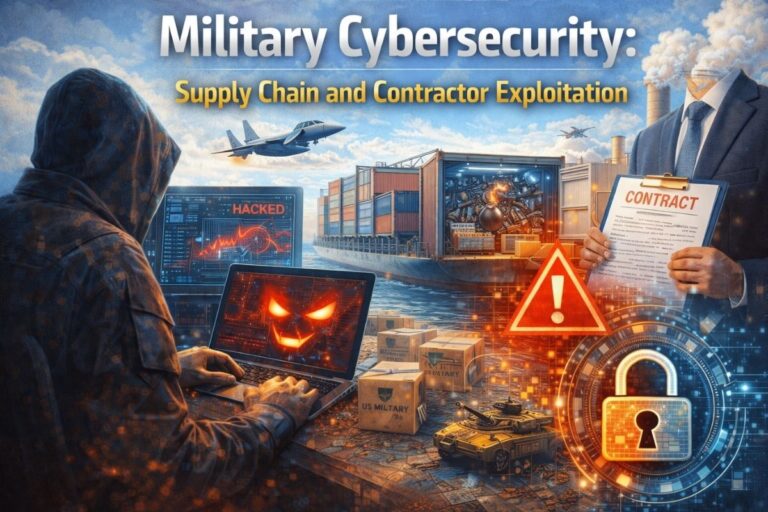
Military cybersecurity is only as strong as the weakest link—and in many defense systems, that weak link is often the supply chain and contractor network. Modern operational technology (OT) and defense assets, including fighter jets, missile systems, and mission planning software, rely on a complex web of vendors, contractors, and service providers. Adversaries recognize this and exploit it systematically.
This article examines how attackers leverage supply chain and contractor vulnerabilities, how executives can understand the risk, and what strategies protect high-value military OT assets.
Why the Supply Chain Matters
Attackers targeting military systems rarely aim to breach a fighter jet in-flight. Instead, they pursue indirect pathways:
- Vendors supplying avionics or firmware updates can introduce subtle vulnerabilities.
- Contractors with diagnostic tools may have network access to sensitive systems.
- Software suppliers for mission planning or logistics provide attack surfaces for persistence and intelligence gathering.
Each link in the supply chain represents a potential point of compromise. In high-stakes defense, these seemingly peripheral weaknesses are often more valuable than direct access to the hardware itself.
The Adversarial Perspective
APT groups targeting military OT systems treat the supply chain as an operational lever:
- Reconnaissance: Identifying contractors, vendor dependencies, and update channels.
- Prioritization: Targeting suppliers with access to mission-critical systems.
- Persistence: Embedding malware, exploiting update mechanisms, or exfiltrating sensitive schematics.
- Operational Leverage: Using compromised vendor systems to monitor, disrupt, or manipulate mission planning without triggering in-field alerts.
Executives often overlook this layer. In reality, supply chain compromise is one of the most effective methods to gain strategic advantage.
📌 Recommended Reading
Military Cybersecurity: APTs Targeting Operational TechHistorical Lessons: Real-World Examples
Several public cases illustrate the threat:
- Firmware Compromise: Vendors delivering updates for industrial or defense systems have been targeted to insert subtle code changes. These could create vulnerabilities in operational systems, even if the update passes standard checks.
- Contractor Network Breaches: APTs infiltrate contractor IT systems to gain access to schematics, mission planning software, or operational data.
- Software Supply Chain Attacks: Compromising mission planning applications or maintenance tools enables long-term surveillance and indirect operational influence.
These incidents demonstrate that supply chain risk is not hypothetical—it is a practical threat that must be accounted for in military cybersecurity strategy.
Identifying Critical Supply Chain Assets
Not all vendors or contractors present the same risk. Executives must understand:
- Which suppliers touch mission-critical systems?
- What network or endpoint access do contractors have?
- Are update mechanisms authenticated, monitored, and verified?
- How frequently are supplier systems audited for compliance?
- Are contractors trained and incentivized for cybersecurity awareness?
By modeling these factors, leaders can prioritize mitigation efforts and allocate resources effectively.
Common Attack Vectors in the Supply Chain
- Firmware and Software Updates: Attackers can insert malicious code or modify configuration files to create latent vulnerabilities.
- Contractor Access Portals: Laptops, VPNs, and diagnostic tools used by third-party personnel are prime entry points.
- Email and Social Engineering: Spear-phishing campaigns target contractor employees to gain credentials or introduce malware.
- Logistics and Maintenance Networks: Communication channels for scheduling, planning, and updating assets can be exploited to monitor or influence operations.
Each vector underscores the principle: weaknesses outside the primary defense perimeter can be exploited to bypass high-security controls.
The Adversary’s Calculus
Hackers conducting supply chain attacks apply a cost-benefit approach:
- Maximize intelligence acquisition with minimal risk of exposure.
- Embed persistence mechanisms that remain undetected in vendor systems.
- Leverage indirect pathways to influence operations without interacting directly with military assets.
From the attacker’s perspective, a compromised contractor network may offer greater leverage than risking a direct, high-profile breach of operational systems.
Executive-Level Threat Modeling
Leaders must integrate supply chain considerations into military cybersecurity strategy:
- Map all contractors, vendors, and service providers interacting with OT assets.
- Assess each supplier’s access level, network connectivity, and update mechanisms.
- Conduct red team exercises simulating APT compromise through third-party systems.
- Develop mitigation strategies for both technical and procedural weaknesses.
- Include supply chain risk in board-level operational and strategic decision-making.
This transforms supply chain risk from a peripheral concern into a core element of cyber strategy.
Mitigation Strategies
Practical steps for executives to harden the supply chain:
- Zero Trust Architecture: Require continuous authentication and verification of all vendor access.
- Secure Update Mechanisms: Implement cryptographic verification of firmware and software updates.
- Continuous Monitoring: Deploy anomaly detection across vendor access points.
- Contractor Audits and Compliance Checks: Regularly review security policies and enforce standards.
- Redundant and Segmented Systems: Limit operational impact if a vendor system is compromised.
- Incident Response Integration: Ensure supply chain breaches are part of the overall cyber incident response plan.
Emerging Supply Chain Threats
As military systems become more connected and software-driven, new vulnerabilities emerge:
- AI and Autonomous Systems: Vendors providing AI models or autonomous control software can be a vector for data poisoning or operational manipulation.
- Cloud-Based Maintenance and Mission Planning: Cloud platforms increase efficiency but expand exposure to remote attackers.
- Third-Party Sensors and IoT Devices: Each sensor connected to OT networks adds potential entry points for persistent threats.
Executives must anticipate these evolving risks and ensure mitigation strategies evolve in parallel.
Cross-Domain Lessons
Supply chain exploitation is not unique to military OT—it mirrors industrial ICS threats:
- Segmentation of critical systems reduces risk.
- Vendor governance and auditing are essential.
- Persistent adversaries target human, procedural, and technical gaps.
- Simulation and red team exercises reveal systemic vulnerabilities.
The insight is clear: the strongest defense is holistic, spanning people, process, and technology.
Executive Takeaways
- Supply chain compromise is a primary threat vector. Direct system attacks are less effective than targeting vendors and contractors.
- Persistence and stealth matter. APTs exploit systemic weaknesses over extended periods.
- Systemic risk modeling is critical. Identify high-value vendor systems and potential cascading operational impacts.
- Proactive mitigation reduces leverage. Zero trust, monitoring, auditing, and segmentation limit adversary influence.
- Cross-domain understanding strengthens defense. Lessons from industrial OT and ICS resilience are directly applicable.
Conclusion
Military cybersecurity extends beyond aircraft, weapons, and mission software. Every contractor, vendor, and supporting system represents both operational utility and potential vulnerability. Attackers are patient and strategic—they exploit indirect pathways, APT tactics, and human factors to gain leverage.
Executives must treat supply chain and contractor networks as critical components of defense. Integrating risk assessment, mitigation, and resilience planning into procurement, contracting, and operational oversight transforms supply chain weaknesses into manageable strategic considerations.
In the high-stakes world of military OT, preparation, foresight, and executive engagement are as powerful as firewalls and encryption.
😄 Cyber Joke
Why did the hacker target the supply chain instead of the military network?
Because it’s easier to sneak in through the backdoor delivery! 😄