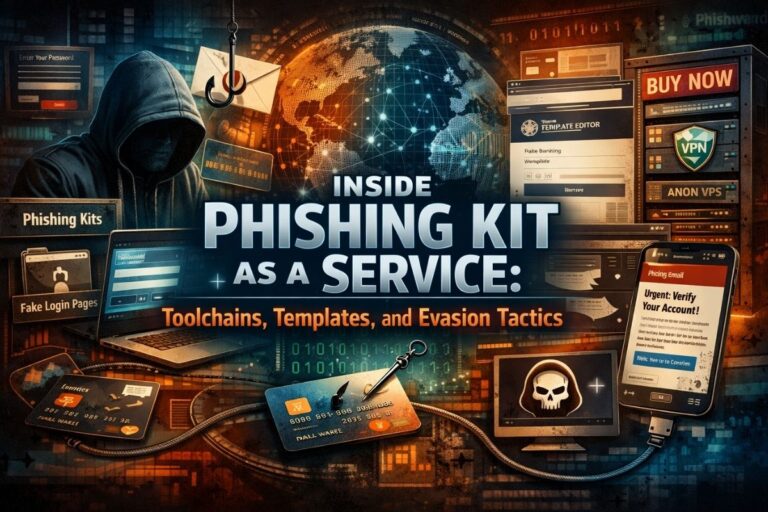
Phishing kit as a service didn’t scale because criminals suddenly got smarter. It scaled because the tooling matured. What used to be fragile, one-off scam kits are now modular platforms built for reuse, resilience, and quiet persistence.
To understand why phishing remains so effective, you have to look under the hood.
The Modern Phishing Kit Toolchain
Today’s phishing kits resemble legitimate software stacks more than amateur scams. A typical phishing kit as a service deployment includes:
- Server-side scripts that dynamically clone legitimate login pages
- JavaScript-based input validation to mimic real authentication flows
- Credential exfiltration pipelines that forward data instantly
- Admin dashboards showing victim interactions in real time
This is not copy-paste fraud. It’s engineered impersonation.
Much like modern ransomware operations, phishing kits now prioritize automation and reuse — a theme also explored in When File Corruption Spreads: Lessons from Modern Ransomware Attacks.
📌 Recommended Reading
Phishing Kit as a Service: Subscription-Based AttacksTemplates That Don’t Age
One of the most dangerous features of phishing kit as a service is template longevity.
Instead of hardcoded HTML, many kits use:
- Dynamic page rendering
- Real-time branding pulls
- Responsive layouts matching official platforms
When Microsoft, Google, or financial institutions update their login flows, kit developers push updates to subscribers — sometimes within hours. The result is phishing pages that age gracefully, staying believable far longer than traditional scams.
This directly undermines deterministic assumptions in forensic analysis, echoing problems discussed in The Myth of Determinism in Digital Forensics.
Evasion Is the Product
Detection avoidance is not an add-on — it’s the selling point.
Modern phishing kits often include:
- IP reputation checks
- Geo-fencing
- Time-based activation
- User-agent filtering
Security scanners see nothing. Automated crawlers get benign content. Only real victims receive the payload.
This selective exposure is why takedowns lag behind campaigns — and why incident responders often arrive after the damage is already done.
Infrastructure Reuse and Campaign Recycling
Phishing kit as a service thrives on reuse.
A single kit can power:
- Hundreds of domains
- Thousands of emails
- Multiple brands
- Continuous campaigns
When one domain is burned, another spins up instantly. Indicators of compromise decay faster than defenders can catalog them.
This operational mindset mirrors the same logic behind Files Hackers Leave Alone — attackers avoid what’s hardened and reuse what works.
Why Traditional Takedowns Fail
When it comes to fighting phishing, most defenses are stuck in the past, obsessed with chasing artifacts like URLs, domains, and hashes. It’s a classic case of playing whack-a-mole—patching one hole only for another to pop up elsewhere.
Enter the world of phishing kits as a service. These slick operations aren’t just random malicious acts; they’re business models. They function at a platform level, making them tougher to take down than a house of cards on a windy day.
So, what’s the solution? If defenders want to stop being just another failed takedown on a long list, they need to shift gears. Here are the game-changers:
- Infrastructure Lineage Tracking: This is about peeling back the layers to see where the bad actors are coming from. Knowing the origins and connections of phishing infrastructure gives defenders crucial insights to anticipate threats.
- Kit Fingerprinting: Think of this as a unique ID tag for phishing kits. By identifying distinctive signatures, defenders can preemptively spot and neutralize threats before they even get started.
- Developer-Level Attribution: It’s not just about the tools; it’s about the people behind them. By identifying the developers creating these kits, we can turn the tables and launch targeted responses that disrupt their operations.
Without adopting these strategies, takedowns will remain reactive and temporary. The reality is that phishing kits are here to stay, fueled by a lucrative business model that thrives on adaptability. If we don’t step up our game, we’ll be stuck in an endless cycle of catch-and-release. Let’s change the narrative and take offensive action against these schemes!
Q&A
How sophisticated are modern phishing kits?
They rival legitimate web applications. Many include dashboards, real-time analytics, update mechanisms, and built-in evasion logic.
Why are phishing kits hard to detect automatically?
Because they selectively serve content. Automated scanners often never see the malicious payload.
Do phishing kits reuse infrastructure?
Yes. Reuse is intentional. It maximizes efficiency and minimizes development effort for attackers.
Are phishing kits linked to ransomware operations?
Frequently. Stolen credentials often serve as initial access for ransomware affiliates.
😄 Cyber Joke
Why do hackers love phishing templates?
Because copy-paste scams are the fast food of cybercrime! 😄