Phishing kit as a service is no longer a fringe concept lurking in dark corners of the internet. It’s a mature, efficient, and disturbingly professionalized business model that has reshaped how phishing attacks are built, deployed, and scaled. Cybercrime didn’t just get smarter — it got subscription-based.
If phishing once required technical skill, infrastructure, and patience, today it requires little more than a crypto wallet and a login. That shift has consequences — and defenders are feeling it.
This article is Part 1 of a three-part series examining how phishing kit as a service has industrialized cybercrime. In the next installment, we’ll go deeper inside the kits themselves — exploring the tooling, infrastructure, and evasion techniques that allow these platforms to survive takedowns and scale globally.
From DIY Scams to Cybercrime-as-a-Service
Traditional phishing used to look amateurish. Broken English. Sloppy layouts. Fake domains that fooled no one but the careless. That era is over.
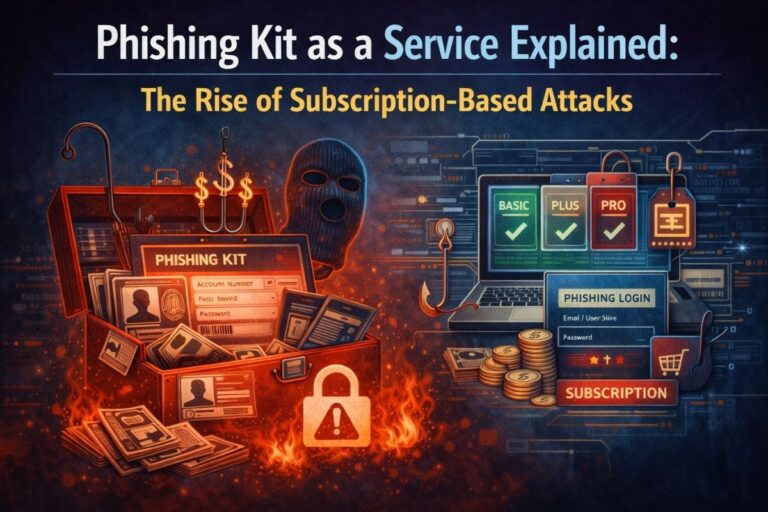
With phishing kit as a service, attackers now rent fully built attack platforms that include:
- Professionally designed phishing pages
- Brand-accurate templates (banks, cloud providers, SaaS platforms)
- Credential-harvesting dashboards
- Email delivery tools
- Automatic updates to bypass detection
This is not hacking in the cinematic sense. It’s operational efficiency — the same logic that drives legitimate SaaS businesses, repurposed for fraud.
📌 Recommended Reading
Exploiting Biometric Surveillance: Permanent Identity RisksHow the Subscription Model Works
Most phishing kits are sold on underground forums and encrypted messaging platforms. Pricing models mirror legitimate software offerings:
- Monthly subscriptions
- Tiered feature access
- Technical support from the developer
- Updates when platforms change login flows
Some kits even advertise uptime guarantees and detection evasion features — an unsettling parallel to enterprise software SLAs.
This lowers the barrier to entry dramatically. Attackers no longer need to understand HTML, email infrastructure, or authentication flows. They simply deploy.
Why Phishing Is Scaling Faster Than Defenses
The rise of phishing kit as a service explains why phishing volume keeps increasing even as awareness improves.
Three key reasons:
1. Skill No Longer Matters
The hardest parts of phishing are abstracted away. Anyone can launch a campaign.
2. Speed Beats Detection
When kits update faster than security filters, defenders are always reacting — not preventing.
3. Professional Design Equals Trust
These kits look real. Users don’t fall for bad phishing — they fall for good impersonation.
This mirrors patterns discussed in [When File Corruption Spreads: Lessons from Modern Ransomware Attacks], where automation and reuse accelerate attacker success faster than organizations can adapt.
The Hidden Risk: Data Integrity, Not Just Credentials
Phishing is often framed as an access problem. In reality, it’s an integrity problem.
Once credentials are stolen, attackers don’t always detonate immediately. They observe. They manipulate. They corrupt workflows quietly — echoing issues explored in [The Myth of Determinism in Digital Forensics], where reproducibility breaks down under real-world complexity.
The damage isn’t always loud. Sometimes it’s subtle, persistent, and devastating.
Why Traditional Security Advice Falls Short
“User training” and “don’t click links” are no longer sufficient responses. Expecting humans to outperform professional deception platforms is unrealistic.
Modern defenses must focus on:
- Behavioral email analysis
- Domain and infrastructure reputation tracking
- Identity-centric monitoring
- Rapid takedown coordination
- Strong internal linking of threat intelligence
This is the same mindset shift required when studying [Files Hackers Leave Alone] — attackers exploit predictable defenses and ignore hardened paths.
What Organizations Should Do Now
Organizations that still treat phishing as a compliance checkbox are already behind.
Effective responses include:
- Monitoring for phishing kit reuse across campaigns
- Tracking indicators tied to kit developers, not just emails
- Integrating identity protection into incident response
- Treating phishing as a systemic threat, not user error
Phishing kit as a service is not a trend — it’s infrastructure.
Final Thought: Cybercrime Has Grown Up
Phishing didn’t evolve accidentally. It evolved because it works — and because the underground economy rewarded efficiency.
Phishing kit as a service represents a turning point: cybercrime that looks, behaves, and scales like legitimate software businesses. The only difference is intent.
Defenders must respond in kind — with strategy, intelligence, and systems that assume attackers are no longer amateurs.
Because they aren’t.
Q&A
What is phishing kit as a service?
Phishing kit as a service is a cybercrime business model where attackers rent or subscribe to ready-made phishing platforms. These kits include templates, credential harvesting pages, dashboards, and ongoing updates, allowing even low-skill attackers to launch sophisticated phishing campaigns.
Why has phishing kit as a service become so popular?
Because it removes technical barriers. Attackers no longer need to build phishing infrastructure from scratch. The subscription model provides speed, reliability, and continuous updates — the same advantages that drive legitimate SaaS adoption.
How is phishing kit as a service different from traditional phishing?
Traditional phishing required manual setup and technical knowledge. Phishing kit as a service automates the process, offers professional-quality designs, and scales easily, making attacks more frequent, convincing, and harder to detect.
Who uses phishing kits?
Not just advanced threat actors. These kits are commonly used by:
- Low-skill criminals
- Organized fraud groups
- Opportunistic attackers
- Ransomware affiliates
The accessibility of phishing kit as a service dramatically widens the attacker pool.
Can security awareness training stop phishing kit attacks?
Training helps, but it is not sufficient. Phishing kit as a service relies on high-quality impersonation and behavioral manipulation that bypasses human judgment. Effective defense requires layered technical controls and identity-focused monitoring.
How can organizations defend against phishing kit as a service?
Defense requires:
- Identity-centric security controls
- Behavioral email analysis
- Infrastructure tracking across campaigns
- Rapid response and takedown coordination
Organizations must assume phishing is persistent, automated, and professionalized.
😄 Cyber Joke
Why did the hacker start selling phishing kits?
Because even cybercrime needed a monthly subscription plan! 😄