Digital Twin: The Version of You That Never Sleeps
Digital Twin.
It sounds like science fiction.
A virtual copy of yourself living somewhere inside a machine.
Most people assume that future has not arrived yet.
It has.
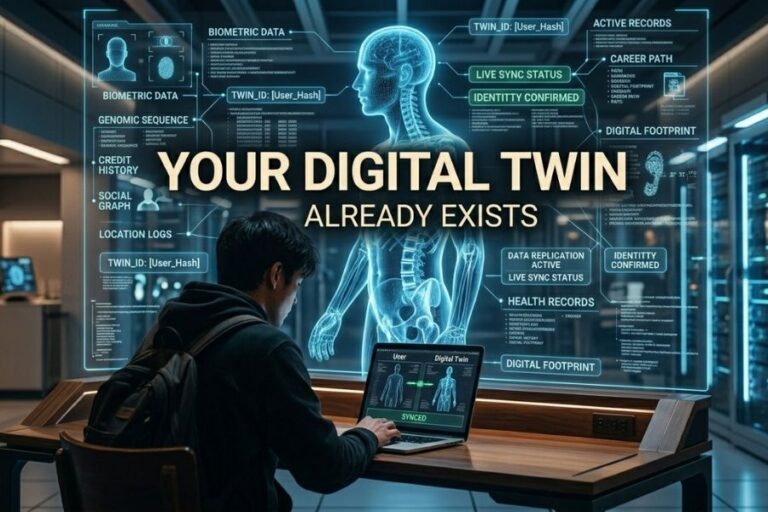
Your Digital Twin already exists.
It knows where you go.
It knows what you buy.
It knows what keeps your attention.
It knows what you search for when you cannot sleep.
It knows what websites you visit.
It knows which advertisements you ignore.
It knows which advertisements you click.
It knows which political stories catch your eye.
It knows which products tempt you.
It may even know things about you that you have not consciously recognized yourself.
The unsettling part is not that it exists.
The unsettling part is that you helped create it.
Every search query.
Every social media interaction.
Every online purchase.
Every location ping.
Every app download.
Every streaming session.
Every website visit.
They all contribute to a growing digital profile that follows you through the internet.
Many people believe they are simply using technology.
Technology is studying them right back.
The modern internet is not just a network of information.
It is a machine designed to learn.
And every day, it learns more about you.
The result is something most people never see.
A Digital Twin.
A data driven version of yourself that exists across countless systems, databases, platforms, and algorithms.
The more information you generate, the more complete it becomes.
The more complete it becomes, the more valuable it becomes.
That value is what makes this conversation important.
Because the Digital Twin is no longer a futuristic concept.
It is a present reality.
Your Digital Twin Is Built From Thousands of Data Points
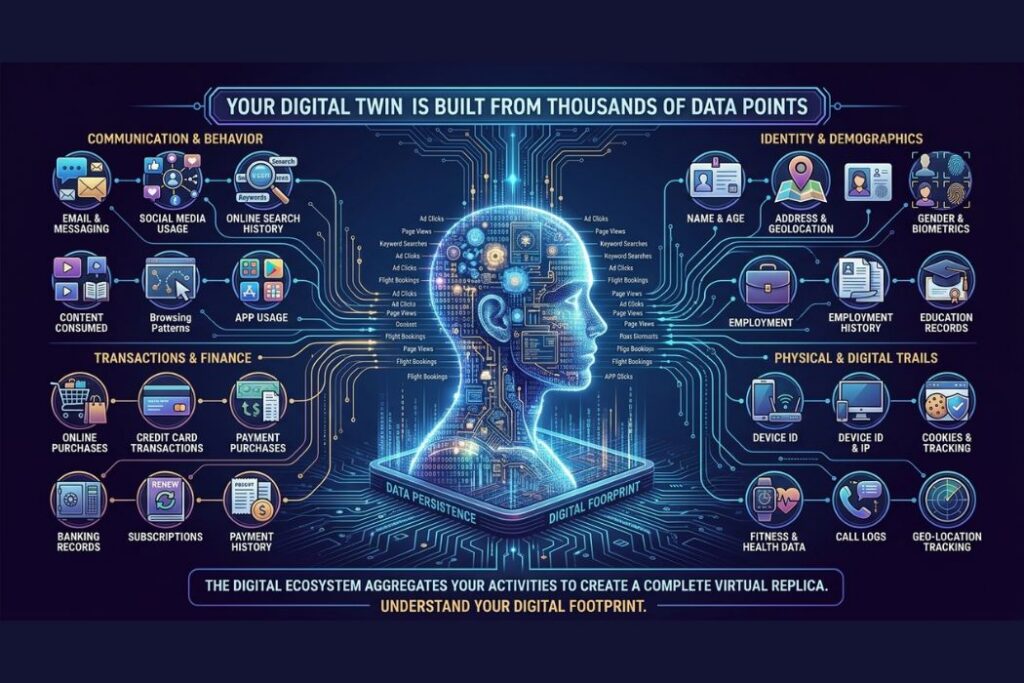
Most people think identity is personal.
The internet thinks identity is statistical.
Human beings see themselves through memories, experiences, beliefs, and emotions.
Machines see patterns.
A search reveals curiosity.
A purchase reveals preference.
A location reveals habit.
A click reveals interest.
One piece of information may appear insignificant.
Ten thousand pieces of information tell a story.
That story becomes your Digital Twin.
Imagine looking at a single puzzle piece.
You cannot see the full image.
Now imagine looking at ten thousand puzzle pieces assembled together.
A picture begins to emerge.
That is exactly how modern data collection works.
A single online action may reveal very little.
Years of online behavior reveal an extraordinary amount.
Patterns begin appearing.
Routines become visible.
Preferences become measurable.
Predictable behaviors emerge.
This is why companies invest enormous amounts of money collecting information.
The goal is not simply gathering data.
The goal is understanding people.
The Digital Twin becomes more accurate every day because people continuously provide new information.
Most of the time, they do it willingly.
Not because they are careless.
Because participation in modern digital life practically requires it.
The internet rewards convenience.
Convenience often requires data.
Data creates profiles.
Profiles create Digital Twins.
Data Brokers Are Collecting the Pieces
Most people know social media companies collect information.
Far fewer understand the role data brokers play in the modern information economy.
Data brokers specialize in collecting, organizing, and analyzing information from a wide variety of sources.
Public records.
Consumer transactions.
Marketing databases.
Online activity.
Demographic information.
Commercial partnerships.
The average person may never knowingly interact with a data broker.
Yet a data broker may possess an extensive profile about them.
This surprises many people.
It should not.
Information has become one of the most valuable resources in the world.
Organizations that understand people possess advantages over organizations that do not.
The more information collected, the more detailed the Digital Twin becomes.
The process resembles assembling a massive intelligence file.
One company may know what you purchase.
Another may know where you travel.
Another may know what websites you visit.
Another may know your professional interests.
Separately, those pieces reveal little.
Combined, they reveal a great deal.
That is where the true power exists.
The Digital Twin is not created by a single company.
It is often created through the accumulation of information across multiple systems.
Many people imagine their information living in isolated silos.
Reality is far more connected.
Data flows.
Systems communicate.
Profiles grow.
The Digital Twin evolves.
Also Read: The Internet Never Forgets. It Just Waits
Artificial Intelligence Makes the Twin Smarter
For years, information was valuable because human analysts could study it.
Artificial intelligence changed the scale of what is possible.
Machines can process enormous amounts of information faster than any human team.
Patterns emerge rapidly.
Predictions become more accurate.
Behavior becomes easier to understand.
Artificial intelligence is not merely storing information.
It is learning from it.
That distinction matters.
A Digital Twin powered by artificial intelligence becomes significantly more useful than a simple collection of records.
The system begins identifying relationships between behaviors.
It begins recognizing patterns.
It begins making predictions.
Think about recommendation systems.
How often have you opened a platform and immediately encountered something that captured your attention?
A video.
A product.
An article.
A song.
A recommendation.
Many people describe these experiences as convenient.
Few stop to consider what made that convenience possible.
Data.
Lots of it.
The Digital Twin acts as the foundation.
The more complete the profile becomes, the easier it becomes for systems to predict what you may do next.
That capability creates value.
Advertisers value it.
Businesses value it.
Governments value it.
Cybercriminals value it.
Anyone seeking influence values it.
The Digital Twin is becoming one of the most important assets in the digital age because it transforms raw information into actionable understanding.
And unlike humans, machines never become tired of learning.
Your Digital Twin May Know You Better Than You Know Yourself
This is where the conversation becomes uncomfortable.
Most people assume they understand themselves better than anyone else.
Data sometimes tells a different story.
Human beings are emotional.
We have biases.
We misremember events.
We overlook patterns.
We rationalize decisions.
Data does not suffer from those limitations.
A Digital Twin can analyze years of behavior without emotion.
It can identify habits that a person never consciously notices.
It can measure routines.
It can track interests.
It can observe changes over time.
In some situations, algorithms have demonstrated an ability to predict preferences with remarkable accuracy.
That reality forces an important question.
Who understands you better?
The person in the mirror.
Or the system that has spent years analyzing your behavior?
That question may sound unsettling.
It should.
Because the answer becomes less obvious with every passing year.
At FileCorrupter.org, we often discuss how cybersecurity intersects with privacy, technology, and information. Few topics demonstrate that intersection more clearly than the rise of the Digital Twin.
The most complete version of you may not exist inside your own mind.
It may exist inside a database.
And most people have no idea how detailed that database has become.
Advertisers Are Already Using It
Long before most people heard the phrase Digital Twin, advertisers were already benefiting from the concept.
Advertising used to be simple.
Place an advertisement in front of a large audience and hope the right people notice it.
Today, advertising is increasingly driven by precision.
Companies want to know who is likely to buy.
When they are likely to buy.
Why they are likely to buy.
And what message is most likely to influence them.
The Digital Twin helps answer those questions.
Every online action contributes to a larger picture. Search habits, browsing patterns, purchase histories, engagement levels, and interests become signals that help organizations understand behavior.
The result is advertising that feels increasingly personal.
Sometimes it feels helpful.
Sometimes it feels unsettling.
Most people have experienced the strange moment of discussing a product, searching for a topic, or researching a service only to find related advertisements appearing shortly afterward.
Whether the explanation involves tracking, behavioral profiling, or predictive analytics, the underlying lesson remains the same.
Your Digital Twin is being used to understand what captures your attention.
Attention has become one of the most valuable resources in the digital economy.
The organizations that understand attention often possess significant advantages.
That is why the Digital Twin continues growing in importance.
It helps transform human behavior into measurable patterns.
Patterns create predictions.
Predictions create profit.
Cybercriminals Want It
If advertisers see value in a Digital Twin, cybercriminals certainly do.
Attackers have always relied on information.
The more information they possess, the easier it becomes to manipulate, deceive, or exploit targets.
A convincing phishing email rarely begins with malware.
It begins with understanding.
Names.
Interests.
Employment details.
Relationships.
Behavioral patterns.
These details help attackers build credibility.
The Digital Twin represents a treasure trove of intelligence.
A criminal who understands how a person behaves gains advantages.
They know which messages appear legitimate.
They know which topics attract attention.
They know which organizations a target trusts.
This is one reason social engineering remains so effective.
People often imagine cyberattacks as purely technical events.
Many are not.
Many attacks begin with information.
The attacker studies the target.
The attacker learns the target.
The attacker exploits the target.
A detailed Digital Twin makes that process easier.
That reality should encourage every reader to think differently about the information they share online.
Every unnecessary detail becomes another piece of the puzzle.
Every public disclosure creates another opportunity for analysis.
The goal is not paranoia.
The goal is awareness.
Information has value.
Valuable assets attract attention.
The Future Belongs to Those Who Control Digital Twins
History has always rewarded those who understand information.
Empires relied on intelligence.
Businesses relied on market knowledge.
Governments relied on records.
The digital age has expanded those principles dramatically.
Today, information is collected on a scale previous generations could barely imagine.
The organizations capable of transforming information into understanding possess extraordinary power.
That power is not limited to technology companies.
Financial institutions use data.
Healthcare organizations use data.
Governments use data.
Retailers use data.
Artificial intelligence systems use data.
The future will increasingly belong to those who understand how to collect, organize, protect, and interpret information.
That reality creates both opportunities and risks.
The opportunity is improved efficiency, better services, stronger security, and more informed decision making.
The risk is excessive surveillance, manipulation, privacy erosion, and concentrated influence.
The Digital Twin sits directly at the center of that conversation.
It represents one of the most valuable assets being created in the modern world.
And unlike traditional assets, it grows automatically.
Every day new information is added.
Every day the profile becomes more detailed.
Every day the Digital Twin becomes more useful.
The most powerful organizations of the future may not simply be the ones with the largest infrastructure.
They may be the ones with the most accurate understanding of human behavior.
The Digital Twin and the Illusion of Anonymity
Many people still believe they move anonymously through the internet.
That belief becomes harder to defend every year.
Modern systems are extraordinarily good at connecting information.
Separate pieces become connected.
Anonymous actions become patterns.
Patterns become profiles.
Profiles become identities.
The average person rarely sees this process taking place.
That invisibility creates a false sense of comfort.
The Digital Twin does not require perfect information to be effective.
It only requires enough information to become useful.
That threshold is often lower than people realize.
The internet remembers behaviors.
The internet records interactions.
The internet observes habits.
Over time, those observations become increasingly valuable.
The illusion is anonymity.
The reality is accumulation.
And accumulation is precisely how the Digital Twin becomes powerful.
Why This Matters More Than Ever
For years, privacy discussions focused on what information organizations collected.
That question still matters.
Today, a more important question is emerging.
What happens after the information is collected?
How is it analyzed?
How is it combined?
How is it used?
The answers to those questions shape everything from advertising experiences to cybersecurity risks.
Understanding the Digital Twin is not merely a privacy issue.
It is a cybersecurity issue.
It is a business issue.
It is a societal issue.
The concept forces people to think differently about information.
Most people focus on the data they knowingly provide.
Few focus on the profile that information creates.
That profile is often far more valuable than any individual data point.
And it is becoming more detailed every day.
Frequently Asked Questions
What is a Digital Twin?
A Digital Twin is a data driven representation of an individual built from online activity, purchases, searches, interactions, locations, and other behavioral information collected across digital systems.
Why is a Digital Twin important?
A Digital Twin helps organizations understand behavior, predict preferences, improve services, target advertising, assess risks, and make decisions based on data driven insights.
Can cybercriminals use a Digital Twin?
Yes. Information associated with a Digital Twin can help attackers conduct social engineering attacks, phishing campaigns, identity related crimes, and other forms of cyber exploitation.
Can I reduce my Digital Twin?
You cannot eliminate it entirely, but you can reduce its size by limiting unnecessary information sharing, reviewing privacy settings, using strong cybersecurity practices, and being mindful about what you publish online.
Final Thought
You see yourself through memory.
Your Digital Twin sees you through data.
One forgets.
The other keeps learning.
That is what makes this topic so important.
Most people still imagine the internet as a collection of websites, applications, and devices.
The reality is far more complex.
Behind those systems exists an expanding network of information that continuously observes, records, and analyzes human behavior.
The Digital Twin is the result.
A version of you assembled from searches, purchases, clicks, locations, interests, and decisions.
A version of you that never sleeps.
A version of you that continues growing whether you think about it or not.
The most unsettling part is not that your Digital Twin exists.
The most unsettling part is that it may understand you better than you understand yourself.
The next time you search for something, click a link, make a purchase, or open an application, remember this:
You are not the only one learning from that interaction.
Your Digital Twin is learning too.
And every day, it becomes a little more complete.
References
National Institute of Standards and Technology (NIST)
Electronic Frontier Foundation (EFF)
Federal Trade Commission Privacy and Data Security Resources